💼 Wells Fargo Q2 2025: A Clearer Runway—But Is the Price Still Right?

Wells Fargo Q2 2025 earnings beat expectations, but NII guidance disappointed. Is the stock undervalued or overhyped? SWOT analysis for value investors.

TL;DR – Strong Quarter, Valuation Getting Ahead?

Wells Fargo delivered solid earnings and regulatory clarity in Q2 2025, including the long-awaited removal of its Fed-imposed asset cap. But flat guidance for Net Interest Income (NII) spooked the market. While shares are rebounding, value investors may want to wait for a more attractive margin of safety closer to $76 before entering.


📊 Quarter Recap: Asset Cap Lifted, But NII Dampens Mood

Wells Fargo posted $5.49B in net income (+12% YoY) and $1.60 EPS, beating expectations. Revenue reached $20.82B, with non-interest income showing strength in advisory and trading fees.

However, Net Interest Income (NII) declined 2% YoY, and full-year guidance was trimmed from growth to flat. That change triggered a 5.6% selloff, before shares rebounded.

CEO Charlie Scharf called the quarter a turning point:

“The lifting of the asset cap by the Federal Reserve marked a pivotal milestone in our transformation.”

Wells is now repositioning for growth—especially in fee-based businesses.


🔍 Key Highlights from Q2

  • Net Income rose to $5.49B, with EPS at $1.60 (GAAP)
  • NII dropped 2% YoY; FY guidance trimmed to flat growth
  • Non-interest income strengthened, especially investment banking (+9%)
  • Efficiency focus continues with tight expense control
  • Asset cap lifted, removing key regulatory hurdle
  • Capital return likely to increase—dividend hikes expected post stress test
Line chart showing Wells Fargo’s revenue and net income over the past five quarters from Q2 2024 to Q2 2025.

🏦 Peer Context: Wells vs JPMorgan & Citi

  • Wells Fargo: Guided for flat NII in FY2025
  • Citigroup: Reiterated low single-digit growth
  • JPMorgan: Holding NII flat, with cost controls as offset

Wells appears slightly more conservative than peers, raising questions about credit demand and pricing pressure.


💵 Capital Return Outlook: What’s Coming?

Wells Fargo currently yields 1.73%, but management has hinted at capital returns improving post-stress test.

  • 10–12% dividend hike is feasible, which would push the yield toward 1.9–2.0%.
  • Share repurchases are also likely to resume more meaningfully in H2 2025.

This return to “normal” capital policy is a key pillar for value-focused investors.


🧭 SWOT Analysis

Wells Fargo’s Q2 2025 performance marks a strategic inflection point—regulatory shackles are gone, fee-based income is recovering, and capital returns are back on the table. But macro uncertainty and cautious NII guidance leave questions about short-term upside. The SWOT analysis below breaks down the bank’s positioning, including estimated price impact for each factor to help value investors frame risk and reward.

SWOT analysis table for Wells Fargo Q2 2025 showing strengths, weaknesses, opportunities, and threats with estimated stock price impact ranges.
Updated SWOT price impact bar chart for Wells Fargo Q2 2025 with symmetric spacing and x-axis starting at –8, illustrating the estimated stock price effect of each SWOT factor.

📈 Valuation Scenarios

After evaluating Wells Fargo’s Q2 2025 results, it’s clear that the market has reacted positively to the lifting of the asset cap and stronger capital positioning. However, to determine whether the current share price reflects true value, we turn to the fundamentals. By applying a blended model—based on earnings, book value, and dividend yield—we arrive at a fair value that gives value investors a grounded view of what the stock is really worth.
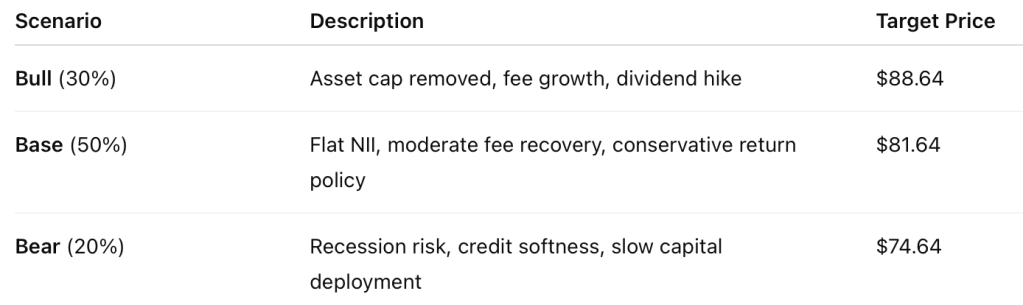
Valuation scenarios table for Wells Fargo Q2 2025, including bull, base, and bear case target prices with probability weights and risk-adjusted fair value estimate.

🎯 Probability-Weighted Price Target: $82.30

Vertical bar chart showing Wells Fargo’s Q2 2025 valuation scenarios with target prices for Bear, Base, Bull cases and current stock price, including a dotted line marking the fair value estimate at $82.30.

🧮 Fair Value Estimate: Clarity Through the Numbers

We calculate fair value using three methods based on official Q2 2025 data:
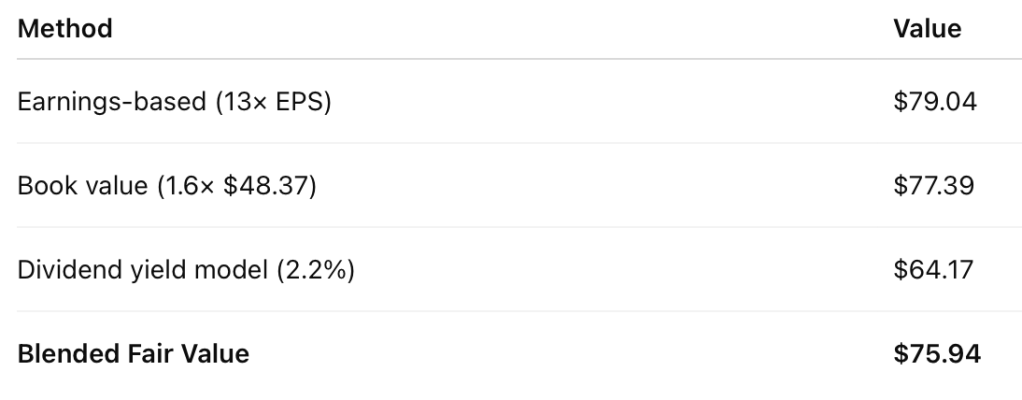
Fair value breakdown table for Wells Fargo Q2 2025 using earnings-based, book value, and dividend yield models, showing individual estimates and the blended fair value of $75.94.

🔎 Verdict: Watchlist Candidate, Not Yet a Buy

With the stock currently at $80.64 and our fair value at $75.94, Wells Fargo is trading 5.8% above our estimate.
While long-term upside exists, value investors may want to wait for a pullback toward $74–76 to lock in a proper margin of safety. The market has largely priced in the asset cap news—but not yet the risk of stagnating interest income.


📣 Call to Action

Want to see how Wells Fargo stacks up against JPMorgan and Citi? Check out our recent bank earnings breakdowns and subscribe for alerts on Goldman Sachs, Bank of America, and Morgan Stanley in the days ahead.


🛑 Disclaimer

This blog is for educational and informational purposes only and is not investment advice. All analysis is based solely on official company filings and earnings calls.
Leave a comment


Goldman Sachs and Morgan Stanley: A High-Stakes Earnings Season for Wall Street’s Finest

Preview the upcoming Q2 2025 earnings for Goldman Sachs and Morgan Stanley. Explore key themes, strategic differences, and what investors should watch as Wall Street’s top banks report.

TL;DR – Two Different Engines, One Market Test

As Goldman Sachs and Morgan Stanley prepare to report their second-quarter results, investors are watching closely to see how two of Wall Street’s most iconic firms are navigating a shifting macro environment. While Morgan Stanley has leaned into wealth management as its long-term growth pillar, Goldman continues to reposition itself after a retreat from consumer banking and a volatile stretch in investment banking. The upcoming earnings will offer a fresh look at which model is winning in 2025—and whether either name is undervalued relative to its forward potential.


Q1 Recap: Strategic Divergence on Full Display

In the first quarter of 2025, the divergence in strategy between these two institutions became increasingly evident. Goldman Sachs delivered better-than-expected results, driven largely by strength in its global markets division—particularly fixed income and commodities trading. While investment banking revenues remained muted, the firm’s Asset and Wealth Management segment showed encouraging growth, quietly contributing to earnings stability amid broader volatility.

Morgan Stanley, in contrast, leaned into its now-dominant wealth management franchise, which continues to anchor its earnings with more predictable, fee-based income. Trading revenues were healthy, though less volatile than Goldman’s, and investment banking activity remained sluggish. The integration of E*TRADE and Eaton Vance appears to be progressing, but margins continue to be scrutinized by analysts who want to see more operating leverage.

Both stocks have tracked broader market gains this year, aided by rising investor sentiment and increased risk appetite. However, the strong run-up in equity markets sets a higher bar for Q2 performance—and makes any shortfall more likely to trigger a valuation reset.


Q2 2025 Preview: Key Themes to Watch

📈 1. Investment Banking Activity and the M&A Pipeline

The long-awaited recovery in deal activity has been uneven, but early signs point to a modest thaw in M&A and equity underwriting markets. Investors will want to see whether either bank is capturing greater wallet share as clients cautiously return to the table. Goldman, with its deep advisory bench, may be positioned to benefit from any early rebound.

💼 2. Wealth Management Profitability and Scale

Morgan Stanley’s wealth business, now a cornerstone of its strategy, remains in focus—particularly operating margins and net new assets. Investors will look for signs that scale advantages from prior acquisitions are beginning to deliver incremental earnings leverage. Conversely, any slip in cost discipline or fee compression could raise concerns about future growth.

📊 3. Trading Performance and Market Volatility

With macro volatility subsiding somewhat in Q2, trading desks may face tougher year-over-year comps. Goldman’s exposure to fixed income and commodities could give it an edge in any remaining dislocations. Morgan Stanley’s more balanced exposure may serve it well in calmer markets, but could also limit upside if activity is muted.

🏦 4. Strategic Repositioning at Goldman

Goldman’s exit from its consumer ventures continues to unfold, and the second quarter may offer further updates on its plans to streamline operations and refocus capital. While these efforts have weighed on sentiment in the past, clarity and discipline in execution could turn the narrative more constructive.

💰 5. Capital Return and CET1 Management

Both firms are expected to comment on their capital return strategies following the latest Fed stress test results. Goldman has historically been more aggressive with buybacks, while Morgan Stanley may emphasize stability and capital preservation. Investors will weigh these decisions against current payout ratios and the firms’ risk-weighted asset profiles.


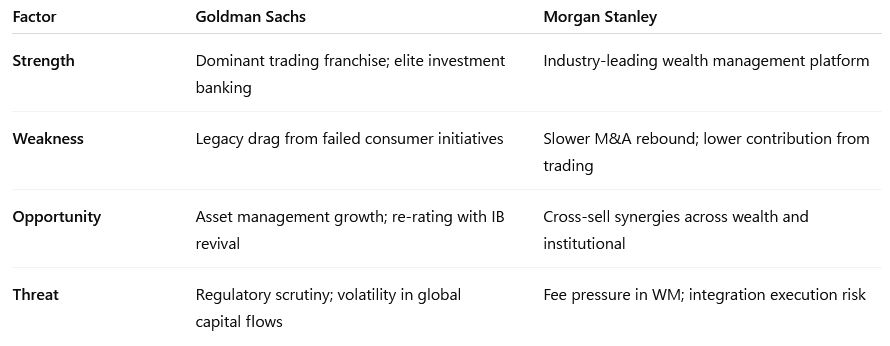
SWOT Analysis: Comparing Strategic Profiles

SWOT analysis table comparing Goldman Sachs and Morgan Stanley ahead of Q2 2025 earnings, highlighting strengths, weaknesses, opportunities, and threats for each firm.

Valuation in Context: Discounted for Uncertainty

From a valuation perspective, both firms trade at a discount to their historical averages, reflecting persistent questions around the pace of recovery in core businesses.

  • Goldman Sachs (GS) is currently trading at approximately 11.2x forward earnings, a discount that arguably reflects both the overhang from its consumer pivot and cyclical risk in trading and advisory.
  • Morgan Stanley (MS) commands a higher multiple, at around 13.3x forward earnings, underpinned by the predictability of its wealth franchise and a more balanced revenue base.

However, if investment banking activity accelerates meaningfully in the second half of the year, Goldman may be poised for a multiple re-rating. Conversely, if market volatility diminishes further, Morgan Stanley’s stable income streams may prove more defensive.


Bottom Line: Different Models, Same Market Test

As both firms head into Q2 earnings, the contrast between Goldman’s capital markets orientation and Morgan Stanley’s wealth-driven stability will once again be on full display. Investors will be looking not only for solid headline numbers, but for forward guidance that supports each firm’s strategic trajectory. Whether it’s Goldman’s return to its core strengths or Morgan Stanley’s steady ascent in fee-based income, the upcoming results could significantly shift investor sentiment—and relative valuations—for the rest of the year.


Stay Ahead of the Curve

📩 Subscribe to SWOTstock.com for full earnings recaps, updated SWOT profiles, and revised valuation scenarios for both Goldman Sachs and Morgan Stanley—posted immediately after earnings are released.


Disclaimer

This article is for informational purposes only and does not constitute financial advice or a recommendation to buy or sell any securities. Always perform your own due diligence or consult a licensed financial advisor before making investment decisions.


Leave a comment