SoftBank FY2025: Value Play or Value Trap? What Retail Investors Should Know

SoftBank has achieved its first annual profit in four years, posting ¥1.15 trillion for FY2025, driven by Vision Fund 1 gains and an aggressive AI investment strategy. Despite high debt and underperformance from Vision Fund 2, the stock appears undervalued, contingent on the company’s ability to fulfill its ambitious goals.

📊 Quick Take: SoftBank’s Comeback with a Catch

SoftBank (TYO: 9984) just reported its first annual profit in four years, driven by gains in its Vision Fund 1 and a bold AI investment strategy. But Vision Fund 2 is still dragging, and debt remains high. For investors who look at the numbers, the stock looks slightly undervalued—but only if the company delivers on its big promises.


📎 Inside the Numbers: What Drove SoftBank’s FY2025 Profit

SoftBank Group posted a net profit of ¥1.15 trillion for the fiscal year ended March 31, 2025. This was a sharp turnaround from a ¥227.6 billion loss in the previous year. Revenue came in at ¥7.24 trillion, up 7.2% year-over-year, with Vision Fund 1 showing strong gains thanks to holdings like ByteDance and Coupang.

Management emphasized a shift from defense to offense: investing aggressively in AI and semiconductors. That includes a $6.5 billion acquisition of Ampere and plans to invest up to $40 billion in OpenAI via a syndicated structure.

Core segment performance also showed solid growth:

  • Consumer Segment: ¥2,952.9B revenue (+4.6% YoY) — growth in mobile and device sales
  • Enterprise Segment: ¥1,389.4B revenue (+6.8% YoY) — strong digital transformation demand
  • Media & EC: ¥826.1B revenue (+8.4% YoY) — profitability from LY Group
  • Financial Segment: ¥355.4B revenue (+14.4% YoY) — PayPay turned profitable
Table showing SoftBank’s FY2025 revenue by business segment compared to FY2024. Includes Consumer, Enterprise, Media & EC, and Financial segments, highlighting year-over-year growth in billions of yen, with PayPay turning profitable and strong gains in digital services.

Retail investors who like to dig into financials should take note: the company is pivoting hard into high-risk, high-reward territory.

Bar chart comparing SoftBank's revenue by business segment between FY2024 and FY2025, showing year-over-year growth across Consumer, Enterprise, Media & EC, and Financial segments.

✔️ FY2025 Financial Snapshot: Key Metrics

  • Revenue: ¥7.24 trillion (+7.2% YoY)
  • Net Profit: ¥1.15 trillion (vs. ¥-227.6B last year)
  • Operating Income: ¥989 billion (+12.9% YoY)
  • Vision Fund 1: ¥940B gain
  • Vision Fund 2: ¥526B loss
  • Debt: ¥20 trillion gross
  • New Bets: $6.5B Ampere deal, $40B OpenAI initiative
  • Milestone: PayPay turned a profit
Line chart showing SoftBank's quarterly revenue and net income over the past five quarters, highlighting profitability turnaround in FY2025."

🔄 SoftBank SWOT Breakdown: What Matters for the Stock Price

Let’s look at what’s working, what isn’t, what could go right, and what could go wrong.

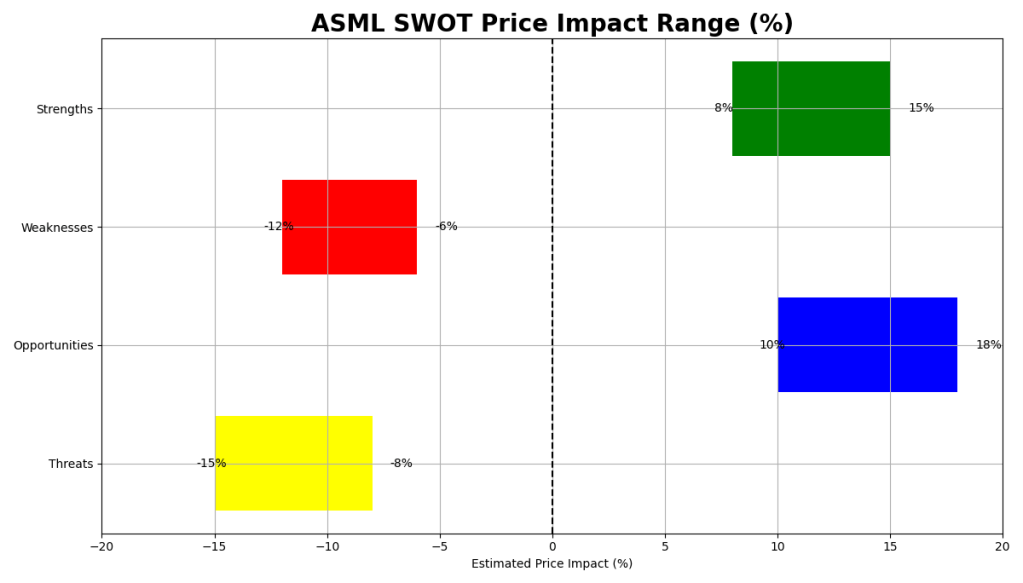
Horizontal bar chart illustrating estimated stock price impact ranges for SoftBank based on SWOT analysis: strengths (green), weaknesses (yellow), opportunities (blue), and threats (red).

✅ Strengths (Estimated Impact: +¥600 to +¥900/share)

SoftBank’s biggest strength this year is its return to profitability after four years of net losses. The ¥1.15 trillion net income was driven by a rebound in Vision Fund 1, with standout contributions from ByteDance and Coupang. This recovery not only boosts confidence in SoftBank’s asset management capabilities but also reinforces the company’s ability to generate liquidity without resorting to fire-sale asset divestments. Combined with a still-strong balance sheet and monetizable assets like Arm, this foundation supports SoftBank’s ability to take bold bets while weathering downturns. If this profit trend continues and Vision Fund 1 remains stable, the stock could see an upside of ¥600 to ¥900.

❌ Weaknesses (Estimated Impact: –¥400 to –¥700/share)

SoftBank’s structural complexity continues to weigh on investor confidence. Vision Fund 2 posted another ¥526 billion in losses, underscoring ongoing difficulties in picking and scaling private tech companies. Furthermore, SoftBank’s gross debt remains high—hovering around ¥20 trillion—which raises concerns about financial leverage, especially in an uncertain macro environment. Transparency remains a challenge too, with limited visibility into how SoftBank values its private holdings. These factors contribute to a persistent NAV discount and could drag the stock down by ¥400 to ¥700 if not addressed.

🌱 Opportunities (Estimated Impact: +¥500 to +¥800/share)

The company’s aggressive pivot toward AI infrastructure is its most exciting growth lever. Its $6.5 billion acquisition of chip designer Ampere and the $40 billion OpenAI syndicate initiative could position SoftBank as a foundational player in the next generation of AI compute platforms. Additionally, further monetization or appreciation of its Arm stake could catalyze a narrowing of the NAV discount. If these initiatives gain traction—especially if SoftBank manages to translate AI exposure into realized profits—the stock could gain ¥500 to ¥800.

⚠️ Threats (Estimated Impact: –¥300 to –¥600/share)

However, execution risk remains substantial. SoftBank’s exposure to China through holdings like ByteDance continues to invite regulatory and geopolitical scrutiny. A negative revaluation of its private tech holdings—especially in Vision Fund 2—could quickly erode book value. Moreover, AI investments are capital-intensive and long-dated, and success is far from guaranteed. If investor sentiment turns bearish due to underperformance or macro risks, these threats could lead to a ¥300 to ¥600 drop in valuation.

📊 SWOT Summary Table

SWOT analysis summary table for SoftBank FY2025, listing strengths such as profit rebound and Vision Fund 1 gains; weaknesses including Vision Fund 2 losses and high debt; opportunities in AI investments and Arm monetization; and threats like China exposure and tech valuation risk. Each category includes estimated stock price impact ranges in Japanese yen.

📈 SoftBank Valuation Outlook: What the Scenarios Say

🟢 Bull Case – ¥9,000/share (25% probability)

In the most optimistic scenario, SoftBank’s AI strategy delivers early wins: Ampere gains market traction, OpenAI collaboration creates monetizable infrastructure, and the Vision Funds return to consistent profitability. With key portfolio holdings like Arm appreciating further and public market sentiment improving, SoftBank’s NAV discount begins to narrow. If earnings stabilize and the market applies a 0.9x multiple to net asset value (up from the current 0.6x), the stock could reach ¥9,000. This case reflects investor confidence in SoftBank evolving into a key AI ecosystem enabler—and we assign it a 25% probability.

⚪ Base Case – ¥7,800/share (55% probability)

The base case assumes steady execution across SoftBank’s core holdings. Vision Fund 1 remains profitable, and Vision Fund 2 stabilizes but still underperforms. AI investments progress but require time to show returns. The company continues monetizing assets like Arm while maintaining financial discipline. We apply a 0.75x NAV multiple to a stable book value, yielding a target price of ¥7,800. This scenario reflects the most likely trajectory based on current guidance and investment pacing.

🔴 Bear Case – ¥5,900/share (20% probability)

In the downside case, Vision Fund 2 continues to post significant losses, and macro/geopolitical headwinds—particularly China exposure—impact SoftBank’s tech-heavy portfolio. AI investments struggle to gain traction or consume more capital than expected. If NAV contracts and the market applies a more conservative 0.55x multiple, the stock could decline to ¥5,900. While less probable, this scenario reflects the risk of execution delays and external shocks, especially in the global tech sector.

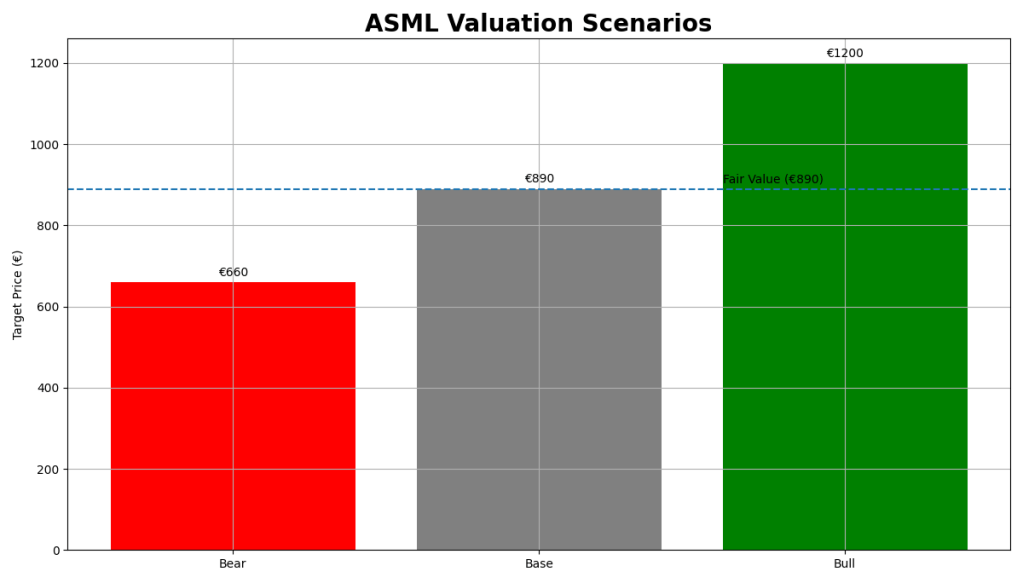
Table outlining SoftBank's FY2025 valuation scenarios: bear case at ¥5,900 with 20% probability, base case at ¥7,800 with 55% probability, and bull case at ¥9,000 with 25% probability. Includes a weighted fair value estimate of ¥7,768 and current stock price of ¥7,132, implying around 9% upside.

🎯 Weighted Probability Valuation

(¥9,000 x 0.25) + (¥7,800 x 0.55) + (¥5,900 x 0.20) = ¥7,768

Current price: ¥7,132 (as of May 13,2025)
Upside: ~+9%


📝 Final Take: Is SoftBank Stock Worth It?

If you trust the numbers and think SoftBank can execute its AI strategy, the stock looks modestly undervalued. But it comes with real risks. This isn’t a set-it-and-forget-it stock—you’ll want to watch each quarter closely.


📢 Stay Ahead: Get More Stock Breakdowns Like This

Want more plain-English stock breakdowns like this? Subscribe now and get the next one before the headlines hit.


⚠️ Disclaimer

This analysis is based only on SoftBank’s official financial report and earnings call. It is not investment advice. Always do your own research before investing.


Leave a comment


AMD Q1 2025 Earnings Breakdown: AI Growth, Gaming Drag, and What Investors Need to Know

Discover AMD’s Q1 2025 earnings with a clear breakdown of AI growth, gaming challenges, and strategic risks. This analysis uses only official financial reports and earnings call data. Includes SWOT insights, valuation scenarios, and investor takeaways—all tailored for retail investors seeking actionable, trustworthy information.

Introduction: Why This Quarter Matters for AMD Investors

AMD just released its Q1 2025 results, and the numbers show a company in transformation. Strong momentum in data center and AI segments is powering growth, but challenges in gaming and macro-level headwinds are keeping the market cautious.

This article breaks down AMD’s earnings using only official sources: the company’s financial report and earnings call. We’ll walk through the financial details, strategic strengths and risks, and conclude with scenario-based valuations—all in a way that’s easy for retail investors to digest.


Quarterly Recap: Growth in Strategic Segments, Strategic Pressure in Legacy

In Q1 2025, AMD posted $5.5 billion in revenue, representing a 2% year-over-year increase. The standout performer was its Data Center segment, which grew 80% YoY, fueled by strong demand from cloud service providers for AI acceleration.

Most notably, AMD surpassed $1 billion in AI GPU revenue for the first time—a major milestone that reflects traction for its MI300 series. On the flip side, the Gaming segment recorded an $800 million inventory write-down, reflecting weaker-than-expected demand and a product transition gap.

Gross margin came in at 52%, down slightly due to the write-down, but operating efficiency remained solid. AMD reaffirmed its full-year $4.3B AI GPU sales target and outlined a clear product roadmap through 2026 with the upcoming MI325 and MI350 chips.


Q1 2025 Financial Highlights

  • Revenue: $5.5B (up 2% YoY)
  • AI GPU Revenue: Surpassed $1B
  • Data Center Growth: +80% YoY
  • Gross Margin: 52%
  • EPS: $0.77 (non-GAAP)
  • Inventory Write-Down: $800M in Gaming
  • FY25 Guidance: $4.3B in AI GPU sales
  • Roadmap: MI325 in mid-2025, MI350 in 2026
  • Geopolitical Exposure: Up to $1.5B at risk from export controls
Line chart showing AMD’s revenue, net income, and capital expenditures over the last five quarters through Q1 2025, highlighting growth in profitability.

Market Reaction and Sentiment

Following the earnings release, AMD’s stock traded slightly lower despite the beat on AI growth—why? Analysts and investors remain cautious due to:

  • Uncertainty around China export restrictions ($1.5B potential impact)
  • Softness in consumer-facing segments like Gaming and Embedded
  • Comparisons to NVIDIA, whose AI platform is more mature (especially on software)

Still, institutional sentiment remains bullish on AMD’s AI roadmap, with many analysts reiterating “Buy” ratings but adjusting near-term price targets for geopolitical risk.


SWOT Analysis: Strategic Positioning with Key Risks

Strengths:
AMD’s biggest strength this quarter is its breakthrough in the AI market. The MI300 series GPUs brought in over $1 billion in Q1 alone, with management reaffirming a $4.3 billion target for FY2025. This strong performance in the Data Center segment, which grew 80% year-over-year, positions AMD as a serious challenger to NVIDIA in AI infrastructure.

Estimated Stock Price Impact (Strengths):

  • AI GPU momentum: +12 per share
  • Data Center growth: +5 per share
  • Total Strength Impact: +$17/share

Weaknesses:
While AMD’s AI story is strong, not all segments are growing. The Gaming division recorded a significant $800 million inventory write-down, putting pressure on margins. Additionally, the mix shift toward high-R&D segments has led to narrower gross margins in the short term.

Estimated Stock Price Impact (Weaknesses):

  • Gaming inventory write-down: –4 per share
  • Margin compression: –3 per share
  • Total Weakness Impact: –$7/share

Opportunities:
Looking ahead, AMD has multiple growth levers. The planned release of the MI325 (2025) and MI350 (2026) promises to extend AI leadership. The company is also poised to gain CPU share in the enterprise segment, especially with new EPYC and Ryzen launches. The edge AI market—spanning automotive, industrial, and embedded systems—presents a long-term expansion opportunity.

Estimated Stock Price Impact (Opportunities):

  • Future AI product roadmap: +10 per share
  • Enterprise CPU growth: +4 per share
  • Total Opportunity Impact: +$14/share

Threats:
Geopolitical tension is AMD’s biggest external risk. The U.S. export restrictions on AI chips could put up to $1.5 billion in revenue at risk. A return of Trump-era tariffs and continued high interest rates could further weigh on valuation multiples.

Estimated Stock Price Impact (Threats):

  • China export risk: –7 per share
  • Tariff & macroeconomic drag: –10 per share
  • Total Threat Impact: –$17/share

SWOT Summary Table with Stock Price Impact

SWOTKey FactorImpact on Stock Price (USD)
StrengthsAI GPU sales momentum (MI300 series)+12
Data center revenue growth+5
Weaknesses$800M gaming inventory write-down–4
Gross margin pressure from product mix–3
OpportunitiesMI325 and MI350 AI roadmap+10
Enterprise CPU share gains+4
Threats$1.5B China export restrictions–7
Tariff risk and macro valuation pressure–10

Net SWOT Impact on Stock Price: +$7 per share

Horizontal bar chart illustrating estimated AMD stock price impact by SWOT category in Q1 2025, including strengths, weaknesses, opportunities, and threats.

Valuation Scenarios: What’s Priced In?

We constructed three valuation scenarios using a DCF-based and multiple-driven approach:

ScenarioTarget PriceAssumptionsProbability
Bull Case$135AI GPU revenue beats guide, China risk contained25%
Base Case$118.70AI guidance met, some weakness in Gaming persists60%
Bear Case$78Export controls expand, weak macro hits enterprise & gaming15%

Probability-weighted fair value: $110.13

Bar chart comparing AMD’s estimated stock price under bear, base, and bull case scenarios in Q1 2025.

Conclusion: Is AMD Fairly Valued?

At its current price of approximately $98, AMD appears undervalued by ~12% relative to our base-case scenario and ~21% compared to the fundamentals-only estimate (ignoring macro headwinds). However, when we factor in external risks like China exposure and interest rate volatility, the stock looks more fairly valued.

For investors with a 2-3 year horizon and confidence in AMD’s AI strategy, the current price offers an attractive risk-adjusted entry point. But short-term performance may remain choppy as macro risks play out.


Disclaimer

This content is for informational purposes only and should not be construed as financial or investment advice. The analysis presented in this article is based solely on publicly available information from AMD’s official Q1 2025 financial report and earnings call transcript. No third-party analyst opinions, speculative media commentary, or unofficial forecasts were included. All valuation scenarios, estimates, and statements are the author’s interpretation of the data and do not represent forward-looking guidance from AMD.

Please conduct your own due diligence or consult a licensed financial advisor before making any investment decisions.


Stay Ahead of the Market

If you found this breakdown helpful and want more clear, data-driven insights directly from earnings calls and official filings — subscribe to our newsletter. No noise, no hype — just signal.

👉 [Subscribe Now]


One response to “AMD Q1 2025 Earnings Breakdown: AI Growth, Gaming Drag, and What Investors Need to Know”

  1. NVIDIA Q1 FY2025: AI Boom Powers Revenue—but Is the Stock Already Fully Priced? – SWOT Stock – Smart Investing Made Simple Avatar

    […] check out our recent breakdowns of AMD Q1 2025, Palantir Q1 2025, Meta Q1 2025 and Alphabet Q1 2025 for more actionable […]

    Like

Leave a comment

Palantir Q1 2025 Earnings Recap: Big Numbers, Big Valuation?

Palantir reported strong Q1 2025 earnings with revenue up 39% and solid profits, yet its stock dropped 8%, raising concerns about valuation. While the company shows strengths in commercial growth and AI traction, weaknesses stem from reliance on government contracts. The stock appears overvalued, reflecting potential regulatory and competitive threats.

Palantir (NASDAQ: PLTR) dropped a strong Q1 2025 earnings report. Revenue was up, profits were solid, and its AI platform (AIP) is gaining traction. But even with all the good news, the stock dropped 8% after earnings. So… what gives?

Well, it might be less about the business—and more about the price. Let’s break it down, in plain English.


📊 Quick Q1 2025 Snapshot

  • Revenue: $634M (+39% YoY)
  • U.S. Commercial Revenue: $255M (+71% YoY)
  • Net Income: $214M
  • Free Cash Flow (FCF): $441M (42% margin)
  • Big Contracts (>$10M): Up 73%
  • Customer Count: Up 39% YoY
  • Stock reaction: −8% after earnings

Palantir’s business is clearly growing, but investors are now wondering if the current stock price has already priced in too much future success.


🧠 SWOT Analysis: Strengths, Weaknesses, Opportunities, Threats

Let’s run through a full SWOT breakdown—plus what each factor means for the stock’s value.


✅ Strengths: Commercial Business on Fire

Palantir’s commercial segment (especially in the U.S.) is growing like crazy. They’re moving beyond defense and government, and they’re finally generating serious free cash flow.

📈 Valuation Impact: +32%
We estimated that if this growth holds, it adds about $24 per share to fair value. This is based on raising long-term FCF assumptions and applying a ~30x FCF multiple to commercial earnings.

  • U.S. commercial revenue up 71%
  • High-margin, cash-generating operations
  • Expanding large enterprise footprint

❌ Weaknesses: Still Relying on Government

Half the business still depends on U.S. government contracts. That’s stable… until it’s not. Also, Palantir’s international revenue isn’t keeping up, and that limits its global reach.

📉 Valuation Impact: −15%
This knocks $11 off fair value by capping international growth and assigning a lower multiple to defense-related revenue.

  • Heavy reliance on U.S. federal contracts
  • Global growth is slow
  • Business model less diversified than peers

🚀 Opportunities: AI Enterprise Boom

Palantir is well-positioned to ride the enterprise AI wave. AIP is getting traction, and the company is now partnering with cloud players like AWS to reach more customers, faster.

📈 Valuation Impact: +18%
This adds ~$13 to fair value, assuming they grow revenue at a 25% CAGR over the next 5 years in the commercial AI segment.

  • AI use cases expanding fast
  • Partnerships make scaling easier
  • Total addressable market is huge and growing

⚠️ Threats: Big Tech Competition, Regulation

Google, Microsoft, Amazon—all building their own enterprise AI tools. Plus, Palantir still faces scrutiny over its military/government work, which could lead to reputational or regulatory challenges.

📉 Valuation Impact: −18%
We subtracted ~$13 from fair value assuming increased sales competition and legal friction reduces margin and contract growth.

  • Big tech is moving in
  • Regulatory/political risks
  • Defense-related perception issues persist

📊 Valuation: What’s the Stock Worth?

We pulled all the SWOT impacts together to estimate a fair value:

  • Base Case Fair Value: ~$88
  • Bull Case (faster commercial + AI wins): ~$110
  • Bear Case (slow adoption + regulatory issues): ~$65
  • Current Price: ~$124

👉 Conclusion: The stock looks about 30% overvalued right now based on fundamentals and growth assumptions. It’s a great company, but the market might be pricing in perfection.


💡 Final Take

Palantir is clearly executing well. Their AI platform is getting adopted, they’re profitable, and they’re building momentum in the commercial space. But the stock might be a bit ahead of itself right now.

If you’re in it for the long haul and believe in Palantir’s AI vision, it might still be worth holding. But if you’re looking to start a position, it could make sense to wait for a pullback.


📌 Disclaimer & Final Notes

This analysis is based solely on official company disclosures—including Palantir’s Q1 2025 financial report, earnings call transcript, and direct management commentary. No third-party commentary or speculative sources were used.

Please note that this content is for informational purposes only and does not constitute investment advice. Always do your own research or consult a licensed financial advisor before making investment decisions.

📬 Want more no-nonsense breakdowns of AI stocks and earnings?
Subscribe to stay updated with the latest earnings summaries, fair value estimates, and plain-language analysis—tailored for everyday investors who want to stay sharp.


One response to “Palantir Q1 2025 Earnings Recap: Big Numbers, Big Valuation?”

  1. NVIDIA Q1 FY2025: AI Boom Powers Revenue—but Is the Stock Already Fully Priced? – SWOT Stock – Smart Investing Made Simple Avatar

    […] check out our recent breakdowns of AMD Q1 2025, Palantir Q1 2025, Meta Q1 2025 and Alphabet Q1 2025 for more actionable […]

    Like

Leave a comment