
TL;DR
AMD’s (NASDAQ:AMD) latest quarter strengthens its growth story. Data Center revenue nearly doubled, operating profitability expanded, and management’s outlook points to another substantial step forward.
For growth investors, the next question is whether that expansion will produce durable earnings and cash flow for shareholders. Inventory investment, customer warrants, and financial support for infrastructure partners make that conversion more complicated.
Our scenario analysis produces a probability-weighted present fair value of approximately $365 per share. The opportunity remains substantial, but an attractive investment also requires a price that provides protection against execution setbacks.
Quarter Recap
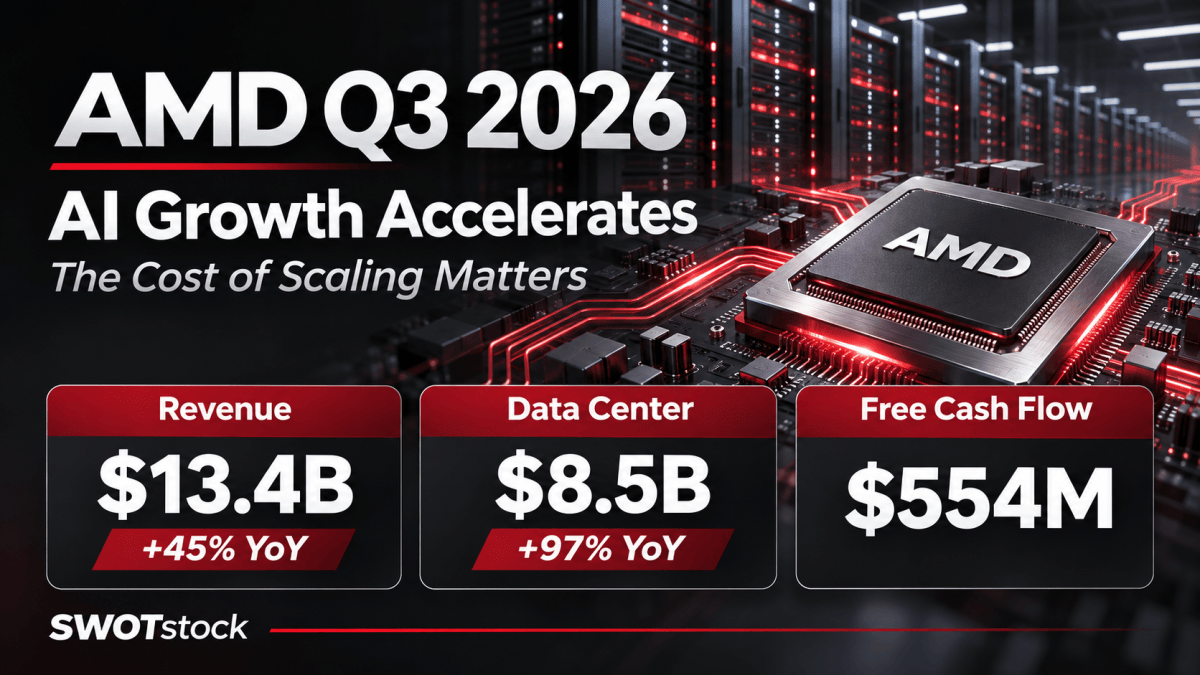
AMD reported third-quarter revenue of $13.377 billion, up 45% from a year earlier. GAAP operating income reached $2.832 billion, while non-GAAP operating income increased 75% to $3.923 billion.
GAAP diluted earnings per share were $1.46, compared with non-GAAP EPS of $2.09. Non-GAAP operating margin expanded to 29%, from 24% a year earlier.
Data Center supplied the largest contribution. Segment revenue reached $8.546 billion, up 97%, supported by EPYC processors and Instinct accelerators. Client and Gaming revenue declined 8% to $3.722 billion, while Embedded revenue increased 29% to $1.109 billion.
AMD is becoming increasingly dependent on Data Center for its growth and profitability. That creates operating leverage alongside greater exposure to the pace of AI infrastructure deployment.
Key Highlights
The growth outlook has strengthened. AMD’s Q4 revenue guidance is approximately $17 billion, with 55% non-GAAP gross margin and $3.75 billion in non-GAAP operating expenses. Those inputs imply approximately $5.6 billion in operating income if delivered. This is a calculation from guidance, rather than a reported result.
Management also said it expects company revenue growth above 80% in 2027, according to the reproduced earnings-call transcript. That outlook raises both the scale of the opportunity and the execution required.
Cash conversion requires closer attention. Quarterly continuing operating cash flow was $1.202 billion, while free cash flow was $554 million. Inventory and receivables absorbed substantial cash during the quarter.
Building inventory ahead of shipments can support future growth. Its quality becomes clearer when products ship, customers pay, and cash generation follows. Continued investment without that subsequent conversion would weaken the investment case.
Some growth comes with additional shareholder exposure. The 10-Q discloses customer warrants covering up to 320 million shares, subject to milestones, and approximately $8.5 billion in maximum partner guarantee exposure. No warrant shares had vested at quarter-end. Guarantees are contingent obligations rather than immediate losses, but they connect part of AMD’s risk to partners’ infrastructure financing.
SWOT Analysis
The ranges below illustrate how individual business developments could affect modeled equity value. They are conditional estimates based on our assumptions, rather than forecasts of share-price movements. Several factors overlap, so the ranges should not be added together.
Strengths
Data Center has become a substantial earnings engine: potential valuation benefit of 4–9%.
The financial benefit extends beyond higher sales. Using an assumed 40% incremental operating margin, Data Center revenue running 5–10% above a baseline would increase quarterly operating profit by approximately $171–342 million. Relative to Q3 non-GAAP operating profit, that translates into roughly 4–9% more earnings at an unchanged valuation multiple.
Operating leverage can amplify further growth: potential valuation benefit of 3–7%.
An additional one to two percentage points of operating margin on Q3 revenue would add approximately $134–268 million in quarterly operating profit. Sustained expense discipline could therefore support earnings growth beyond revenue growth.
Weaknesses
Working-capital demands reduce near-term cash available to shareholders: potential valuation discount of 5–10%.
Rapid expansion requires funding before all customer payments arrive. If weak cash conversion persists, an earnings-based valuation deserves a discount. Our illustrative 5–10% adjustment reflects that concern; it is a judgment about valuation rather than a measured loss already incurred.
Adjusted earnings require an owner-economics check: potential valuation reduction of 5–10%.
Stock compensation and customer incentives affect what ultimately belongs to each shareholder. If sustainable earnings per share are 5–10% below an unadjusted non-GAAP model after allowing for those costs, valuation falls proportionately at a constant multiple.
Opportunities
Broader systems deployment could expand customer spending: potential valuation benefit of 9–17%.
Successful adoption across CPUs, accelerators, and systems could increase AMD’s revenue per deployment. A 10–20% Data Center revenue uplift, using the same assumed 40% incremental margin, would increase quarterly operating profit by approximately $342–684 million.
Consistent execution could support a higher valuation multiple: potential valuation benefit of 5–10%.
Delivering the production ramp while improving cash conversion would reduce uncertainty. A 5–10% increase in the earnings multiple could follow if investors gain confidence in the durability of growth. That confidence must be earned through repeated delivery.
Threats
Deployment or supply delays could materially affect earnings: potential valuation reduction of 9–17%.
A 10–20% Data Center revenue shortfall against a future baseline would reduce operating profit by approximately $342–684 million under our incremental-margin assumption. This range excludes any additional decline in the valuation multiple.
Pricing and product mix could offset part of the growth benefit: potential valuation reduction of 3–7%.
A one to two percentage-point gross-margin shortfall on Q3 revenue would remove approximately $134–268 million in operating profit if expenses remained unchanged. Strong revenue growth can coexist with weaker shareholder returns when the margin earned on that growth disappoints.
Valuation Scenarios
We value AMD using FY2027 earnings, apply a scenario-specific earnings multiple approximately one year ahead, and discount the resulting value by 12% to today.
Our model deducts a $3 billion annual stock-compensation allowance from operating profit calculated on a non-GAAP basis. It assumes a 15% normalized tax rate, approximately offsetting net interest and other income, and differing levels of economic dilution.
These assumptions and probabilities are our judgments. Share counts are economic allowances for potential dilution, rather than forecasts of GAAP weighted-average shares. Customer-warrant revenue reductions are assumed within modeled revenue and margins; the warrant remeasurement liability is not deducted separately.
Bear Case: Growth Falls Short of the Deployment Plan
Probability: 30%.
Revenue reaches $75 billion, with a 25% non-GAAP operating margin. After the stock-compensation allowance and tax, adjusted net income is approximately $13.39 billion.
Using 1.75 billion economic diluted shares produces EPS of $7.65. A 25× earnings multiple gives a one-year target of approximately $191, or $171 in present value.
AMD still grows substantially in this scenario. The disappointment comes from the gap between that growth and the outcome needed to sustain a premium valuation.
Base Case: AMD Delivers Approximately Its Growth Outlook
Probability: 50%.
Revenue reaches $95 billion, with a 32% non-GAAP operating margin. Adjusted net income is approximately $23.29 billion after our stock-compensation allowance and tax.
With 1.85 billion economic diluted shares, adjusted EPS is approximately $12.59. A 35× multiple produces a one-year target of approximately $441, or $393 in present value.
This remains an optimistic operating outcome. The multiple also assumes meaningful growth continues beyond 2027.
Bull Case: Strong Adoption and Margin Expansion Continue
Probability: 20%.
Revenue reaches $110 billion, with a 36% non-GAAP operating margin. Adjusted net income reaches approximately $31.11 billion.
Using 2.00 billion economic diluted shares, including the full potential customer-warrant allowance, produces EPS of approximately $15.56. A 42× multiple gives a one-year target of approximately $653, or $583 in present value.
This outcome requires strong execution, sustained customer demand, and confidence that exceptional growth extends beyond the modeled year.
Probability-Weighted Fair Value
Weighting the three scenarios produces a one-year target of approximately $408 and a present fair value of approximately $365.
A 20% margin of safety against our weighted fair value corresponds to approximately $292. A 30% margin corresponds to approximately $255.
The valuation multiple remains a major source of uncertainty. Applying 30× or 40× to Base-case earnings changes present value to approximately $337 or $450, respectively.
Verdict
AMD’s quarter provides stronger evidence that its Data Center opportunity is becoming profitable business at scale. The growth thesis has progressed.
The investment decision depends on how much an investor pays for that progress. Our Base case assumes approximately 82% revenue growth in 2027, substantial margin expansion, and continued growth beyond that year. Those are demanding assumptions even for a company executing well.
For a growth investor, AMD offers considerable opportunity alongside significant execution and valuation risk. A purchase price materially above our weighted fair value would depend increasingly on the Bull case, with less protection if deployments, profitability, or cash conversion disappoint.
The next results should be judged on three outcomes: deployment growth, cash collected from that growth, and earnings retained per share after incentives and dilution.
Call to Action
As AMD scales, which evidence would most strengthen your conviction: broader production deployments, higher margins, or stronger free cash flow?
Disclaimer
This article is for educational and informational purposes and is not personalized investment advice. Valuation scenarios reflect assumptions that may prove incorrect. Actual outcomes may differ materially.

