NVIDIA Q4 FY2026 Earnings: AI Dominance Intact — Is the Stock Still Underpricing the Cycle?

TL;DR Summary

NVIDIA (NVDA:NASDAQ) delivered another explosive quarter, with Q4 revenue up 73% year-over-year and Data Center revenue surging 75%. Gross margins remain near 75%, and management guided to $78B in next-quarter revenue — even excluding China data center compute revenue.

The AI infrastructure cycle is clearly not over.

Based on official financials and management guidance, fair value lands around $240–$250, versus the current price near $150. For growth investors, the debate is no longer whether NVIDIA is dominant — it’s whether the AI cycle can extend long enough to justify sustained premium valuation.


Quarter Recap

NVIDIA reported Q4 FY2026 revenue of $68.1B, up 73% year-over-year and 20% sequentially. The real engine remains Data Center, which generated $62.3B, growing 75% YoY.

Gross margins held near 75%, confirming that pricing power remains intact despite scale. Full-year FY2026 revenue reached $215.9B, up 65% from the prior year.

Management guided Q1 FY2027 revenue to $78B ±2%, notably excluding China data center compute revenue. That implies the core AI demand machine remains strong even under export constraints.


Key Highlights

• Data Center revenue continues to scale at hyperscale velocity

• Blackwell ramp is underway, supporting next-gen demand

• Gross margin durability near 75% signals structural advantage

• China revenue excluded from guidance, reducing forward visibility but also lowering expectation risk

• $41.1B returned to shareholders in FY2026 through buybacks and dividends


SWOT Analysis

NVIDIA is no longer being valued as a chipmaker. It is being valued as the foundational AI infrastructure layer. The sustainability of that thesis depends on ecosystem dominance, demand durability, and competitive containment.

Strengths

• AI infrastructure leadership with 75% YoY Data Center growth

Estimated price impact: +10% to +18%

• CUDA + NVLink ecosystem lock-in creating high switching costs

Estimated price impact: +8% to +15%

• Sustained gross margin near 75% demonstrating pricing power

Estimated price impact: +5% to +10%

• Visible product roadmap (Blackwell, Rubin) reducing cycle uncertainty

Estimated price impact: +6% to +12%


Weaknesses

• Heavy revenue concentration in Data Center

Estimated price impact: -8% to -15%

• Premium valuation near ~45x earnings requires near-flawless execution

Estimated price impact: -10% to -20%


Opportunities

• Inference demand expansion beyond training workloads

Estimated price impact: +10% to +20%

• Sovereign AI and enterprise adoption wave

Estimated price impact: +8% to +15%

• Software monetization and services layer expansion

Estimated price impact: +5% to +12%


Threats

• China export restrictions tightening further

Estimated price impact: -8% to -18%

• Hyperscaler custom silicon (ASICs) long-term margin risk

Estimated price impact: -10% to -20%

• AI capex digestion cycle if hyperscalers pause

Estimated price impact: -15% to -30%
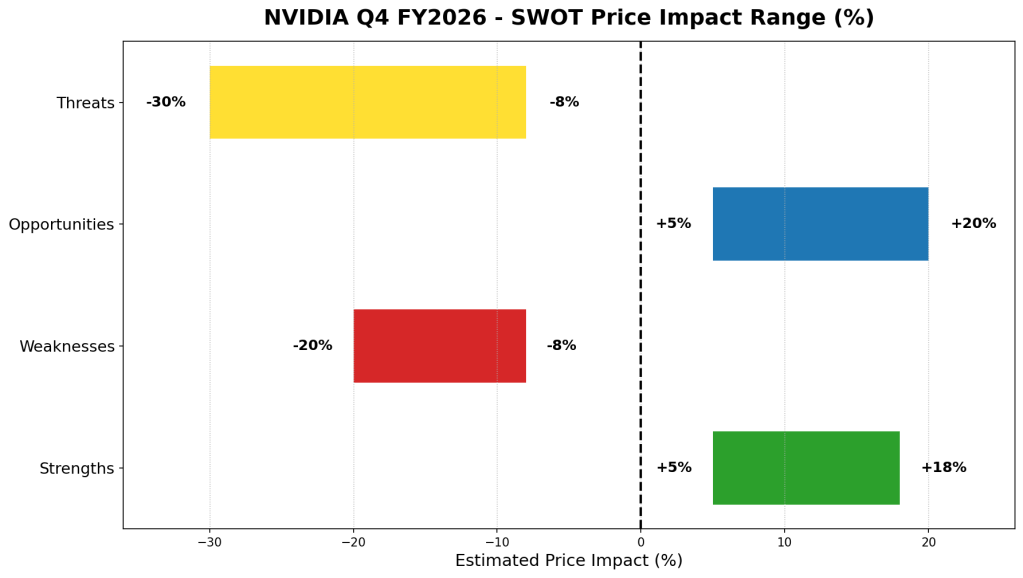
NVIDIA Q4 FY2026 SWOT price impact range chart showing Strengths (+5% to +18%), Weaknesses (-20% to -8%), Opportunities (+5% to +20%), and Threats (-30% to -8%) with a zero reference line.
NVIDIA Q4 FY2026 SWOT price impact analysis. Strengths and Opportunities suggest upside potential of up to +20%, while Weaknesses and Threats indicate downside risk reaching -30%, highlighting both AI leadership momentum and valuation sensitivity.

Valuation Scenarios

Bear Case — AI Growth Moderates

Assumptions:

• EPS slows to ~$6.00

• Multiple compresses to ~30x

Target price: $170–$180

Probability: 25%


Base Case — Strong but Moderating Growth

Assumptions:

• EPS ~$6.50

• Multiple stabilizes ~40x

Target price: $240–$260

Probability: 50%


Bull Case — AI Cycle Extends Multi-Year

Assumptions:

• EPS ~$7.00+

• Multiple holds 45–50x

Target price: $300–$320

Probability: 25%


Probability-Weighted Fair Value

Weighted fair value: ~$246

Fair value range based strictly on official financials:

$240–$250
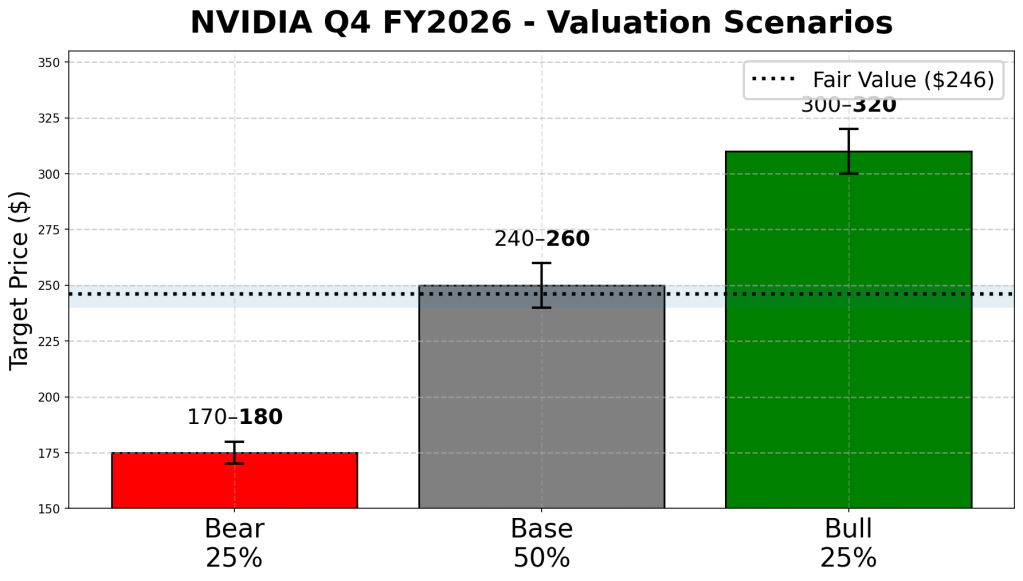
NVIDIA Q4 FY2026 valuation scenarios chart showing Bear case $170–$180 (25%), Base case $240–$260 (50%), and Bull case $300–$320 (25%) with a probability-weighted fair value of $246.
NVIDIA Q4 FY2026 valuation scenarios. The Base case ($240–$260) carries the highest probability at 50%, while the Bull case extends toward $320 if the AI cycle persists. The probability-weighted fair value stands near $246, with a $240–$250 range based strictly on official financials.

Verdict

For Type 1 growth investors, NVIDIA remains the clearest AI infrastructure winner. The numbers show no structural slowdown yet. Gross margins remain elite. Guidance implies continued scale.

The real risk is not weak demand — it’s cycle compression. If AI capex pauses, the stock will re-rate quickly. But as long as hyperscaler demand persists, NVIDIA remains structurally advantaged.

This is no longer an early-stage AI bet. It is an AI cycle duration bet.


Call to Action

If you follow AI infrastructure leaders, subscribe to SWOTstock for structured earnings breakdowns, price-impact SWOT analysis, and scenario-based valuation models built for growth investors.


Disclaimer

This analysis is for informational purposes only and does not constitute investment advice. Always conduct your own due diligence and consult a licensed financial advisor before making investment decisions.


SAP Q2 2025 Earnings: Cloud Momentum, AI Push — Is This Pullback a Buy?

SAP’s Q2 2025 earnings delivered 24% cloud growth, margin expansion, and a strong AI roadmap, yet shares dipped 6%. Is this a buying opportunity for growth investors?

TL;DR

SAP’s Q2 2025 delivered 24% YoY cloud growth83% free cash flow surge, and margin expansion, yet the stock dropped ~6%. For growth‑minded investors, this may be an opportunity to accumulate, as SAP pushes deeper into AI‑driven enterprise solutions and China expansion, though macro and FX risks remain.


Quarter Recap: Why This Matters to Growth Investors

SAP posted Q2 revenues of €9.43B, driven by cloud revenue of €5.13B (+24% YoY) and a backlog increase of 22%Operating margin rose to 27.2% (+1.8pp), while free cash flow surged 83% to €2.36B.

So why did shares drop ~6%? The market zeroed in on slowing backlog growthmacroeconomic uncertainty, and FX drag, which overshadowed the otherwise strong report.

Why you should care: SAP’s fundamentals still point to a cloud‑first, AI‑powered transformation with improving profitability — a combination attractive for growth investors with a mid‑term horizon.


Key Highlights

  • Cloud revenue: €5.13B (+24% YoY)
  • Total backlog: +22% YoY
  • Operating margin27.2% (+1.8pp YoY)
  • Free cash flow€2.36B (+83% YoY)
  • Share buyback: Up to €5B, supporting EPS
Line chart showing SAP’s revenue and net income over the past five quarters, highlighting steady growth through Q2 2025.

AI: More Than a Buzzword — What SAP Is Building

SAP is embedding generative AI into its Business AI platform, integrating tools across ERP, procurement, and HR. It’s also expanding AI‑as‑a‑service offerings, giving customers access to pre‑built, domain‑specific AI models.

CEO Christian Klein emphasized that AI is “not just an add‑on but core to SAP’s next‑generation enterprise software.” This positions SAP to capture higher‑margin, stickier revenue as clients adopt AI‑enhanced workflows.


Peer Comparison: How Does SAP Stack Up?

Bar chart comparing SAP, Oracle, and Microsoft in Q2 2025 for cloud growth percentage, operating margin percentage, and P/E ratio.
  • SAP: Cloud +24%, margin 27.2%, P/E ~24x
  • Oracle: Cloud +20%, margin ~41%, P/E ~30x
  • Microsoft (Intelligent Cloud): +21%, margin ~42%, P/E ~35x

SAP trades at a relative discount while maintaining competitive growth — a point for long‑term investors to watch.


SWOT Analysis: Price Impact on the Table

SAP’s Q2 shows resilience in cloudgrowing AI initiatives, and geographic diversification, offset by backlog sensitivity and macro risk.

Horizontal bar chart showing SAP Q2 2025 SWOT price impact: strengths and opportunities with positive effects, weaknesses and threats with negative effects.
SWOT analysis table for SAP Q2 2025 showing strengths, weaknesses, opportunities, and threats with estimated price impact ranges.

Valuation Scenarios: Where Could the Stock Go?

Bar chart showing SAP Q2 2025 valuation scenarios: Bear case €165, Base case €200, Bull case €230, Current Price €185, with a dotted line marking the fair value at €199.
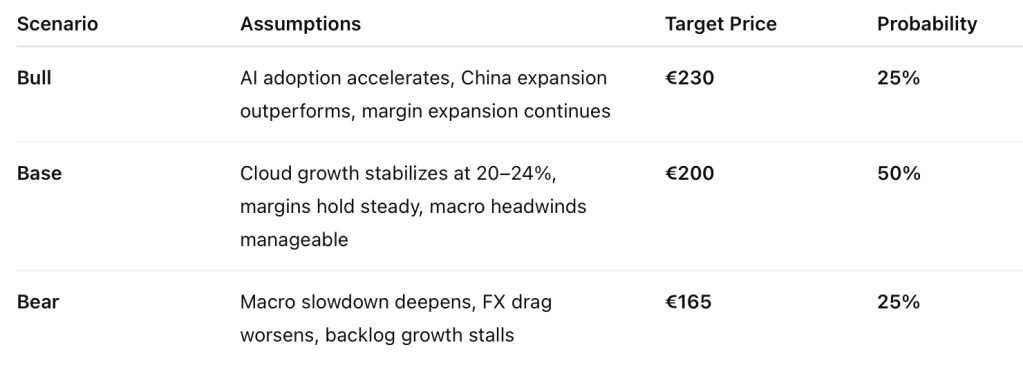
Valuation scenarios table for SAP Q2 2025 showing bull, base, and bear cases with assumptions, target prices, and probabilities.

Probability‑Weighted Fair Value:
(0.50 × 200) + (0.25 × 230) + (0.25 × 165) = €198.75 (~€199).


Verdict: An Attractive Mid‑Term Entry for Growth Investors

SAP is cheaper than its peers, with comparable growth and a clear AI‑driven roadmap. The post‑earnings dip brings it within our fair value range (€195–205), offering a tactical entry for investors who believe in its AI and China growth story.


Call to Action: Should You Buy?

Before adding SAP, ask yourself:

  • Do you believe AI integration will drive higher‑margin growth?
  • Are you comfortable with China exposure amid global trade uncertainty?
  • Does SAP’s valuation vs. Oracle/Microsoft justify a position in your portfolio?

Join the conversation: What’s your take on SAP’s AI pivot? Share your thoughts in the comments and explore more at SWOTstock.com.


Disclaimer

This article is for informational purposes only and does not constitute investment advice. All analysis is based solely on SAP’s official Q2 2025 financial statements, earnings call transcript, and management commentary.


Leave a comment