
TL;DR
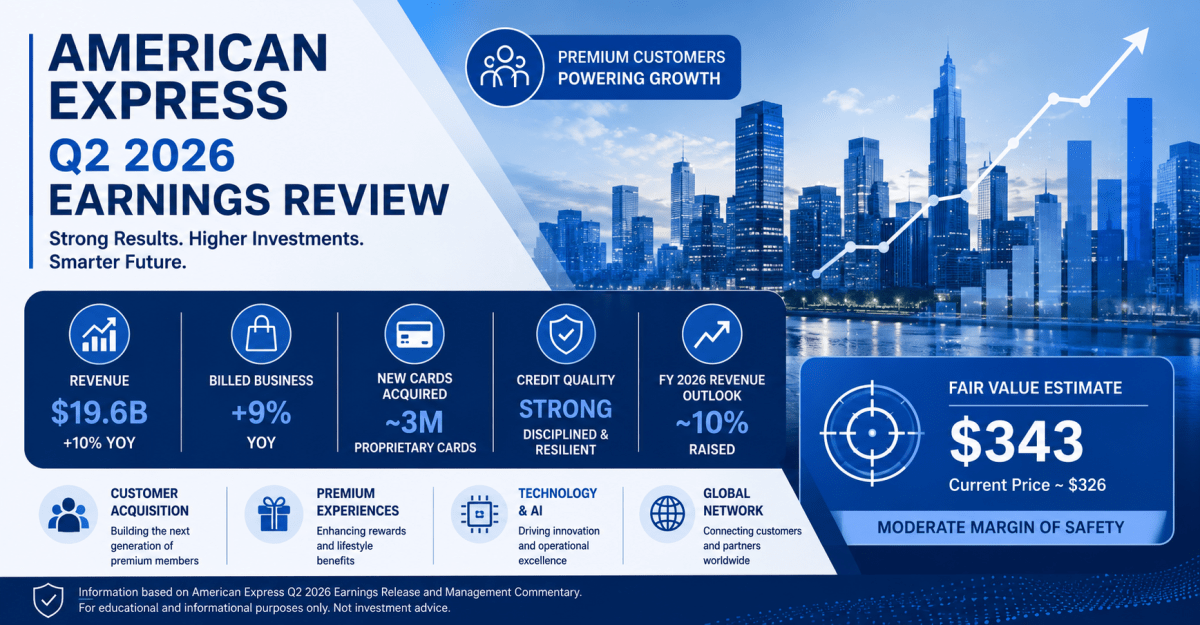
American Express (AXP:NYSE) delivered another fundamentally strong quarter. Revenue grew 10%, billed business increased 9%, approximately 3 million new cards were added, and management raised its full-year revenue growth outlook. Yet the stock fell more than 4% after earnings.
The sell-off was less about deteriorating fundamentals and more about changing investor expectations. While revenue is accelerating, management chose to continue investing heavily in customer acquisition, rewards, technology and AI instead of raising earnings guidance. Investors are now asking whether these investments will eventually translate into stronger profit growth.
Using only American Express’ official financial results and management commentary, our probability-weighted fair value is US$343 per share. With the stock closing around US$326 after earnings, the current price offers a modest margin of safety, though not yet a classic deep-value opportunity.
Quarter Recap
American Express continued to demonstrate why it remains one of the highest-quality franchises in the financial sector.
Revenue reached US$19.6 billion, representing 10% year-over-year growth, supported by resilient spending from affluent card members. Total billed business increased 9%, while approximately 3 million new proprietary cards were issued during the quarter, highlighting continued success in expanding the customer base.
Credit quality remained exceptionally healthy. Delinquencies and write-offs stayed well controlled, reinforcing management’s long-standing disciplined underwriting approach.
Management also increased its full-year revenue growth outlook to approximately 10%, reflecting confidence that premium customer demand remains robust despite an uncertain macroeconomic environment.
However, management maintained its earnings-per-share guidance rather than increasing it, signalling that much of the incremental revenue will continue to be reinvested into marketing, customer benefits, technology, AI and premium product enhancements.
That decision ultimately shaped the market’s reaction.
Key Highlights
- Revenue increased 10% year over year to US$19.6 billion.
- Diluted EPS increased to US$4.53.
- Total billed business grew 9%.
- Approximately 3 million new proprietary cards were added.
- Credit metrics remained healthy with disciplined risk management.
- Full-year revenue growth guidance was increased to approximately 10%.
- EPS guidance remained unchanged as management continues investing for long-term growth.
SWOT Analysis
American Express remains a premium franchise with durable competitive advantages. The business itself strengthened during the quarter, but the investment debate has shifted toward whether higher customer acquisition and engagement costs will permanently reduce operating leverage.
Strengths
- Affluent customer base continues to spend strongly (+8% to +12%)
- Spending remained resilient despite macro uncertainty.
- Premium customers continue supporting consistent revenue growth.
- Powerful premium brand and closed-loop network (+6% to +10%)
- Strong customer loyalty supports attractive economics and pricing power.
- The integrated payment network remains difficult for competitors to replicate.
- Excellent credit quality (+5% to +8%)
- Low delinquency and write-off rates reduce downside earnings risk.
- Disciplined underwriting continues to differentiate American Express from many financial peers.
- Continued customer acquisition (+4% to +8%)
- Around 3 million new cards were added.
- Strong Millennial and Gen Z adoption extends future growth potential.
- Management confidence in business momentum (+3% to +6%)
- Raising revenue guidance demonstrates confidence in continued customer spending.
Weaknesses
- Revenue growth is not yet translating into stronger earnings leverage (-6% to -10%)
- Revenue guidance increased while EPS guidance remained unchanged.
- Investors are waiting for clearer evidence that current investments will generate higher profits.
- Expenses are growing faster than revenue (-5% to -9%)
- Marketing, rewards, customer engagement and technology investments continue to pressure margins.
- Premium valuation reduces room for disappointment (-4% to -8%)
- High-quality businesses still require sustained earnings growth to justify premium multiples.
Opportunities
- Growing younger premium customer base (+6% to +12%)
- Millennials and Gen Z customers provide decades of potential spending and cross-selling opportunities.
- AI and digital investment improving long-term efficiency (+3% to +7%)
- Continued investment may enhance customer experience, fraud prevention and operational productivity.
- Continued global travel recovery (+3% to +8%)
- International travel remains an important long-term growth driver for premium card spending.
Threats
- Increasing competition in premium cards (-7% to -12%)
- Richer rewards and customer benefits may permanently increase acquisition and retention costs.
- Consumer spending slowdown (-6% to -11%)
- A prolonged economic slowdown would eventually affect discretionary spending.
- Credit deterioration during weaker economic conditions (-5% to -10%)
- Higher charge-offs would reduce profitability if macro conditions weaken.
- Interest-rate and regulatory changes (-3% to -6%)
- Changes in regulation or funding costs could affect long-term returns.
Valuation Scenarios
American Express continues to generate consistent revenue growth while maintaining one of the strongest consumer credit portfolios in the industry. The primary uncertainty is no longer demand, but whether today’s elevated investment spending will produce higher operating leverage in future years.
Bear Case — US$285 (25% probability)
This scenario assumes premium-card competition intensifies, customer acquisition costs remain structurally higher, revenue growth slows and margins remain under pressure.
Base Case — US$345 (50% probability)
Revenue continues growing around management’s outlook, current investments gradually improve productivity, credit quality remains healthy and margins begin recovering over the next one to two years.
Bull Case — US$395 (25% probability)
American Express successfully converts today’s investment into stronger earnings growth, premium spending remains robust and investors reward the business with further valuation expansion.
Probability-Weighted Fair Value
Combining these scenarios produces a probability-weighted fair value of approximately US$343 per share.
With the shares trading around US$326, the market currently values American Express at roughly a 5% discount to our estimated intrinsic value.
Verdict
American Express did not report a weak quarter.
Instead, management chose to prioritise long-term franchise strength over short-term earnings optimisation. Revenue continues to accelerate, customer acquisition remains strong and credit quality is among the best in the industry.
The post-earnings decline reflects investor concerns that higher spending on rewards, technology and customer engagement may delay future earnings expansion rather than signal any deterioration in the underlying business.
For long-term investors, the central question is whether these investments represent temporary growth spending or a permanent increase in the cost of defending the premium franchise.
At the current share price, American Express appears reasonably valued with a modest margin of safety, but not yet at the kind of discount that would qualify as a “fat pitch.” A more compelling opportunity would likely emerge if the shares approached the US$280–310 range without any corresponding deterioration in business fundamentals.
Call to Action
Do you think the market overreacted to American Express’ unchanged earnings guidance, or is rising competition making premium-card economics permanently more expensive?
Share your thoughts below, and follow SWOTstock for independent, evidence-based earnings analysis built from official company disclosures rather than consensus headlines.
Disclaimer
This article is for educational and informational purposes only and should not be considered investment advice. The analysis is based on American Express’ official earnings release, SEC filings and management commentary available at the time of writing. The valuation scenarios and fair value estimates reflect independent judgement and should not be interpreted as price targets or recommendations to buy or sell securities. Always conduct your own research and consider your financial circumstances before making any investment decisions.

