💼 Wells Fargo Q2 2025: A Clearer Runway—But Is the Price Still Right?

Wells Fargo Q2 2025 earnings beat expectations, but NII guidance disappointed. Is the stock undervalued or overhyped? SWOT analysis for value investors.

TL;DR – Strong Quarter, Valuation Getting Ahead?

Wells Fargo delivered solid earnings and regulatory clarity in Q2 2025, including the long-awaited removal of its Fed-imposed asset cap. But flat guidance for Net Interest Income (NII) spooked the market. While shares are rebounding, value investors may want to wait for a more attractive margin of safety closer to $76 before entering.


📊 Quarter Recap: Asset Cap Lifted, But NII Dampens Mood

Wells Fargo posted $5.49B in net income (+12% YoY) and $1.60 EPS, beating expectations. Revenue reached $20.82B, with non-interest income showing strength in advisory and trading fees.

However, Net Interest Income (NII) declined 2% YoY, and full-year guidance was trimmed from growth to flat. That change triggered a 5.6% selloff, before shares rebounded.

CEO Charlie Scharf called the quarter a turning point:

“The lifting of the asset cap by the Federal Reserve marked a pivotal milestone in our transformation.”

Wells is now repositioning for growth—especially in fee-based businesses.


🔍 Key Highlights from Q2

  • Net Income rose to $5.49B, with EPS at $1.60 (GAAP)
  • NII dropped 2% YoY; FY guidance trimmed to flat growth
  • Non-interest income strengthened, especially investment banking (+9%)
  • Efficiency focus continues with tight expense control
  • Asset cap lifted, removing key regulatory hurdle
  • Capital return likely to increase—dividend hikes expected post stress test
Line chart showing Wells Fargo’s revenue and net income over the past five quarters from Q2 2024 to Q2 2025.

🏦 Peer Context: Wells vs JPMorgan & Citi

  • Wells Fargo: Guided for flat NII in FY2025
  • Citigroup: Reiterated low single-digit growth
  • JPMorgan: Holding NII flat, with cost controls as offset

Wells appears slightly more conservative than peers, raising questions about credit demand and pricing pressure.


💵 Capital Return Outlook: What’s Coming?

Wells Fargo currently yields 1.73%, but management has hinted at capital returns improving post-stress test.

  • 10–12% dividend hike is feasible, which would push the yield toward 1.9–2.0%.
  • Share repurchases are also likely to resume more meaningfully in H2 2025.

This return to “normal” capital policy is a key pillar for value-focused investors.


🧭 SWOT Analysis

Wells Fargo’s Q2 2025 performance marks a strategic inflection point—regulatory shackles are gone, fee-based income is recovering, and capital returns are back on the table. But macro uncertainty and cautious NII guidance leave questions about short-term upside. The SWOT analysis below breaks down the bank’s positioning, including estimated price impact for each factor to help value investors frame risk and reward.

SWOT analysis table for Wells Fargo Q2 2025 showing strengths, weaknesses, opportunities, and threats with estimated stock price impact ranges.
Updated SWOT price impact bar chart for Wells Fargo Q2 2025 with symmetric spacing and x-axis starting at –8, illustrating the estimated stock price effect of each SWOT factor.

📈 Valuation Scenarios

After evaluating Wells Fargo’s Q2 2025 results, it’s clear that the market has reacted positively to the lifting of the asset cap and stronger capital positioning. However, to determine whether the current share price reflects true value, we turn to the fundamentals. By applying a blended model—based on earnings, book value, and dividend yield—we arrive at a fair value that gives value investors a grounded view of what the stock is really worth.
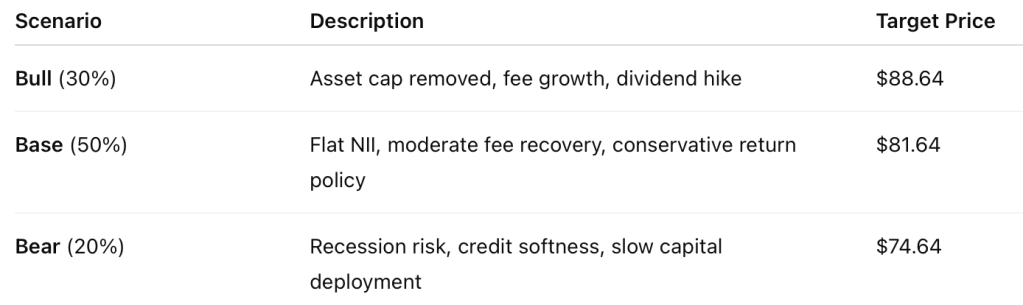
Valuation scenarios table for Wells Fargo Q2 2025, including bull, base, and bear case target prices with probability weights and risk-adjusted fair value estimate.

🎯 Probability-Weighted Price Target: $82.30

Vertical bar chart showing Wells Fargo’s Q2 2025 valuation scenarios with target prices for Bear, Base, Bull cases and current stock price, including a dotted line marking the fair value estimate at $82.30.

🧮 Fair Value Estimate: Clarity Through the Numbers

We calculate fair value using three methods based on official Q2 2025 data:
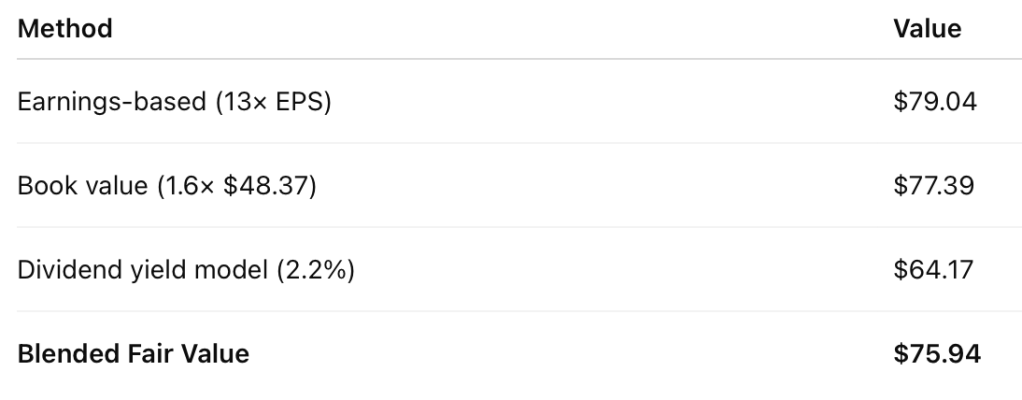
Fair value breakdown table for Wells Fargo Q2 2025 using earnings-based, book value, and dividend yield models, showing individual estimates and the blended fair value of $75.94.

🔎 Verdict: Watchlist Candidate, Not Yet a Buy

With the stock currently at $80.64 and our fair value at $75.94, Wells Fargo is trading 5.8% above our estimate.
While long-term upside exists, value investors may want to wait for a pullback toward $74–76 to lock in a proper margin of safety. The market has largely priced in the asset cap news—but not yet the risk of stagnating interest income.


📣 Call to Action

Want to see how Wells Fargo stacks up against JPMorgan and Citi? Check out our recent bank earnings breakdowns and subscribe for alerts on Goldman Sachs, Bank of America, and Morgan Stanley in the days ahead.


🛑 Disclaimer

This blog is for educational and informational purposes only and is not investment advice. All analysis is based solely on official company filings and earnings calls.


Leave a comment


🏦 Citigroup Q2 2025: Resilient Earnings, But Has the Turnaround Arrived?

Citigroup Q2 2025 earnings beat expectations with strong trading revenue and capital returns. See our SWOT analysis, fair value estimate, and how Citi stacks up against JPMorgan and Wells Fargo.

TL;DR Summary

Citigroup posted a robust Q2 beat, with EPS up 29% YoY and trading revenue surging in volatile markets. Its RoTCE improved to 8.7%, but still trails its 2026 target. With a tangible book value of $94.16 and a fair value estimate of $90.87, the stock appears fairly priced — but global expansion and capital return plans could drive future upside.


Q2 2025 Earnings Recap

Citigroup reported net income of $4.0B and EPS of $1.96, exceeding consensus expectations. Revenue rose 8% YoY to $21.7B, driven by double-digit growth in Markets and US Personal Banking. Trading desks thrived amid tariff-related volatility, while the firm continued to pare down non-core operations and reinvest in digital.

Line chart showing Citigroup’s revenue and net income over the past five quarters from Q2 2024 to Q2 2025.

Key Metrics:

  • Revenue: $21.7B (+8% YoY)
  • Net Interest Income: +12% YoY
  • RoTCE: 8.7%
  • Tangible Book Value (TBV): $94.16
  • CET1 ratio: 13.5%
  • Capital Returned: $3.1B via buybacks and dividends

Management Highlights & Macro Context

On the earnings call, management reiterated its goal to reach 10–11% RoTCE by 2026, noting that simplification and technology modernization are key levers. Management acknowledged macro uncertainties but emphasized a strong capital position and stable consumer credit trends.

Meanwhile, markets benefited from tariff-induced volatility, boosting trading revenue by 16% YoY — the highest since 2020. Consumer banking remained steady, and Citi’s global diversification shielded it from regional slowdowns.


Strategic Growth: Asia in Focus

Citigroup is doubling down on Asia. The firm increased its Japan investment banking headcount by 15%, and reported a 140% YoY rise in institutional banking fees from Japan alone. This aligns with its plan to boost international dealmaking and fee-based income amid soft domestic lending margins.


Peer Comparison: How Did Citi Stack Up?

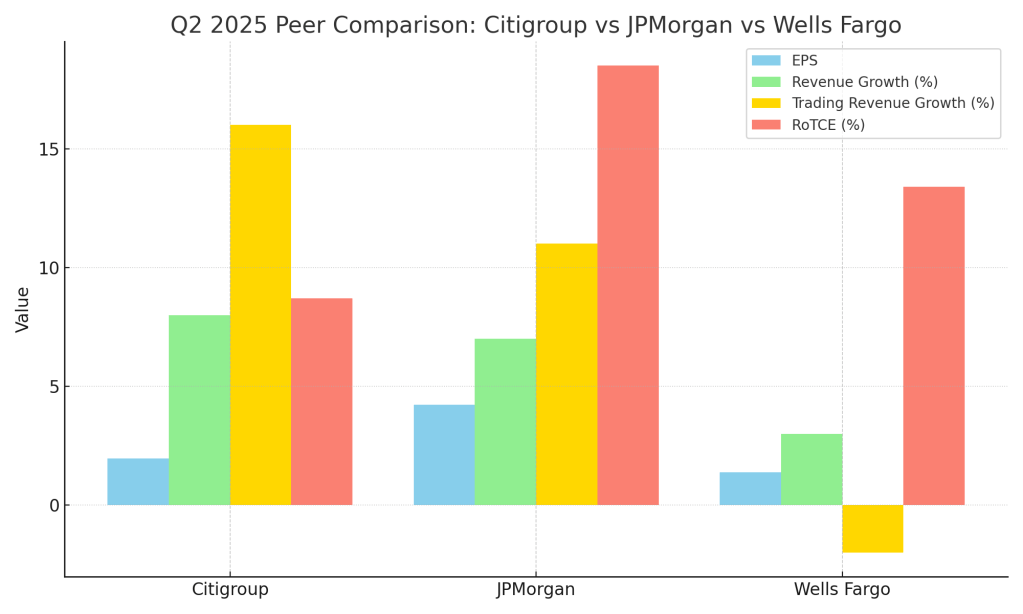
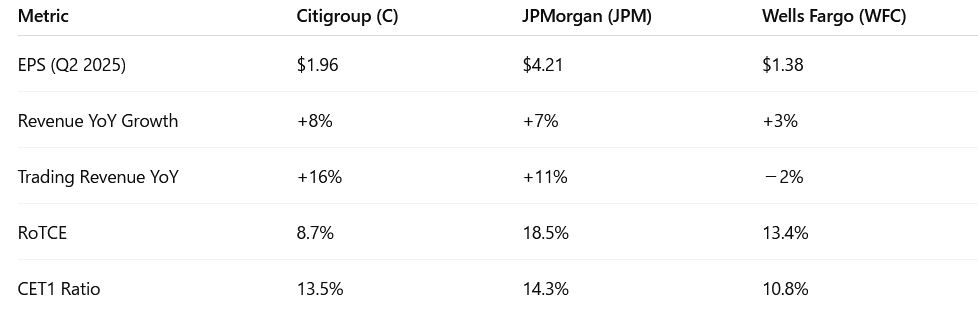
Compared to JPMorgan and Wells Fargo, Citigroup still lags on profitability metrics like RoTCE (8.7% vs. JPM’s 18.5% and WFC’s 13.4%). However, Citi outperformed both in revenue growth (+8%) and trading revenue (+16%), indicating strength in capital markets and global diversification. Its CET1 ratio of 13.5% also reflects robust capital flexibility—positioning it well for continued buybacks and selective growth investments. The key gap remains consistent shareholder return and operational efficiency, which Citi is still working to close.

Q2 2025 financial comparison table of Citigroup, JPMorgan, and Wells Fargo showing EPS, revenue growth, trading performance, RoTCE, and CET1 ratios.
Grouped bar chart comparing Citigroup, JPMorgan, and Wells Fargo for Q2 2025: EPS, revenue growth (%), trading revenue growth (%), and RoTCE (%).

🧠 SWOT Analysis

Strengths

Resilient earnings growth and capital return.
Citigroup delivered strong YoY net income growth (+25%) and EPS of $1.96, with over $3B in capital returned via buybacks and dividends. Net interest income surged +12%, with double-digit revenue growth in key segments (Markets, Services, US Personal Banking). CET1 ratio at 13.5% gives capital flexibility.

💰 Estimated Price Impact: +6 to +10%
If sustainable RoTCE > 9% is priced in with buybacks continuing, target valuation rises toward tangible book.

Weaknesses

Still below RoTCE target, cost pressure lingers.
At 8.7%, RoTCE is still short of management’s 10–11% 2026 target. Expenses rose 2% YoY (3% adj.), and cost of credit rose +16%. Execution risk remains on strategic transformation.

📉 Estimated Price Impact: −3 to −6%
Market may discount earnings quality or raise concerns about future margin compression.

Opportunities

Strategic repositioning + digital scale-up.
Management reiterated restructuring plans, exited non-core markets, and emphasized digital growth (incl. tokenized asset initiatives and credit cards). These efforts aim to lift RoTCE structurally.

🚀 Estimated Price Impact: +4 to +8%
If digital scale materializes and operating leverage improves, upward re-rating to 0.95–1.05x TBV is possible.

Threats

Macro risk + regulatory shifts.
Loan reserves were built up in response to macro uncertainty and higher charge-offs in cards. Also, potential regulatory capital rule changes (Basel Endgame) could pressure CET1 deployment.

⚠️ Estimated Price Impact: −4 to −7%
Any credit deterioration or CET1 squeeze could limit upside from capital return plans.


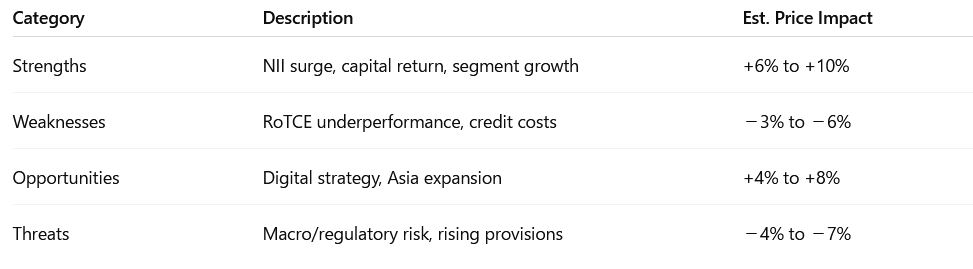
📊 Summary SWOT Table (Price Impact Ranges)

SWOT analysis table for Citigroup Q2 2025 showing strengths, weaknesses, opportunities, and threats with estimated stock price impact ranges.
Horizontal bar chart showing Citigroup’s Q2 2025 SWOT price impact ranges: Threats (-7% to -4%), Opportunities (+4% to +8%), Weaknesses (-6% to -3%), and Strengths (+6% to +10%), with a vertical dashed line at 0%

📈 Valuation Scenarios Based on SWOT

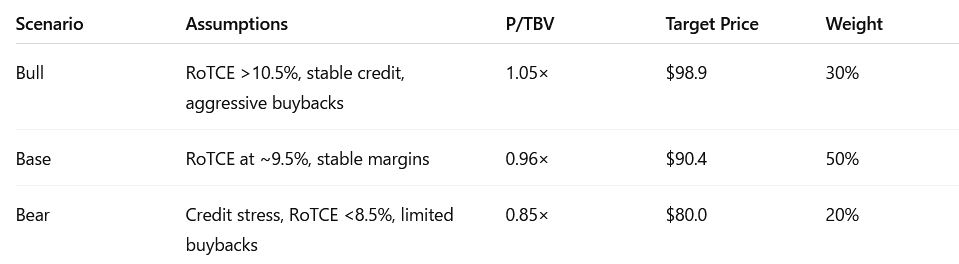
Assume current price = $90, Tangible Book Value (TBV) = $94.16, base-case P/TBV target = 0.95×–1.00×


Valuation scenarios table for Citigroup Q2 2025 showing bull, base, and bear cases with P/TBV multiples, target prices, and probability weights.

Fair Value=(98.9×0.3)+(90.4×0.5)+(80.0×0.2)=$90.87

Vertical bar chart showing Citigroup’s Q2 2025 valuation scenarios: Bull case ($98.9, green), Base case ($90.4, gray), Bear case ($80.0, red), and Current Price ($90.0, black), with a dotted blue line at Fair Value ($90.87).

Fair Value & Verdict

At $90, Citigroup trades near our fair value estimate of $90.87. The stock reflects Q2’s upside already, and future gains depend on the bank hitting its RoTCE goals and expanding fee-based revenues abroad.

Investor Verdict:
Neutral near-term outlook. Value investors should monitor credit trends and execution on transformation. Accumulate if price dips closer to TBV ($94.16) with upside potential from Asia growth and capital return.


📬 Call to Action

Want to compare Citi’s Q2 against JPMorgan and Wells Fargo?
Check out our SWOTstock posts on those banks and subscribe for updates after every major U.S. bank report.


⚠️ Disclaimer

This article is for informational purposes only and not investment advice. All analysis is based on Citigroup’s official Q2 2025 financial report and earnings call. No external analyst projections or third-party commentary were used.


Leave a comment