
TL;DR Summary
Berkshire Hathaway’s FY2025 results showed softer operating earnings and insurance volatility, yet the balance sheet has never been stronger. With over $370B in cash and disciplined capital allocation under Greg Abel, the long-term compounding story remains intact. However, at around $500 per BRK.B share, the stock appears close to fair value. For DIY value investors, the key question is no longer quality — it’s margin of safety.
Quarter Recap
Berkshire Hathaway reported FY2025 results in late February 2026. Operating earnings declined modestly year-over-year, reflecting weaker insurance underwriting and investment writedowns. GAAP net income was more volatile due to mark-to-market adjustments in the equity portfolio.
Despite softer earnings, Berkshire ended the year with a record cash position exceeding $370B. Share repurchases remained limited, and the company was a net seller of equities during much of the year.
This was also the first full annual report under CEO Greg Abel, marking a formal transition from the Buffett era while maintaining the same capital allocation philosophy.
Key Highlights
• Operating earnings declined modestly year-over-year
• Insurance underwriting results weakened in Q4
• Cash & equivalents reached record levels (~$370B+)
• No major acquisition deployed despite large liquidity
• Leadership transition to Greg Abel formally underway
• Equity portfolio remains concentrated in high-quality holdings
SWOT Analysis
Berkshire is not an earnings-momentum stock. It is a capital allocator built for long-term compounding. FY2025 did not break the story — but it did test investor patience. For value investors, durability matters more than quarterly growth.
Strengths
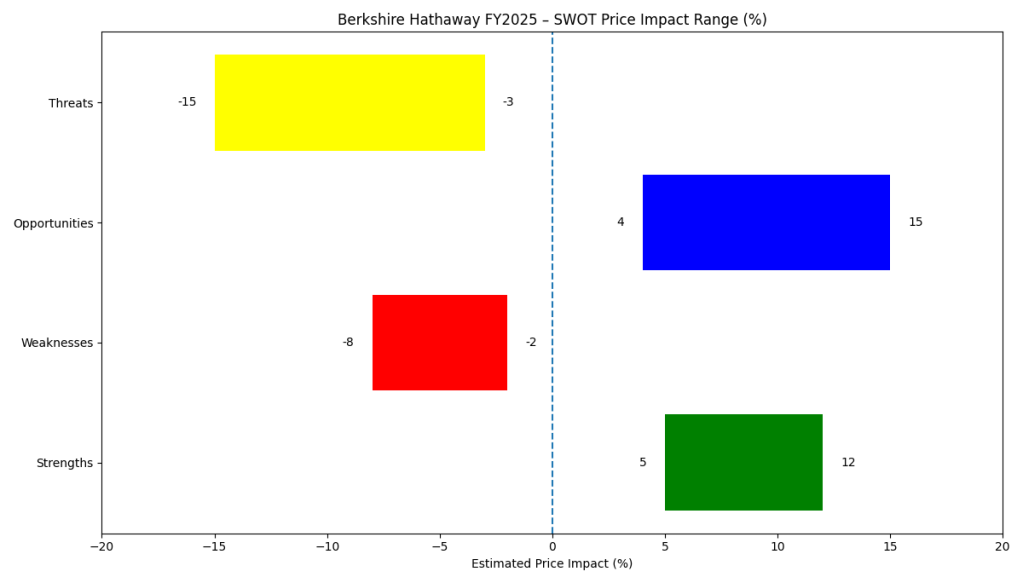
• Massive cash position providing downside protection and acquisition optionality
Estimated Price Impact: +5% to +12%
• Diversified operating businesses (insurance, rail, energy, manufacturing)
Estimated Price Impact: +4% to +8%
• Long-standing capital allocation discipline now reinforced under Abel
Estimated Price Impact: +3% to +7%
• High-quality equity portfolio generating dividends and embedded gains
Estimated Price Impact: +4% to +10%
Weaknesses
• Insurance earnings volatility and catastrophe exposure
Estimated Price Impact: -3% to -8%
• Slower organic growth relative to high-growth market leaders
Estimated Price Impact: -2% to -6%
• Leadership transition uncertainty in post-Buffett era
Estimated Price Impact: -3% to -7%
Opportunities
• Large-scale acquisition during market downturn
Estimated Price Impact: +8% to +15%
• Improvement in insurance pricing cycle
Estimated Price Impact: +4% to +9%
• Opportunistic share buybacks below intrinsic value
Estimated Price Impact: +5% to +10%
Threats
• Major insurance catastrophe event
Estimated Price Impact: -6% to -15%
• Significant equity portfolio drawdown
Estimated Price Impact: -5% to -12%
• Prolonged inability to deploy excess cash effectively
Estimated Price Impact: -3% to -8%
Valuation Scenarios (based on BRK.B)
Berkshire should be valued on normalized operating earnings rather than GAAP net income due to mark-to-market volatility. Using conservative assumptions aligned with Buffett-style valuation discipline:
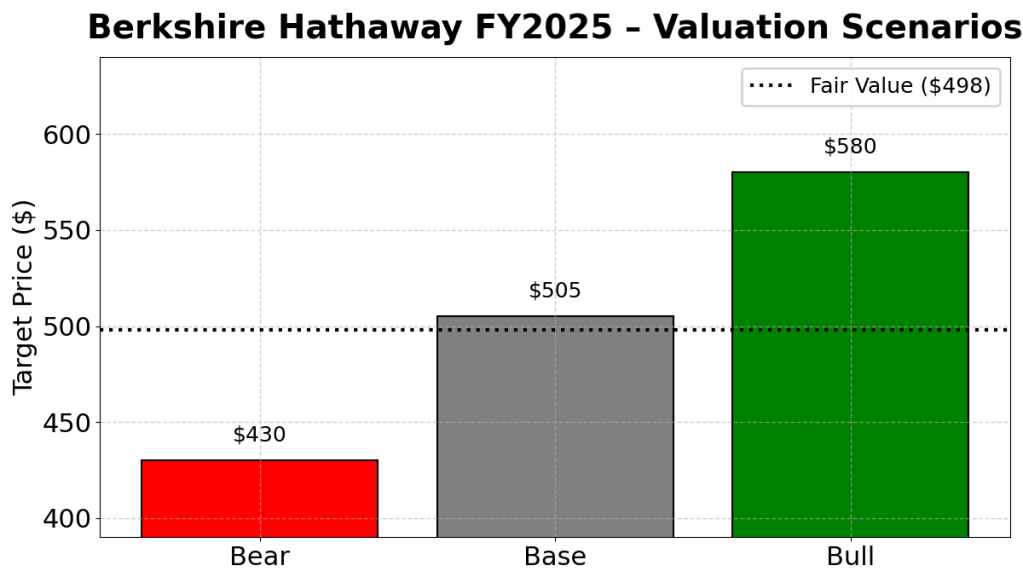
Bear Case
Flat or declining operating earnings
14× earnings multiple
No major capital deployment
Implied Price Target: $430
Probability: 30%
Base Case
4–6% operating earnings growth
16× earnings multiple
Gradual capital deployment
Implied Price Target: $505
Probability: 50%
Bull Case
8–10% earnings growth
Successful large acquisition
18× earnings multiple
Implied Price Target: $580
Probability: 20%
Probability-Weighted Fair Value:
≈ $498
Verdict
Berkshire Hathaway remains one of the highest-quality capital allocators in the world. The balance sheet strength is extraordinary, and the business model remains durable.
However, at roughly $500 per BRK.B share, the stock trades close to intrinsic value under conservative assumptions. There is limited margin of safety unless earnings growth accelerates or a large acquisition creates incremental intrinsic value.
For DIY value investors, Berkshire is still a core compounding vehicle — but not a deep bargain today.
Call to Action
If you are building a long-term value portfolio, ask yourself:
Are you buying Berkshire for safety, or for upside?
Follow SWOTstock for structured, investor-focused earnings analysis grounded in intrinsic value logic — not headlines.
Disclaimer
This article is for informational purposes only and does not constitute investment advice. Investors should conduct their own research and consider their financial circumstances before making investment decisions.


 SWOT Stock - Smart Investing Made Simple
Leave a comment