
TL;DR
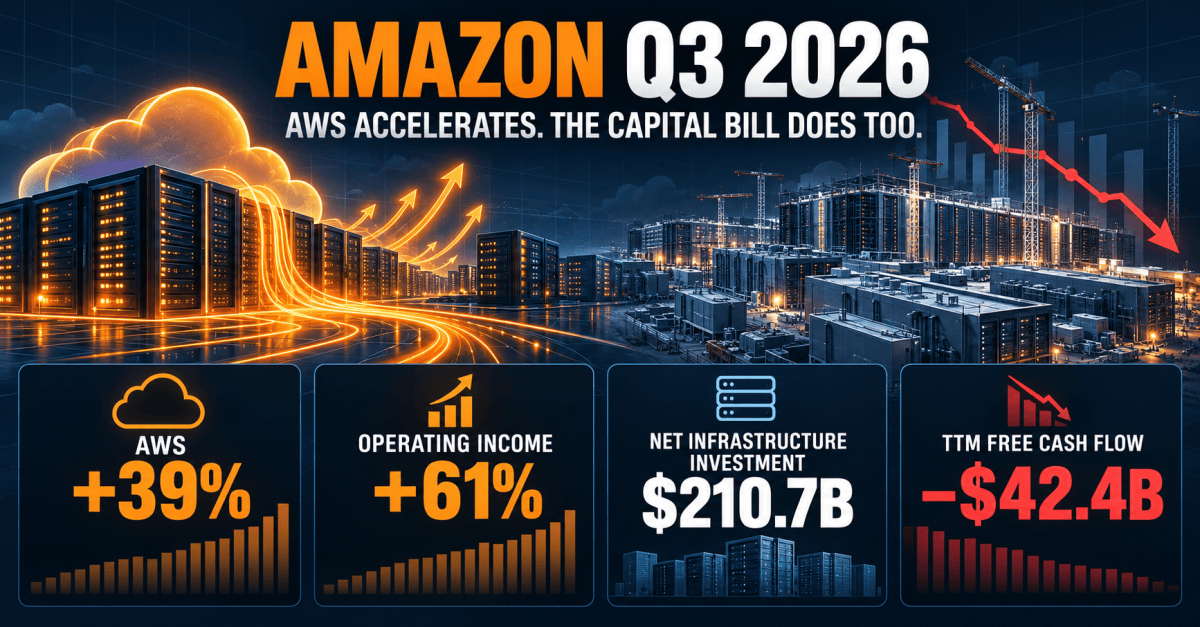
Amazon’s (AMZN:NASDAQ) third-quarter results strengthened the long-term growth thesis. AWS revenue accelerated 39%, AWS operating income increased 55%, and the segment maintained a 38.7% operating margin. Amazon also reported rapid growth in Bedrock usage and projected AWS revenue growth above 40% in both 2027 and 2028.
The operating performance, however, required substantially more capital than anticipated. Trailing infrastructure investment reached $210.7 billion, free cash flow deteriorated to negative $42.4 billion, and long-term debt rose to $173.1 billion.
Our updated probability-weighted fair value is approximately $259 per share, down from $275 after Q2. Against an initial post-earnings price of approximately $227, Amazon offers a modest 12% margin of safety—but not enough to eliminate the risk that AI growth generates inadequate returns on the capital required to support it.
Quarter Recap
Amazon reported third-quarter revenue of $201.9 billion, up 12% year over year and 13% excluding currency movements. Amazon said the shift of most Prime Day activity from Q3 into Q2 reduced reported quarterly growth by approximately four percentage points.
Operating income increased 61% to $28.1 billion. The operating margin rose from 9.7% to a record 13.9%.
Net income was $20.7 billion, or $1.89 per diluted share, compared with $21.2 billion and $1.95 per share a year earlier. The comparison was affected by $9.5 billion of pre-tax Anthropic investment gains recognized in Q3 2025.
AWS was again the central growth engine. Revenue increased 39% to $46.0 billion, while operating income rose 55% to $17.8 billion. Its operating margin reached 38.7%, compared with 34.6% a year earlier and 39.4% in Q2.
North American sales increased 6% to $112.9 billion, while operating income rose 82% to $8.7 billion. International sales increased 5%, or 8% excluding currency, to $43.1 billion. International operating income increased 32% to $1.6 billion.
Advertising revenue increased 11%, or 12% excluding currency, to $19.6 billion. Amazon attributed part of the slowdown from Q2’s 26% growth to Prime Day and other timing effects. It expects advertising growth to return to the high teens in Q4.
For the fourth quarter, Amazon expects revenue of $240 billion to $247 billion and operating income of $28.5 billion to $33.5 billion. It continues to expect approximately $220 billion of cash capital expenditure in 2026. ir.aboutamazon.com
Market Reaction
Amazon shares had already fallen 4.25% during the regular session, closing at $243.79 before the earnings release. They subsequently declined to approximately $225–227 in extended trading, representing an additional loss of around 7%.
Measured from the previous day’s $254.60 close, Amazon lost approximately 11% across the regular and extended sessions.
Published coverage initially described the decline as a reaction to Amazon missing market expectations. That is accurate, but the size of each expectation gap matters.
Reported revenue of $201.9 billion was only around 0.1%–0.2% below published consensus estimates. EPS of $1.89 was approximately 4% below expectations, while the midpoint of Q4 revenue guidance was only about 0.4% below consensus.
The larger gaps appeared elsewhere.
Advertising revenue was approximately 5.7% below published expectations. More importantly, quarterly capital expenditure of $77.3 billion was roughly $18.6 billion—or 32%—above expectations. AWS revenue, by contrast, exceeded consensus estimates.
Reuters emphasized the combination of softer guidance, cash burn and unexpectedly high capital expenditure. Axios similarly focused on the deterioration in free cash flow and the cost of Amazon’s AI infrastructure expansion.
The reaction was therefore about results falling below expectations, but not primarily because consolidated revenue missed by a fraction of one percent. The more economically important surprise was that Amazon required substantially more capital to deliver its accelerating AWS growth.
The first post-earnings regular session had not closed at the time of this analysis, so the market signal remains provisional.
Key Highlights
AWS Growth Accelerated Again
AWS revenue growth increased from 28% in Q1 to 37% in Q2 and 39% in Q3. Its annualized revenue run rate reached approximately $184 billion.
Amazon also reported nearly sevenfold growth in Fortune 500 customer spending on Bedrock and approximately seventeenfold growth in Bedrock token volume. Tens of thousands of customers now use Bedrock AgentCore, deploying twice as many agents during Q3 as during the preceding three quarters combined.
These disclosures provide evidence that AWS demand extends beyond training large models. Amazon is also participating in inference, agent deployment, serverless computing, storage, databases and enterprise AI workflows.
AWS Profitability Remained Exceptional
AWS generated approximately 63% of Amazon’s quarterly operating income despite accounting for only 23% of revenue.
Its 38.7% operating margin declined slightly from Q2’s 39.4%, but remained substantially above the 34.6% reported a year earlier.
Every percentage-point change in AWS margin affects annualized operating income by approximately $1.8 billion at the current revenue run rate. This makes AWS utilization, pricing and depreciation central to Amazon’s valuation.
Retail Profitability Continued Improving
North America and International generated combined quarterly operating income of $10.3 billion, compared with approximately $6.0 billion a year earlier.
The improvement matters because it reduces Amazon’s dependence on AWS as the only source of meaningful profit. Retail also provides additional funding for infrastructure investment.
However, International’s 3.7% quarterly margin remains well below North America’s 7.7%, leaving both opportunity and execution risk.
Advertising Lost Momentum
Advertising growth slowed from 26% in Q2 to 11% in Q3.
Prime Day timing makes the sequential comparison imperfect, and management expects growth to recover to the high teens in Q4. Nevertheless, advertising is an important high-margin counterweight to the capital intensity of AWS and retail.
Amazon therefore needs to demonstrate that the slowdown was temporary rather than an early sign of weaker advertising monetization.
The Cash-Flow Deterioration Was Substantial
Trailing operating cash flow increased 29% to $168.3 billion. But net property-and-equipment investment rose 82% to $210.7 billion.
As a result, trailing free cash flow deteriorated from negative $7.6 billion in Q2 to negative $42.4 billion in Q3. One year earlier, Amazon generated positive free cash flow of $14.8 billion.
Long-term debt also increased from $65.6 billion at the end of 2025 to $173.1 billion by September 2026. Quarterly interest expense rose from $538 million to $1.69 billion.
Amazon retains considerable financial capacity, but its AI expansion is no longer being funded solely through excess operating cash generation. ir.aboutamazon.com
SWOT Analysis
Amazon’s Q3 results present an unusually wide distribution of potential outcomes. Stronger AWS growth raises the upside, while worsening capital intensity lowers the downside and base cases.
Strengths
- AWS growth and scale: Every five-percentage-point difference in annual AWS growth could change estimated fair value by approximately 3%–5%.
- AWS profitability: Every 100-basis-point change in AWS operating margin represents approximately 1.5%–2% of estimated equity value.
- Retail operating leverage: A sustainable 100-basis-point improvement across the combined North American and International segments could add approximately 5%–7% to fair value.
- Consolidated margin expansion: A sustainable percentage-point improvement in Amazon’s overall operating margin could affect fair value by approximately 6%–8%.
- Enterprise AI adoption: If Bedrock and related services eventually generate an additional $10 billion of annual revenue at attractive margins, the potential fair-value contribution could be approximately 3%–4%.
Weaknesses
- Negative free cash flow: If infrastructure spending remains above operating cash generation for another two years, the delay in shareholder cash returns could reduce fair value by approximately 10%–20%.
- Rising financing costs: A 100-basis-point increase in the effective cost of Amazon’s long-term debt could reduce fair value by approximately 1.5%–2%.
- Advertising deceleration: A ten-percentage-point difference in annual advertising growth could affect fair value by approximately 2%–4%.
- AWS earnings concentration: A five-percentage-point reduction in the AWS margin could reduce fair value by approximately 8%–10%.
- Delayed depreciation pressure: A 10% increase in annual depreciation without corresponding incremental gross profit could reduce fair value by approximately 6%–8%.
Opportunities
- AWS growth above 40%: Management’s projection for more than 40% growth in 2027 and 2028 creates substantial upside if Amazon can maintain its margins.
- Bedrock as a model-neutral enterprise platform: An additional $15–20 billion of platform-related revenue could add approximately 5%–8% to fair value.
- Trainium and Graviton economics: A sustainable 200–300-basis-point AWS margin improvement from proprietary chips and better utilization could add approximately 3%–6%.
- Retail margin improvement: A further 100–200-basis-point improvement across Amazon’s retail segments could add approximately 6%–12%.
- Advertising normalization: A return to high-teens advertising growth could add approximately 2%–3% relative to a low-growth outcome.
Threats
- Inadequate returns on AI capital: Amazon can achieve high AI revenue growth without earning an adequate return if depreciation, energy, financing and customer incentives absorb too much of the economics. A five-percentage-point reduction in the long-term AWS margin could reduce fair value by approximately 8%–10%.
- Technological obsolescence: A 5% economic impairment of Amazon’s $508.9 billion net property-and-equipment balance would equal approximately $25 billion before tax. Depending on the underlying cause, the potential equity-price effect could be approximately 5%–10%.
- Cloud price competition: A 5% reduction in expected AWS revenue or pricing could reduce fair value by approximately 3%–6%.
- Infrastructure delays: If energy, memory or construction constraints leave 5% of annual investment economically underutilized, more than $10 billion of capital could generate limited near-term revenue. The potential valuation effect is approximately 3%–6%.
- Customer bargaining power: A 200-basis-point AWS margin concession associated with large-customer pricing could reduce fair value by approximately 3%–4%.
Valuation Scenarios
Because current free cash flow is distorted by Amazon’s infrastructure build, we value the company using normalized 2027 operating earnings. We separate AWS from Amazon’s other businesses and exclude non-recurring Anthropic investment gains.
Bear Case: $150 per share — 30% probability
The bear case assumes AWS reaches $225 billion of 2027 revenue but its operating margin falls to 30% as depreciation, energy and infrastructure costs catch up with the investment cycle.
Non-AWS revenue reaches approximately $700 billion at a 5.5% operating margin. After allowing for higher financing costs, taxes and dilution, normalized EPS reaches approximately $6.85.
Applying a 22-times multiple produces a target of approximately $150.
This scenario does not require AWS to contract. It represents the risk that Amazon achieves substantial growth without earning adequate returns on the capital required to support it.
Base Case: $265 per share — 50% probability
The base case assumes AWS reaches $255 billion of 2027 revenue and maintains a 35% operating margin.
Non-AWS revenue reaches approximately $735 billion, with a 6.8% operating margin supported by retail efficiency and advertising growth. Normalized EPS reaches approximately $9.49.
Applying a 28-times multiple produces a target of approximately $265.
This scenario assumes successful AI monetization but recognizes that rising depreciation and financing requirements will prevent Q3’s exceptional AWS margin from expanding further.
Bull Case: $405 per share — 20% probability
The bull case assumes AWS reaches $290 billion of 2027 revenue while sustaining a 39% operating margin.
Non-AWS revenue reaches approximately $770 billion, with its operating margin expanding to 8%. Normalized EPS reaches approximately $12.25.
Applying a 33-times multiple produces a target of approximately $405.
This outcome requires Amazon’s infrastructure to reach high utilization, proprietary chips to improve unit economics, advertising growth to recover and retail margins to continue expanding.
Valuation Verdict
Weighting the three scenarios produces an updated fair value of approximately $259 per share.
Against an initial post-earnings benchmark of approximately $227:
- Implied upside is around 14%.
- The margin of safety measured against fair value is around 12%.
- Valuation risk is medium.
- The bear case still represents approximately 34% downside.
Our previous Q2 fair value was $275. The updated estimate is approximately 6% lower.
The change does not mean Amazon’s operating business weakened. AWS growth was stronger than we previously assumed, raising our bull-case value from $385 to $405.
The lower weighted valuation reflects a weaker bear case, a slightly lower base case and a higher probability that Amazon’s infrastructure investment takes longer to generate adequate shareholder cash returns.
Verdict
Amazon remains one of the strongest large-scale ways to participate in cloud computing and enterprise AI adoption. Q3 supplied further evidence that AWS demand is real, accelerating and increasingly connected to inference and production AI workloads.
But demand alone does not determine investment returns.
Amazon is spending more than its entire operating cash flow on infrastructure. Debt, interest expense and depreciation are rising, while the timing of free-cash-flow normalization has moved further into the future.
At approximately $227, the post-earnings decline has created a more attractive entry point than the $272 level following Q2. But the current discount is modest relative to the uncertainty surrounding Amazon’s eventual return on AI capital.
For a growth investor, Amazon is now reasonably valued but not deeply undervalued. A price near $220 would provide a more appropriate margin of safety, while a price close to $207 would begin to compensate more fully for the bear-case risk.
The central conclusion is:
Amazon’s growth engine became more powerful in Q3—but the capital required to run that engine expanded even faster.
Call to Action
The most important question for Amazon investors is no longer whether AWS can grow. It is whether AWS can preserve its margins and generate sufficient cash returns after accounting for infrastructure investment, depreciation and financing costs.
What would change your view first: continued AWS growth above 40%, a recovery in free cash flow, or evidence that capital expenditure is beginning to normalize?
Sources
Financial information is based on Amazon’s Q3 2026 earnings release, official financial statements and earnings materials. Market-reaction commentary is presented separately and references published reporting from Reuters and Axios.
Disclaimer
This article is for informational and educational purposes only. It does not constitute investment advice, a recommendation to buy or sell securities, or a guarantee of future performance.
Valuation scenarios depend on assumptions that may not materialize. Investors should conduct their own research and consider their objectives, financial position and risk tolerance before making investment decisions.

