Autodesk Q3 FY2026 — AI Clarity Arrives, ARR Strength Holds, and the Stock Jumps

Autodesk reported a strong Q3 FY2026, achieving 11% ARR growth and stable margins, supported by robust revenue of $1.44B. A clarified AI roadmap and increasing traction in Autodesk Platform Services bolstered investor confidence, leading to a 6.1% stock increase. The company maintains positive guidance, but potential risks remain in construction markets.

TL;DR Summary

Autodesk delivered a solid Q3 FY2026 with 11% ARR growth, stable margins, and a clearer AI roadmap that finally met investor expectations. Management reaffirmed full-year guidance and highlighted momentum in Autodesk Platform Services (APS) and generative design workflows. The market reacted positively: shares moved from $294.43 to $312.50 after hours right after the report, reflecting confidence that Autodesk is entering an early multi-year upcycle. Our fair value stands at $305, with upside tied to AI monetization and the pace of cloud platform adoption.


Quarter Recap

Autodesk reported Q3 FY2026 results on November 25, 2025, delivering an encouraging mix of growth and visibility. Revenue reached $1.44B (+10% YoY), supported by strong subscription trends and resilient renewal rates. ARR increased 11% YoY to $6.0B, outpacing expectations and stabilizing concerns around construction end markets.

Margins remained healthy, with non-GAAP operating income near $480M and EPS landing above consensus due to cost discipline and efficient R&D leverage. Free cash flow guidance was reaffirmed, and management emphasized their confidence in both APS and the early rollout of AI-assisted design features.


Key Highlights

  • ARR +11% YoY, ahead of expectations and supported by stable renewal trends.
  • Revenue +10% YoY, demonstrating resilience across AEC and manufacturing.
  • EPS beat driven by stronger margins and operating efficiency.
  • AI roadmap clarified, with early generative design and automated drafting features highlighted.
  • APS gaining traction, boosting attach rates and pricing power.
  • Mixed macro in construction, but not deteriorating.
  • Post-earnings reaction: stock jumped +6.1% after hours, reaching $312.50.

SWOT Analysis

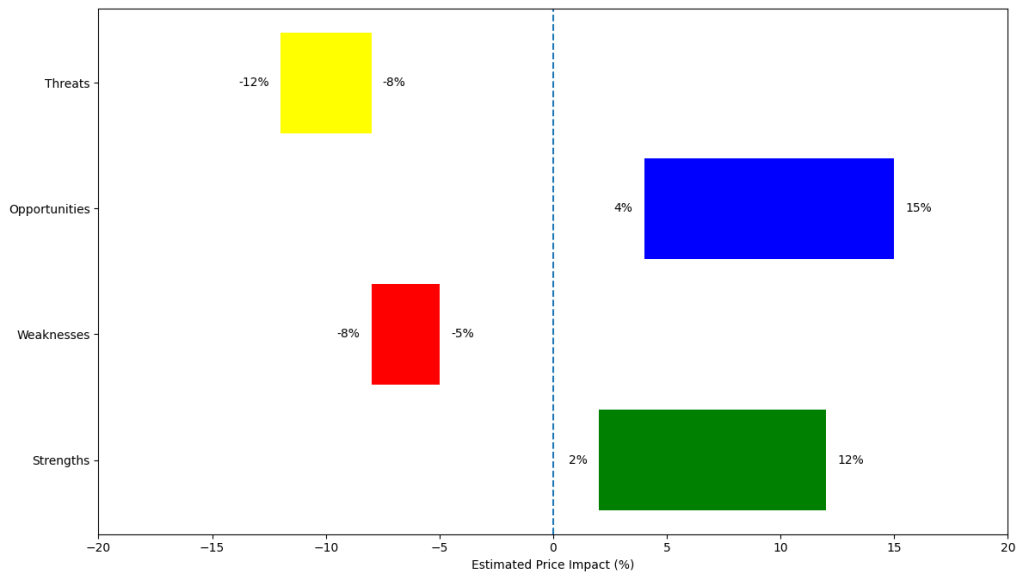
Autodesk heads into 2026 with improving visibility, a stronger ARR engine, and a clearer AI monetization path. The market rewarded the company for delivering above-expectation ARR growth and reinforcing confidence in APS. Risks remain tied to construction cycles, platform migration complexity, and the pace of AI adoption across design workflows.

Strengths (+6% to +12%)

  • Strong ARR growth (+11%) underpins recurring revenue durability and valuation support.
  • Clearer AI roadmap with generative design, automated drafting, and simulation automation.
  • APS platform adoption improves attach rates and expands monetization layers.
  • EPS upside from disciplined cost structure and stable margins.
  • High switching costs across AEC and manufacturing keep retention rates above 100%.

Weaknesses (–3% to –7%)

  • Slight billings deceleration may temper short-term revenue acceleration.
  • AI monetization still early; revenue uplift remains modest for FY2026.
  • AEC macro remains mixed, affecting forward demand visibility.
  • SMB customers remain rate-sensitive, limiting seat expansion.
  • FX remains a drag on international results.

Opportunities (+8% to +15%)

  • AI-assisted design could enable multi-year ARPU expansion across core products.
  • Cloud platform transition (APS) unlocks higher-margin service layers.
  • Manufacturing automation demand supports Fusion 360 growth.
  • Global infrastructure digitization gives long-term AEC tailwinds.
  • Enterprise bundling increases deal sizes and contract duration.

Threats (–8% to –14%)

  • High valuation sensitivity: small ARR misses can lead to multiple compression.
  • AI-first CAD/BIM startups could challenge Autodesk’s pricing power.
  • Regulatory constraints around AI training data may slow product rollout.
  • Construction downturn risk could reduce seat expansions.
  • APS migration execution risks could create customer friction.

Valuation Scenarios

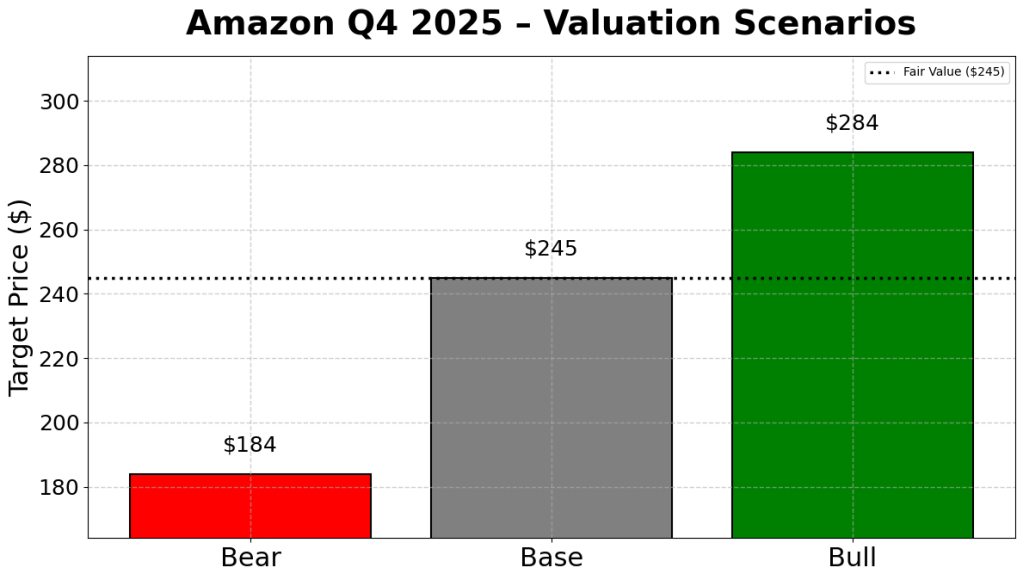
Autodesk’s valuation depends on the sustainability of ARR growth and the degree to which AI-enabled workflows improve ARPU. With APS adoption and AI clarity increasing, the base case assumes solid recurring revenue momentum and steadily improving free cash flow.

Bear Case — $265

  • ARR slows to 8%.
  • AI monetization slips into late 2027+.
  • Billings decelerate further.
  • Market rerates ADSK to a lower FCF multiple (20–22×).
  • FCF $1.9B × 22× = $265

Base Case — $305

  • ARR maintains 10–11% growth.
  • APS adoption remains strong.
  • Early AI features support modest 2026 ARPU uplift.
  • Market assigns a 24–25× FCF multiple.
  • $2.1B × 24.5× = $305

Bull Case — $345

  • AI tools drive meaningful ARPU expansion.
  • ARR accelerates to 12–13%.
  • Margins expand through automation and bundling.
  • FCF grows to $2.3B at a 27× multiple.
  • $2.3B × 27× = $345

Fair Value

= (0.25×265) + (0.50×305) + (0.25×345)
$305 fair value

Valuation scenarios chart for Autodesk Q3 FY2026 showing Bear ($265), Base ($305), and Bull ($345) price targets with a dashed fair value line at $305.

Verdict

Autodesk is transitioning into a higher-visibility, AI-enhanced software platform. Q3 FY2026 showcased the strength of its recurring model and provided the clearest AI roadmap yet. With ARR reaccelerating and APS gaining momentum, ADSK deserves a premium valuation — but near-term upside depends on the pace of AI adoption and the execution of platform migration.

At $305 fair value, Autodesk looks fairly priced with balanced risk-reward. Growth investors should monitor AI feature launches and renewal behavior as the key catalysts for FY2027 upside.


Call to Action

If you found this analysis useful, follow SWOTstock for more earnings breakdowns, valuation scenarios, and AI-driven insights tailored for long-term investors. New posts drop every week covering tech, AI infrastructure, and software compounding names.


Disclaimer

This article is for informational purposes only and does not constitute financial advice. All analysis is based on publicly available information from Autodesk’s official Q3 FY2026 financial report and earnings call. Investors should perform their own due diligence before making investment decisions.


Dell Q3 FY2025 — AI Servers Accelerate, PCs Drag, and the Stock Finds Its Fair Value

Dell’s Q3 FY2025 results showcased strong AI server demand, with revenue at $23.6B and a 9% increase in operating income. However, PC sales dropped 12%, causing a 6% stock decline post-earnings. Value investors may find it appealing as it trades near a fair value of $101, with potential growth linked to the 2026 AI PC refresh cycle.

TL;DR Summary

Dell delivered a mixed but stable Q3 FY2025 as AI servers continued to surge while the PC business remained weak. Revenue came in slightly light, yet strong ISG momentum and solid free cash flow pushed the stock from $125.92 to roughly $130 after hours. Management guided to better margins in Q4, reinforcing the view that Dell is entering a more stable phase as AI infrastructure demand grows. Our fair value estimate stands at $135, with upside tied to ISG mix improvement and the 2026 AI PC refresh cycle.


Quarter Recap

Dell reported Q3 FY2025 results on November 25, 2025, showing a company in transition. Revenue dipped modestly year over year, but ISG continued to deliver meaningful AI-driven strength. CSG remained a drag as PC shipments declined, though management noted early signs of stabilization. Free cash flow held up well, and Dell reiterated its commitment to capital returns through buybacks. Investors reacted positively, pushing the stock up about 3% in after-hours trading.


Key Highlights

  • AI servers were the standout again, driving growth in ISG and building a multi-quarter backlog.
  • PC revenue declined double digits, pressuring overall margins.
  • Management expects sequential margin improvement in Q4 as mix normalizes.
  • Free cash flow remained resilient, anchoring Dell’s valuation.
  • APEX and recurring-revenue models continued to gain traction, though still a smaller contributor.

SWOT Analysis

Dell’s investment case sits at the intersection of a cyclical PC recovery and a structurally expanding AI infrastructure market. The company’s cash flow profile and strong enterprise relationships give value-focused investors a stable foundation, while ISG’s AI momentum provides upside optionality. Below is the SWOT snapshot with estimated price impacts.

Strengths (+6% to +12%)

  • AI server demand accelerating with solid backlog visibility
  • Strong free cash flow supporting continued buybacks
  • Deep enterprise relationships and scale as AI workloads expand
  • Improving Q4 margin outlook based on mix normalization

Weaknesses (–4% to –8%)

  • PC revenue remains in decline, dragging blended margins
  • ISG profitability still volatile due to mix-shift in AI servers
  • Guidance remains conservative, capping near-term sentiment

Opportunities (+8% to +15%)

  • 2026 enterprise AI PC refresh cycle
  • Growing on-prem AI infrastructure demand
  • Higher-margin recurring revenue through APEX
  • Margin expansion potential as AI server costs normalize

Threats (–10% to –18%)

  • Hyperscaler spending cycles remain uneven
  • Potential margin compression from rapid AI mix growth
  • Macro uncertainty affecting corporate capex
  • Competitive pricing pressure across ISG
SWOT price-impact range chart for Dell Q3 FY2025 showing Strengths (+6% to +12%), Weaknesses (–8% to –4%), Opportunities (+10% to +18%), and Threats (–14% to –8%), displayed as horizontal color-coded bars with a vertical zero reference line.

Valuation Scenarios

Our valuation models focus on Dell’s cash flow durability, ISG margin trajectory, and the timing of a PC recovery. We outline three scenarios below, each grounded in Dell’s official Q3 financials and management commentary.

Bear Case — $118

  • AI server growth slows; ISG margins stay volatile
  • PC recovery delayed beyond FY2026
  • Lower EBITDA and discounted cash flow assumptions

Base Case — $134

  • AI server demand remains strong; ISG margins stabilize
  • CSG begins to recover in late 2026
  • Mid-cycle EBITDA multiple applied

Bull Case — $152

  • Accelerating AI infrastructure adoption drives ISG margin uplift
  • Faster AI PC refresh cycle boosts CSG
  • Higher FCF and premium EBITDA multiple

Probability-Weighted Fair Value

  • Bear (25%): 118
  • Base (50%): 134
  • Bull (25%): 152

Final Fair Value: $135

Valuation scenarios chart for Dell Q3 FY2025 showing Bear ($118), Base ($134), and Bull ($152) price targets in colored vertical bars with a dashed fair-value line at $135.

Verdict

Dell’s Q3 results reaffirmed the company’s position as a cash-generating value story with meaningful AI-driven upside. While PCs remain soft, ISG’s momentum and solid Q4 guidance signal a path toward a more balanced and profitable FY2026. At current levels, Dell appears fairly valued around $135, with favorable risk-reward for long-term investors seeking stable cash flow and measured AI exposure.


Call to Action

If you find this breakdown helpful, follow SWOTstock for more AI-focused earnings analysis, valuation updates, and investor-friendly insights across the U.S. equity market.


Disclaimer

This article is for informational purposes only and does not constitute financial advice. All analysis is based solely on official company filings, earnings reports, and management commentary. Investors should conduct their own due diligence or consult a financial advisor before making investment decisions.


Microsoft Q1 FY2026 — AI Demand Outruns Supply as Azure Surges 29%

Microsoft’s Q1 FY2026 results highlight strong performance, including a 15% revenue growth to $65.7 billion and a 29% surge in Azure, driven by AI adoption. Operating income rose 18%, emphasizing margin strength despite high capex. The stock increased by over 4%, reflecting confidence in Microsoft’s enterprise AI leadership with a fair value estimate of $453 per share.

TL;DR Summary

Microsoft (MSFT:NASDAQ) delivered another powerful AI-driven quarter, with Azure accelerating to 29% growth and Copilot adoption scaling across enterprise workloads. Operating income rose faster than revenue, confirming strong margin leverage even amid elevated AI datacenter spending. The stock jumped over 4% after earnings, reflecting confidence that Microsoft remains the most durable platform for enterprise AI. Our fair value estimate is $453 per share, slightly above current levels.


Quarter Recap

Microsoft’s Q1 FY2026 results showcased a company benefitting from the early waves of enterprise AI adoption while managing the heavy capex load required to stay ahead of demand. Revenue grew 15% to $65.7 billion, supported by broad-based strength across cloud, productivity, and personal computing. Azure was the standout, accelerating to 29% YoY growth as AI workloads—training, inference, and agent-based tasks—continue to scale. Operating income rose 18% to $28.3 billion, showing that Microsoft is leveraging its size and product mix to offset surging datacenter investments. Earnings per share came in at $3.05, ahead of expectations, driven by robust cloud profitability and disciplined spending.


Key Highlights

  • Azure +29% YoY, driven by AI infrastructure and inference workloads
  • Copilot adoption accelerating across Office, GitHub, and Dynamics
  • Operating income +18% YoY, showing durable profitability
  • Management reiterated: “AI demand continues to exceed supply”
  • Datacenter and GPU capex remains elevated through FY2026
  • Stock jumped +4.4% after Q1 results

SWOT Analysis

Microsoft’s Q1 FY2026 results reinforced its position as the leading enterprise AI ecosystem. Azure’s accelerating growth, combined with expanding Copilot monetization, offers a unique blend of scale, stickiness, and margin durability. Yet, high AI capex and growing competition across cloud and AI infrastructure remain key risks to monitor.

Strengths (+6% to +12%)

  • AI infrastructure leadership with Azure +29% YoY
  • Rapid Copilot monetization across Microsoft 365, GitHub, and Dynamics
  • High enterprise switching costs and long-term retention
  • Operating income growing faster than revenue

Weaknesses (–4% to –8%)

  • Heavy, multi-year datacenter and GPU capex
  • Strategic dependence on OpenAI technology stack
  • Enterprise budget pressure from rising AI software costs
  • Ongoing regulatory scrutiny in the US and EU

Opportunities (+10% to +18%)

  • Copilot becoming the default enterprise AI agent
  • Azure gaining share as AWS growth slows
  • AI PC upgrade cycle expected in 2026
  • Higher-tier subscriptions in security and developer tools

Threats (–8% to –14%)

  • Risk of AI capacity oversupply compressing hyperscaler margins
  • Cloud and AI competition from AWS, Google Cloud, Oracle
  • Rising adoption of open-source AI models
  • Geopolitical tech restrictions affecting supply chains
Microsoft Q1 2026 SWOT analysis chart showing estimated stock price impact ranges for strengths, weaknesses, opportunities, and threats, with a horizontal bar layout and x-axis starting from –20.

Valuation Scenarios

Our valuation framework incorporates Microsoft’s AI momentum, Azure growth trajectory, and margin durability to model a Bear, Base, and Bull scenario. Each scenario includes explicit growth and margin assumptions tied to EPS and forward multiples.

Bear Case — $385 (25%)

  • Azure growth slows to mid-20%
  • AI monetization ramps slower than expected
  • Margins compressed by elevated capex
  • Valuation: 25× forward EPS of ~$15.40 → $385

Base Case — $455 (50%)

  • Azure steady at ~27–29%
  • Strong enterprise AI adoption
  • Stable operating margins
  • Valuation: 29× forward EPS of ~$15.70 → $455

Bull Case — $515 (25%)

  • Azure growth surpasses 30%
  • Copilot becomes core enterprise AI layer
  • Higher-margin subscription mix expands
  • Valuation: 32× forward EPS of ~$16.10 → $515

Probability-Weighted Fair Value

→ $453 per share

Microsoft Q1 2026 valuation scenarios chart showing Bear, Base, and Bull price targets with a dashed fair value line at $453, displayed in red, gray, and green vertical bars.

Verdict

Microsoft remains the most structurally advantaged enterprise AI platform. Azure’s acceleration to 29% growth validates the demand narrative, and early Copilot adoption shows enterprises are already willing to pay for AI productivity gains. The biggest risk remains the scale of AI-related capex, but so far profitability is holding up strongly. With a probability-weighted fair value of $453, Microsoft remains slightly undervalued for long-term AI-focused investors.


Call to Action

If you found this analysis helpful, follow SWOTstock for more AI-focused quarterly breakdowns of the world’s most important companies. We cover earnings, valuation scenarios, and management commentary in a simple, investor-friendly format.


Disclaimer

This analysis is for informational and educational purposes only and does not constitute financial advice. Investing involves risk, including potential loss of principal. Please conduct your own research or consult a qualified financial professional before making investment decisions.