Microsoft Q3 FY25: Strong AI Momentum, But Is the Stock Already Fully Priced?

Microsoft’s Q3 FY25 earnings beat expectations with strong Azure and AI growth. This in-depth analysis includes key highlights, SWOT breakdown, and stock valuation scenarios to help investors decide if MSFT is a buy, hold, or overvalued. Based only on official financials and earnings call.

Quick Take: Microsoft’s Q3 FY25 at a Glance

Microsoft’s Q3 FY25 earnings beat expectations across the board, driven by Azure’s 23% growth and rising Copilot adoption. Margins expanded, and management sounded confident about long-term AI monetization. But with the stock trading at $435, much of that optimism may already be priced in. Our analysis suggests the stock is fairly valued with limited upside unless Copilot monetization accelerates further.


Quarter Recap

Microsoft reported another strong quarter, with revenue reaching $70.1 billion, up 13% year-over-year. Net income rose 18% to $25.8 billion, and EPS hit $3.46—up 18% from last year. The standout performer was Azure, which grew 23% in constant currency, with about 16 percentage points attributed to AI-related services.

CEO Satya Nadella emphasized “material AI usage revenue” and confirmed that Copilot adoption is broadening across Microsoft 365, GitHub, and Dynamics. Despite ramping up AI infrastructure investments (CapEx of $14 billion this quarter), Microsoft maintained strong operating margins at 46%.

This quarter matters because it signals that Microsoft is not just leading in AI hype—it’s beginning to turn that momentum into revenue and margin growth.


Key Highlights

  • Revenue: $70.1B (+13% YoY)
  • Net Income: $25.8B (+18% YoY)
  • EPS: $3.46
  • Azure Growth: +23% YoY (16 pts from AI)
  • Operating Margin: 46%
  • Microsoft 365 Commercial Revenue: +12%
  • CapEx: $14B
  • Free Cash Flow: $20.3B
  • RPO (future revenue backlog): $315B (+34% YoY)

SWOT Analysis: What’s Behind the Numbers

Let’s break it down using the simple SWOT framework—what’s going well, what’s not, where the upside is, and what risks could derail the story.


Strengths

Microsoft’s cloud and AI strategy is clearly working. Azure’s 23% growth—with AI workloads driving more than half that—shows early returns on heavy AI investments. Commercial bookings and RPO (future revenue) are growing fast, and the company has scaled its margin even while expanding CapEx.

Estimated stock impact: If sustained, these results could support a +$20–30/share uplift in fair value.


Weaknesses

The More Personal Computing segment is still sluggish. Windows OEM and Surface revenue posted modest gains (3–5%), and Copilot monetization—while promising—is still early. Some segments may weigh on overall revenue growth if cloud doesn’t continue to outperform.

Estimated impact: A drag on future growth could shave –$5 to –$10/share off fair value.


Opportunities

The biggest upside? AI monetization. Microsoft is embedding Copilot across every product—Office, GitHub, Dynamics—and that creates an enormous paid seat opportunity. With 430M Microsoft 365 commercial seats, even modest Copilot adoption could unlock billions in new revenue.

Estimated impact: If realized at scale, this could add +$30–50/share to valuation over time.


Threats

Valuation is the elephant in the room. Microsoft is trading at 33x forward earnings—well above its 10-year average of 26x. That’s a premium for perfection. If AI adoption underwhelms or regulation slows the rollout, the stock could de-rate quickly.

Estimated downside: In a bearish scenario, risks could cut –$40–60/share off the stock.


SWOT Summary Table

CategoryHighlightsEst. Price Impact
StrengthsAzure + AI growth, strong margins+$20–30
WeaknessesPC revenue lag, early-stage Copilot monetization–$5 to –$10
OpportunitiesAI monetization across Microsoft ecosystem+$30–50
ThreatsRich valuation, regulatory headwinds–$40–60

Valuation Scenarios

Based on these insights, here’s how the stock could play out in three different scenarios:

Base Case (Most likely)

  • Summary: Azure continues strong, AI monetization grows gradually, margins hold
  • Fair Value: $412
  • Probability: 50%

Bull Case

  • Summary: Copilot adoption surges, AI margins expand, regulation minimal
  • Valuation: $476
  • Probability: 30%

Bear Case

  • Summary: AI monetization lags, CapEx overwhelms margins, P/E compresses
  • Valuation: $336
  • Probability: 20%

Weighted Average Estimate

(412 × 0.5) + (476 × 0.3) + (336 × 0.2) = 206 + 142.8 + 67.2 = \textbf{$416/share}

Current Price: $435
Estimated Fair Value: $416
Implied Overvaluation: ~4.3%


Verdict

At $435, Microsoft stock appears slightly overvalued, with much of the AI success already priced in. That doesn’t mean it’s a sell—but it suggests a hold for long-term investors and a wait-for-a-better-entry for new buyers.

If you believe Copilot will be as transformative as Office or Azure, the bull case may still hold. But in the near term, upside looks limited unless Microsoft significantly accelerates AI monetization.

Final Call: Fair to mildly overvalued. Hold.


Call to Action

Want simple, no-fluff breakdowns like this delivered before the headlines hit?
Subscribe now at SWOTstock.com and get our next earnings deep dive straight to your inbox.


Disclaimer

This post is based solely on Microsoft’s official Q3 FY25 financial report and earnings call transcript. It does not constitute investment advice. Please conduct your own research or consult a financial advisor before making any investment decisions.

Leave a comment

Apple Q2 2025 Earnings: Strong Profits, Bigger Buybacks—But Is There Still Long-Term Upside?

Apple’s Q2 2025 earnings show record profits, a $100B buyback, and solid long-term fundamentals. See SWOT analysis, valuation scenarios, and what long-term investors need to know.

What Long-Term Investors Should Take From Apple’s Latest Earnings Report

If you’re building a long-term portfolio, Apple likely has a place in it. But with the stock near $183 and the company posting record earnings in Q2 2025, the question becomes: is Apple still a smart hold—or has most of the upside already been priced in?

Let’s break it down clearly and factually using Apple’s own numbers from its earnings report and investor call.


Consistency You Can Count On: Apple’s Q2 2025 in Context

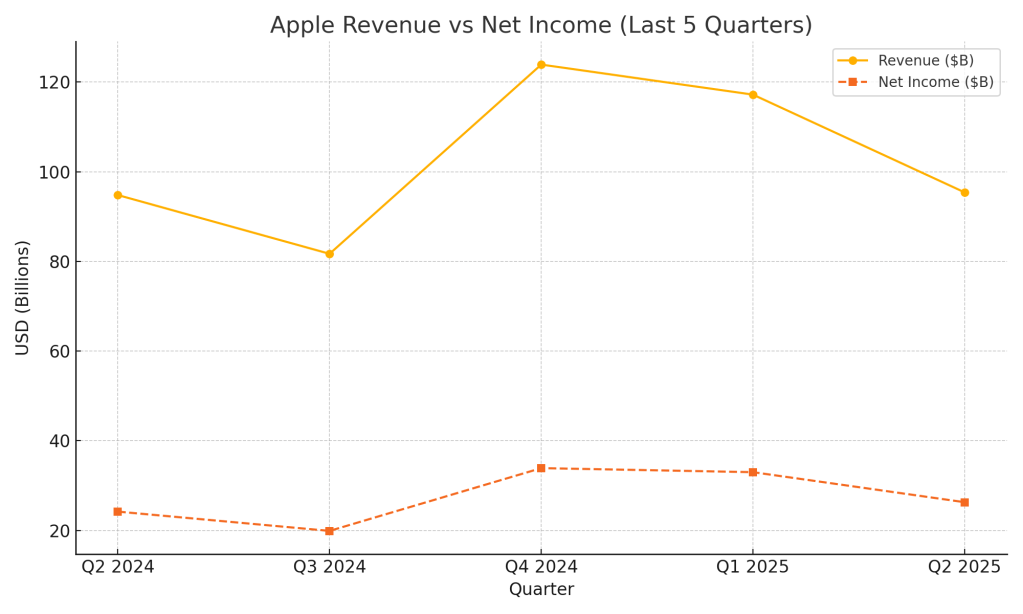
Apple reported $95.4 billion in revenue, a 5% increase year-over-year, and delivered an EPS of $1.65, up 8%—the highest ever for a March quarter. The company also continued returning capital to shareholders at scale: $29 billion was distributed this quarter through buybacks and dividends.

For long-term holders, this quarter shows why Apple remains one of the most reliable compounders in the market:

  • Services revenue hit a new record at $26.6B, growing 12% YoY.
  • Mac and iPad sales both grew, reversing previous softness.
  • iPhone revenue held steady, up 2%, despite global macro pressures.
  • A new $100 billion buyback program was authorized, further enhancing shareholder value.

These are not flashy numbers—they’re the kind of consistent results that build wealth over time.


Long-Term Growth in Action: What the Last 5 Years Say

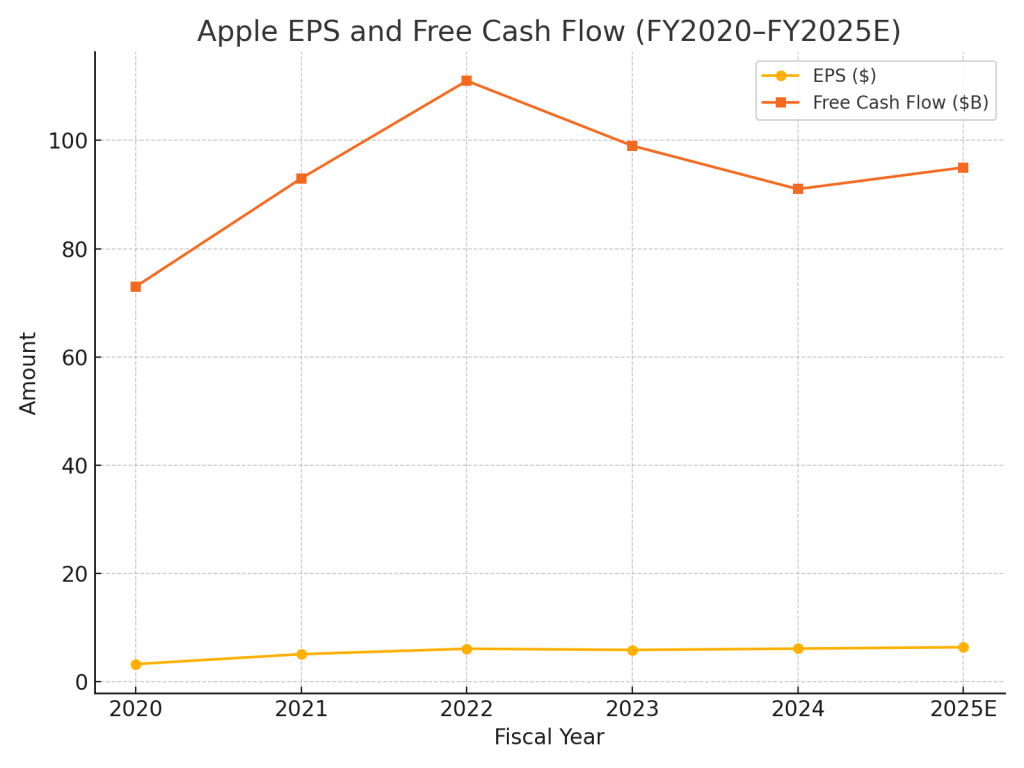
Apple’s steady growth is no accident. EPS has grown from $3.28 in FY2020 to an expected $6.40 in FY2025, nearly doubling in five years—despite global challenges.

Free cash flow has remained consistently above $90 billion annually, allowing for uninterrupted buybacks and dividend growth. This consistency is why Apple continues to anchor many long-term portfolios.

Line chart of Apple EPS and free cash flow from fiscal year 2020 to projected 2025, showing consistent financial growth

Key Metrics That Matter

MetricQ2 2025 ResultYoY Change
Revenue$95.4B+5%
EPS$1.65+8%
Free Cash Flow$24BSteady
Services Revenue$26.6B+12%
iPhone Revenue$46.8B+2%
Dividend$0.26/share+4%
Buyback Authorization$100BNew
Line chart showing Apple’s quarterly revenue and net income from Q2 2024 to Q2 2025, highlighting growth trends and profitability patterns

What Could Move the Stock: SWOT Breakdown

Understanding the strengths and risks from Apple’s own disclosures can help investors evaluate where the stock might go from here.

Strengths – Durable Growth and Massive Capital Returns

Apple is a cash machine. Record EPS, strong services performance, and a $100B buyback point to continued shareholder value creation.

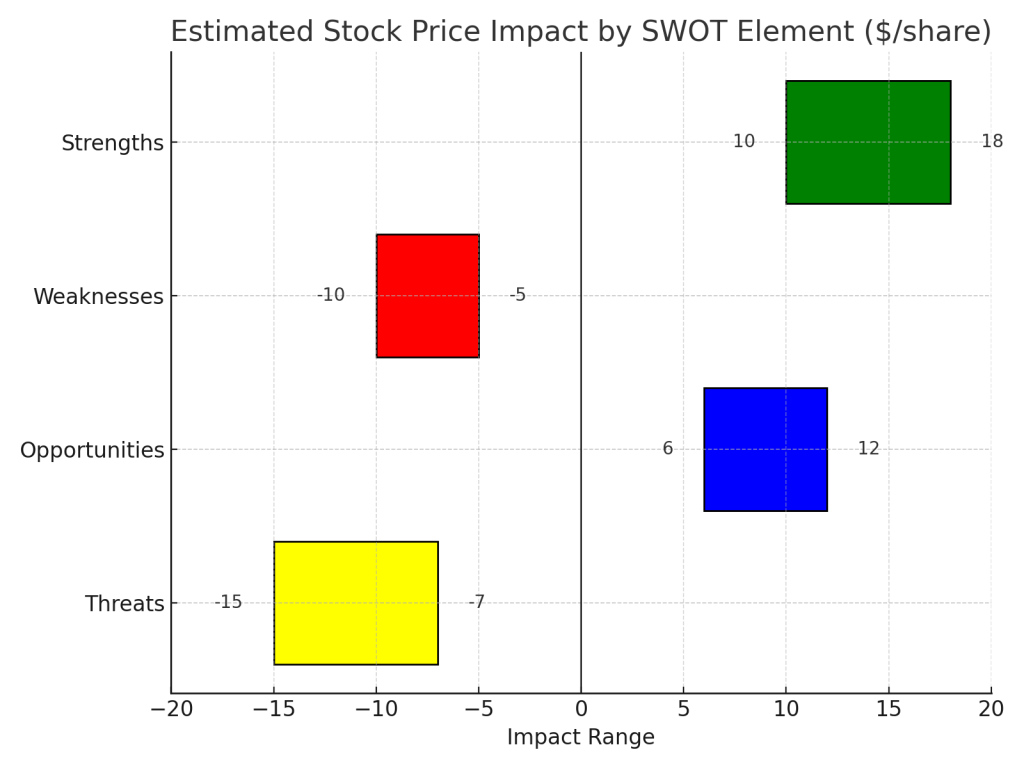
Stock Price Impact Estimate: +$10 to +$18

  • Recurring high-margin revenue from services
  • Growing installed base across all regions
  • Buyback program supports share price

Weaknesses – Margin Pressure and Regional Slowdowns

Gross margins dipped this quarter, and revenue in China declined slightly. Wearables also underperformed against last year’s strong launch cycle.

Stock Price Impact Estimate: –$5 to –$10

  • FX and input cost headwinds
  • Gross margin contraction (down 340 bps)
  • Regional weakness in China and wearables

Opportunities – AI, Global Scale, and Supply Chain Shift

Apple Intelligence and Siri upgrades may drive the next hardware upgrade cycle. At the same time, Apple is shifting production for U.S. sales to India and Vietnam to reduce risk.

Stock Price Impact Estimate: +$6 to +12

  • Growth in international services markets
  • Supply chain resilience reduces geopolitical risk
  • New AI features deepen ecosystem loyalty

Threats – Tariffs and Legal Scrutiny

Apple faces $900M in tariff costs in the next quarter and is still navigating legal risks around its App Store practices.

Stock Price Impact Estimate: –$7 to –$15

  • Near-term margin hit from trade policy
  • Long-term impact from regulatory rulings
  • FX volatility in key markets

SWOT Summary

CategoryKey DriversEst. Stock Impact
StrengthsRecord EPS, services growth, $100B buyback+10 to +18
WeaknessesGross margin pressure, China softness–5 to –10
OpportunitiesAI integration, global services, supply chain shift+6 to +12
ThreatsTariffs, legal pressure, FX risks–7 to –15
Apple Q2 2025 SWOT analysis chart showing estimated stock price impact ranges for strengths, weaknesses, opportunities, and threats from -20 to 20 dollars

Valuation Scenarios: What’s the Long-Term Fair Value?

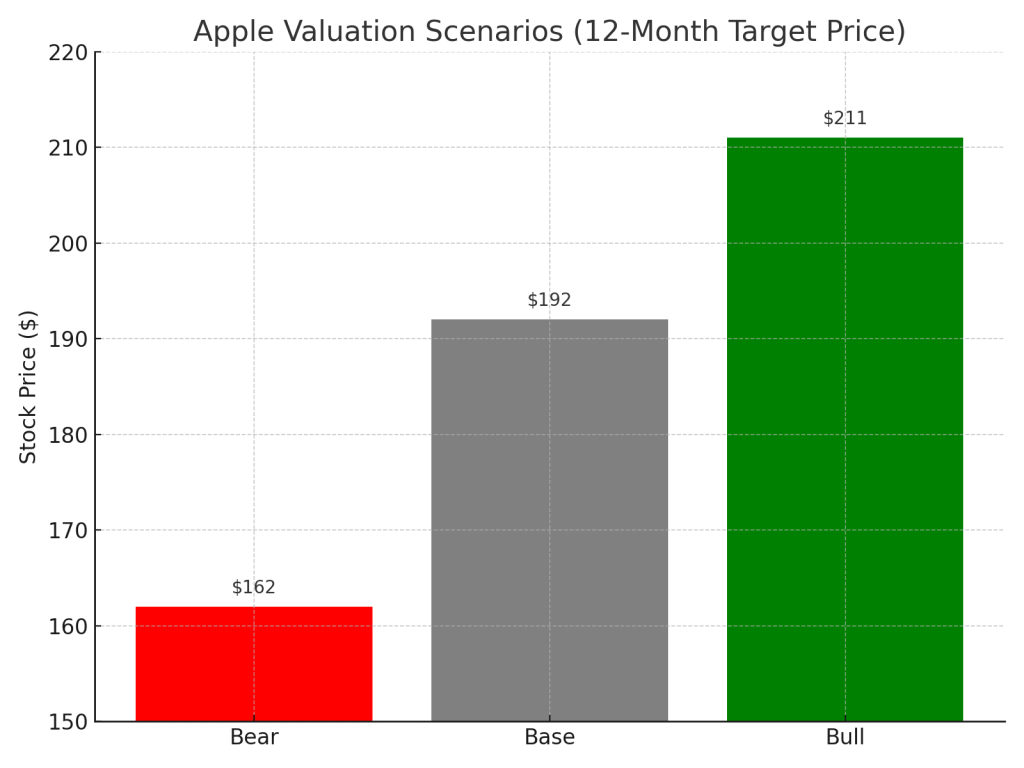
Apple’s fundamentals suggest a forward EPS of $6.40. Using long-term average P/E multiples, here are three valuation outcomes:

ScenarioEPSP/ETarget PriceProbability
Bull6.7531.3$21130%
Base6.4030.0$19250%
Bear6.1026.5$16220%

Weighted Fair Value: ~$191.7/share

Bar chart showing Apple Q2 2025 stock valuation scenarios for bull, base, and bear cases with estimated prices of 211, 192, and 162 dollars

At the current price of ~$183, Apple appears slightly undervalued, with 4–5% upside in the base case. For long-term investors, this aligns with steady, risk-adjusted growth—not hype-driven returns.


Should You Wait for a Better Entry?

At around $183, Apple trades near its weighted fair value of ~$191.7. That suggests limited short-term upside, but not overvaluation.

If you’re building a position or adding, a price closer to $175 may offer a more attractive risk-reward ratio, based on:

  • Base case fair value estimate of $192
  • Recent support levels and volatility range
  • Tariff risks temporarily weighing on sentiment

This doesn’t mean you need to wait—but it provides a disciplined approach if you’re cost-sensitive.


Final Take: Still a Core Holding for Long-Term Portfolios

Apple remains a model of long-term stability. It won’t double overnight, but it doesn’t need to. With strong cash flow, deep ecosystem loyalty, and AI expansion ahead, it’s a smart hold or buy-on-dips candidate for any long-term portfolio.


Want More No-Nonsense Stock Breakdowns?

We focus on what matters: financial results, strategy, and stock implications—without spin.
Subscribe to SWOTstock for clean, clear earnings analysis. Or follow us on Instagram @SWOTstock for mobile-friendly snapshots and updates.


Disclaimer

This blog is based solely on Apple’s official Q2 2025 financial report and earnings call. It is not investment advice. Always evaluate your own risk before investing.


Leave a comment

Meta Q1 2025 Earnings: AI Surge, Profit Growth—But Is META Stock Fully Priced In?

Meta’s Q1 2025 results highlight a 16% revenue increase to $42.31 billion and a 35% rise in net income, reaching $16.64 billion. User growth in Meta AI and Threads was substantial, with over 1 billion and 350 million users, respectively. Despite high capital expenditures and losses in Reality Labs, the stock seems fairly valued at $572.

TL;DR – Meta’s Growth Story Looks Real, But the AI Payoff Is What Matters Now

Meta (NASDAQ: META) reported a solid quarter with double-digit revenue and profit growth, driven by strong platform engagement and early momentum from its AI rollout. The company is investing heavily in infrastructure and innovation—but faces growing pressure to turn those investments into monetized outcomes. At current levels, the stock looks reasonably valued, with upside if AI and Threads translate into durable revenue streams.


Quarter Recap – A Strong Start to 2025, Anchored in AI and Efficiency

Meta kicked off 2025 with a confident earnings report, signaling both financial strength and strategic clarity. Total revenue rose 16% year-over-year to $42.31 billion, while net income surged 35% to $16.64 billion, reflecting higher operating efficiency. The company’s operating margin improved to 38%, up from 33% a year ago—an encouraging sign that Meta is scaling profitably even while reinvesting in growth.

The core theme from the earnings call was unmistakable: AI is no longer an R&D project—it’s central to Meta’s product strategy. CEO Mark Zuckerberg emphasized that Meta AI is now integrated across major platforms like Instagram, WhatsApp, and Messenger, reaching nearly 1 billion monthly active users. Meanwhile, Threads—Meta’s challenger to X—is building momentum with 350 million MAUs and a growing developer toolkit.

But the quarter wasn’t without friction. Capital expenditures were sharply revised upward, and losses in Reality Labs continue to weigh on sentiment. Still, the overall tone from management was forward-looking, emphasizing long-term platform value and leadership in AI infrastructure.


Meta Earnings: Key Financial Highlights

  • Revenue: $42.31B (+16% YoY)
  • Net income: $16.64B (+35% YoY)
  • Operating margin: 38%
  • Capital expenditures: $13.69B in Q1; FY forecast raised to $64–$72B
  • Meta AI monthly users: ~1 billion
  • Threads monthly active users: 350M+
  • Reality Labs operating loss: $4.2B
Line chart showing Meta Platforms' revenue, net income, and capital expenditures over five quarters through Q1 2025

Meta AI and Threads: User Growth Trends

Meta AI and Threads have shown strong user adoption over the past five quarters. Meta AI reached nearly 1 billion users, while Threads surpassed 350 million.

Meta AI and Threads user growth chart from Q1 2024 to Q1 2025 showing rising engagement across platforms

SWOT Analysis – Strong Execution, but Investors Want Monetization

Let’s step back and view Meta’s quarter through a SWOT lens to understand the moving pieces—from execution strengths to the potential tailwinds and risks that will shape the stock’s next leg.

Bar chart displaying estimated stock price impact of Meta’s strengths, weaknesses, opportunities, and threats

Strengths

Meta continues to deliver where it counts—profitable growth, improving margins, and user scale. The integration of Meta AI across its family of apps shows real traction, and early signals from Threads are stronger than many expected. The financial discipline underpinning the quarter suggests Meta can maintain performance even amid heavy reinvestment.

💰 Price impact estimate:
If current execution continues and AI traction sustains, this could support a +15 to +20 point uplift in the share price over the next few quarters.


Weaknesses

Despite the strong fundamentals, Meta’s CapEx trajectory is drawing scrutiny. The company is now forecasting $64B–$72B in 2025 capital spending, largely tied to AI infrastructure and custom silicon development. That’s a massive commitment—one that only pays off if monetization follows. Meanwhile, Reality Labs posted another $4.2B loss, with no clear commercial wins in sight. Lastly, advertising remains ~96% of total revenue, making the business model sensitive to economic cycles.

📉 Price impact estimate:
These structural weaknesses could cap near-term valuation expansion by –$5 to –$10 if they persist without clearer returns.

Opportunities

The biggest catalyst on the horizon is AI monetization. Meta has multiple vectors to pursue: consumer-facing AI assistants, developer APIs built on Llama 3, ad personalization powered by real-time inference, and an open-source AI ecosystem that could challenge OpenAI’s and Google’s closed models. Threads could also evolve into a standalone growth engine, particularly if Meta builds a differentiated ad product for it.

🚀 Upside potential:
If even part of this vision materializes, we could see +25 to +40 points added to fair value estimates.

Threats

As Meta’s influence in AI and digital infrastructure grows, so does regulatory attention. The EU’s Digital Markets Act and FTC scrutiny in the U.S. remain open fronts, and legal action could impact product features, data policy, or monetization timelines. At the same time, competition is intensifying—Google, OpenAI, Apple, and Microsoft are all doubling down on AI, each with unique strengths. Add in macro risk (a pullback in ad spend, for example), and Meta’s story becomes more fragile than the numbers might initially suggest.

⚠️ Risk estimate:
If multiple threats crystallize at once, the stock could decline by –$20 to –$30 per share from current levels.

SWOT summary table for Meta Q1 2025 earnings, showing strengths (+15 to +20 impact), weaknesses (–5 to –10), opportunities (+25 to +40), and threats (–20 to –30), with notes on AI scale, CapEx, monetization, and regulatory risks.

META Stock Valuation Forecast: Bull, Base, and Bear Cases

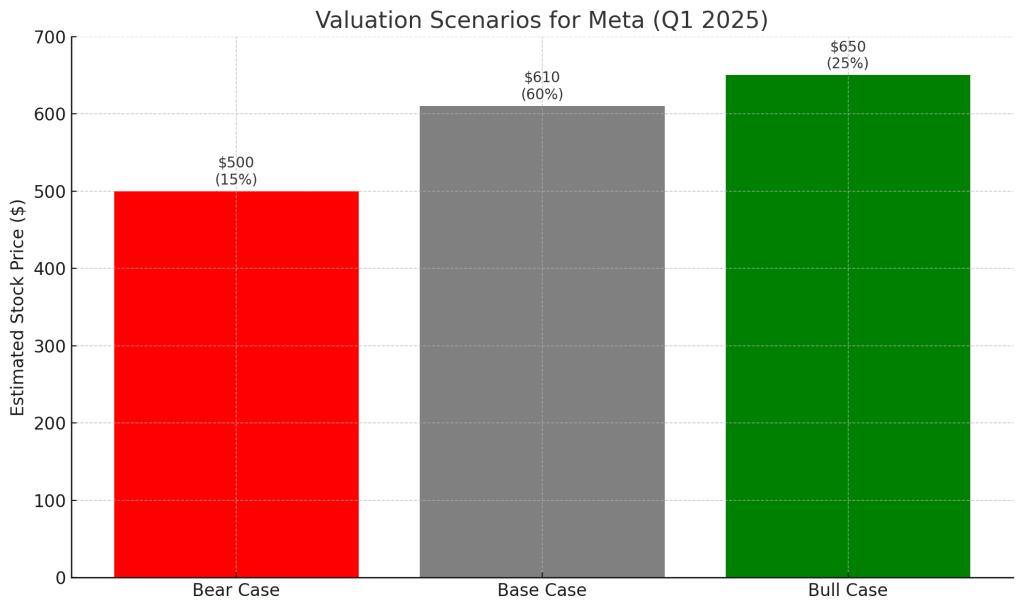
Based on Q1 data and forward guidance, here are potential outcomes for Meta’s stock price:

Bar graph showing Meta’s stock price forecast under base, bull, and bear case scenarios for Q1 2025

Base Case (60% Probability)

  • Continued margin strength, stable ad growth
  • Fair Value Estimate: $610

Bull Case (25% Probability)

  • AI monetization and Threads acceleration exceed expectations
  • Valuation: $650

Bear Case (15% Probability)

  • Weak AI ROI, regulatory pressure, margin compression
  • Valuation: $500

Weighted Average Valuation: (610 × 0.6) + (650 × 0.25) + (500 × 0.15) = $602.5


Is Meta Stock Fairly Valued After Q1 2025?

Meta’s Q1 2025 performance is robust, showing both operational strength and ambitious long-term vision. With strong engagement metrics and margin expansion, the stock appears fairly valued to slightly undervalued at $572. Risks remain, especially around spending and monetization, but Meta’s scale and pace of innovation provide a long growth runway.


Stay Informed: Subscribe for More Stock Insights

Want clear, data-driven stock insights with no fluff? Follow @SWOTstock and subscribe to our blog for simple breakdowns of every major earnings season.


Disclosure and Research Policy

This analysis is based solely on Meta’s Q1 2025 earnings report and official company call transcript. It is not financial advice. Please do your own research before making investment decisions.


2 responses to “Meta Q1 2025 Earnings: AI Surge, Profit Growth—But Is META Stock Fully Priced In?”

  1. NVIDIA Q1 FY2025: AI Boom Powers Revenue—but Is the Stock Already Fully Priced? – SWOT Stock – Smart Investing Made Simple Avatar

    […] check out our recent breakdowns of AMD Q1 2025, Palantir Q1 2025, Meta Q1 2025 and Alphabet Q1 2025 for more actionable […]

    Like

  2. Uber Q1 2025 Earnings: Strong Profits, Bold Plans, But Is the Stock Price Getting Ahead of Itself? – SWOT Stock – Smart Investing Made Simple Avatar

    […] check out our recent breakdowns of Amazon Q1 2025, Meta Q1 2025, and Alphabet Q1 2025 for more actionable […]

    Like

Leave a comment