
Amazon Q4 2025 Earnings: AI Investment Surge vs Cash Flow Pressure

Amazon’s Q4 2025 performance highlights its transition to an AI infrastructure and cloud profit model, with AWS driving revenue growth despite increased capital expenditure impacting free cash flow. The company shows long-term potential but faces near-term valuation pressures due to heavy investment, presenting a mixed outlook for investors.

TL;DR Summary

Amazon (AMZN:NASDAQ) delivered another quarter showing that it is evolving into an AI infrastructure and cloud profit engine layered on top of global retail scale. AWS continues to expand strongly, retail efficiency is improving, and operating income remains robust. However, free cash flow compressed sharply due to heavy AI-driven capital investment. The market now views Amazon as a long-term AI compounder, but near-term valuation is capped by capex intensity.


Quarter Recap

Amazon reported Q4 2025 revenue growth of 14% year over year, with AWS again acting as the primary profit engine. Operating income expanded despite several one-time charges, and North America retail margins improved as logistics efficiency initiatives continue to bear fruit. At the same time, property and equipment spending surged as Amazon accelerates AI infrastructure buildout.

The key story is investment phase vs monetization phase — the same pattern Amazon followed in prior cloud and logistics expansion cycles.


Key Highlights

• AWS revenue grew strongly, with segment operating income reaching $12.5B in the quarter

• North America retail operating income rose significantly, showing structural efficiency gains

• International profitability remains modest compared to domestic performance

• Operating cash flow continues to expand, but free cash flow declined due to heavy infrastructure spending

• AI-driven capex is the central strategic theme


SWOT Analysis

Amazon is transitioning from a retail-led growth company to a cloud + AI + ecosystem platform company with retail acting as a distribution moat.

Strengths

• AWS remains the dominant earnings driver with strong revenue growth and margin contribution

Estimated price impact: +8% to +12%

• North America retail operating leverage improving through logistics optimization

Estimated price impact: +4% to +7%

• High-margin advertising and ecosystem monetization layered on top of Prime and retail traffic

Estimated price impact: +3% to +5%


Weaknesses

• Free cash flow compression due to aggressive AI and infrastructure investment

Estimated price impact: –5% to –8%

• International retail profitability still uneven

Estimated price impact: –2% to –4%


Opportunities

• AI demand cycle could trigger a multi-year AWS acceleration similar to early cloud growth

Estimated price impact: +10% to +15%

• Logistics network creates durable competitive moat supporting ecosystem monetization

Estimated price impact: +4% to +6%


Threats

• Capex shock risk if AI infrastructure ROI lags expectations

Estimated price impact: –8% to –12%

• Cloud competition and AI infrastructure pricing pressure

Estimated price impact: –4% to –6%
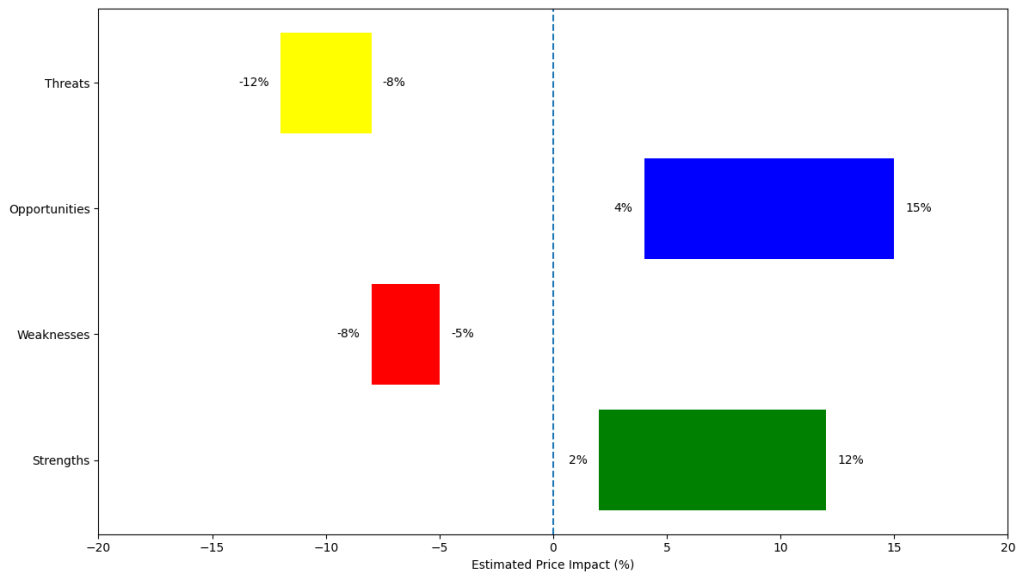
SWOT price impact range chart for Amazon Q4 2025 earnings, showing strengths, weaknesses, opportunities, and threats with estimated percentage impact on stock price.
Amazon SWOT Price Impact Analysis (Q4 2025): AWS growth and AI opportunities drive upside potential, while heavy AI capex and cash flow compression create near-term downside risk.

Valuation Scenarios

Amazon’s valuation now depends on whether the AI investment cycle produces margin expansion or becomes a prolonged cash drain.

Bear Scenario

• AI infrastructure monetization slower than expected

• Free cash flow remains suppressed

• AWS growth moderates

Price outcome: –15% to –20%


Base Scenario

• AWS growth sustains around current pace

• AI workloads drive gradual margin expansion

• Retail margins remain stable

Price outcome: ~+10%


Bull Scenario

• AI cycle mirrors early cloud boom

• AWS re-accelerates strongly

• Advertising and Prime ecosystem margins expand

Price outcome: +25% to +30%


Probability-weighted fair value:

Amazon appears worth ~8–12% above current trading levels
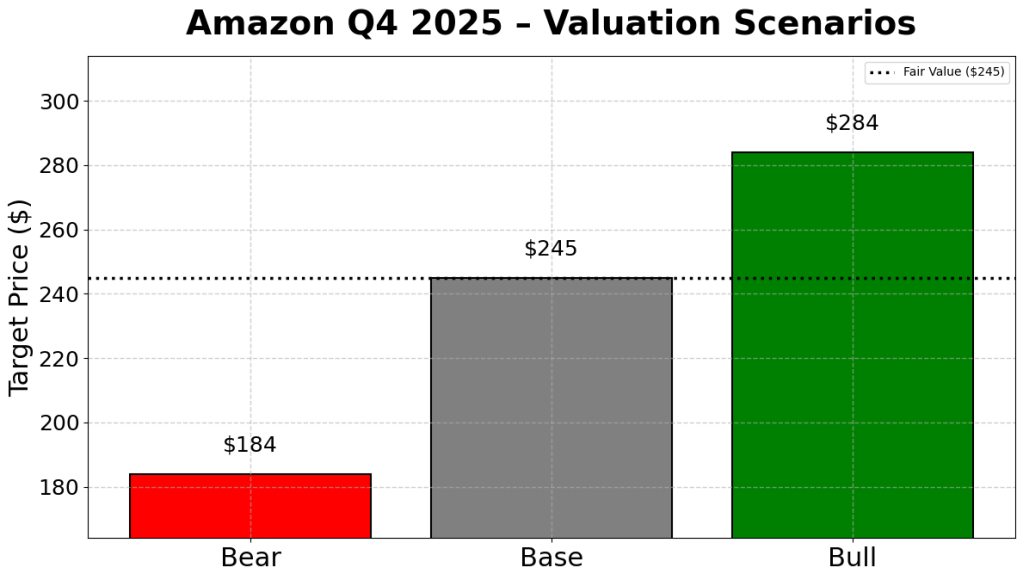
Valuation scenarios chart for Amazon Q4 2025 showing bear, base, and bull target prices with a probability-weighted fair value line.
Amazon Valuation Scenarios (Q4 2025): Bear case reflects AI investment pressure, base case assumes steady AWS growth, and bull case models strong AI monetization, with fair value near the base scenario.

Verdict

Amazon remains a long-term platform compounder, but it is currently in a heavy reinvestment phase. This is not a short-term margin story — it is an infrastructure cycle story. For tech-savvy growth investors, Amazon represents AI infrastructure exposure with ecosystem protection, but patience is required while cash flow is absorbed by buildout.


Call to Action

If you follow platform companies transitioning into AI infrastructure leaders, Amazon is a key case study. Follow SWOTstock for more structured earnings breakdowns focused on real valuation drivers.


Disclaimer

This analysis is for educational purposes only and is not financial advice. Investors should conduct their own research and consider risk tolerance before making investment decisions.


Amazon Q1 2025 Financial Result : Is This the Breakout Year for the Tech Giant?

Amazon’s Q1 2025 earnings reveal strong momentum, with revenue at $143.3 billion, and operating income doubling to $18.4 billion, largely due to AWS’s growth. However, retail faces margin pressures and international uncertainty. Investing in AI and infrastructure may bolster future prospects, but global risks and competition remain significant concerns for investors.

Amazon Q1 2025: What Retail Investors Should Know

Amazon just released its Q1 2025 earnings, and the company is showing some serious momentum. But for everyday investors, the real question is: what do these numbers actually mean for the stock—and for your portfolio?

Let’s walk through the key takeaways using a simple SWOT analysis based only on Amazon’s official earnings report and call with investors.

Strengths: Profits Are Back in a Big Way

Amazon had a very strong quarter. Revenue came in at $143.3 billion, up 13% from last year. More importantly, operating income more than doubled to $18.4 billion. That’s a sign the business isn’t just growing—it’s becoming more efficient.

Amazon Web Services (AWS), its cloud business, is leading the charge. It grew 17% to $25 billion and is expected to hit $100 billion in annual revenue soon. The company is also making the most of its ad business, which brought in over $11 billion this quarter. These high-margin segments are helping Amazon shift from a low-margin retailer into a tech-driven profit machine.

Weaknesses: Retail Still Has Its Limits

Despite all the good news, Amazon’s core retail business is still facing margin pressure. It’s growing, but not as profitably as AWS or ads. International sales are particularly tricky. With a strong U.S. dollar and geopolitical tensions, overseas profits are being squeezed.

And while logistics improvements are helping with delivery speed, they’re also expensive. Rising fulfillment costs and higher wages continue to be a drag on retail profitability.

Opportunities: AI and Automation Are the Future

Amazon’s leadership made it clear: AI is at the center of everything. From Alexa to its internal logistics systems, Amazon is investing heavily in making its operations smarter. These investments aren’t just about shiny new products—they’re meant to cut costs, speed up delivery, and improve customer experience.

The company is also rolling out new data centers to support generative AI and high-performance computing. These infrastructure investments could position AWS to dominate the next wave of enterprise technology.

Threats: Global Risks and Policy Changes

On the risk side, there’s the possibility of rising U.S.–China tensions. If tariffs are reintroduced or expanded, Amazon could face higher costs—especially since many third-party sellers rely on goods from China.

The other major concern is consumer demand. While things are strong now, any slowdown in the U.S. economy or a dip in consumer spending could hit Amazon’s retail and ad businesses hard. On top of that, competition from Walmart, Shopify, and others isn’t letting up.

What Does This Mean for the Stock?

Amazon’s stock is currently trading around $190.20 (as of May 1, 2025). Based on different scenarios, that’s right around fair value. In a bullish case, where AI drives real operating leverage and AWS continues to grow faster than expected, the stock could rise to $205. In a steady, base-case scenario, we see it hovering closer to $195. But if macro risks materialize or cloud growth cools off, it could fall to around $180—or possibly lower if trade tensions worsen.

Overall, Amazon’s Q1 2025 report shows a company firing on multiple cylinders, especially in the high-margin parts of its business. For long-term investors, it remains one of the most dominant and innovative companies in the world. But it’s also important to keep an eye on rising costs and geopolitical uncertainty.

If you’re thinking about buying or holding Amazon shares, this may be a good moment to assess your confidence in its AI and cloud future—and your comfort with some short-term bumps along the way.


Disclaimer: This post is for informational purposes only and does not constitute investment advice. Always do your own research or speak with a financial advisor before making investment decisions.


One response to “Amazon Q1 2025 Financial Result : Is This the Breakout Year for the Tech Giant?”

  1. Uber Q1 2025 Earnings: Strong Profits, Bold Plans, But Is the Stock Price Getting Ahead of Itself? – SWOT Stock – Smart Investing Made Simple Avatar

    […] check out our recent breakdowns of Amazon Q1 2025, Meta Q1 2025, and Alphabet Q1 2025 for more actionable […]

    Like

Leave a comment