ASML Q4 2025: Record AI Orders, But Is the Stock Pricing Perfection?

ASML recorded €13.2B in new bookings in Q4 2025, driven by AI semiconductor demand, pushing its backlog to nearly €39B. However, the stock trades above calculated fair value, emphasizing reliance on High-NA EUV adoption and sustained AI capital expenditure. Valuation risks and geopolitical threats could impact future returns.

TL;DR Summary

ASML just reported record bookings driven by AI-related semiconductor demand, reinforcing its role as the critical infrastructure supplier to advanced chip manufacturing. However, the stock is already trading well above our calculated fair value, meaning future returns now depend on High-NA EUV adoption and sustained AI capex growth exceeding already-lofty expectations.


Quarter Recap

ASML delivered a strong Q4 2025 report, with revenue reaching €9.7B and gross margins holding above 52%, a rare level of profitability for capital equipment companies. The headline number was bookings: €13.2B in new orders, more than doubling expectations and pushing backlog to nearly €39B. Management guided 2026 revenue to €34–39B, signaling continued demand from AI-driven chip investments.

This quarter confirmed that ASML is no longer a purely cyclical semiconductor equipment supplier; it is increasingly viewed as a structural AI infrastructure enabler.


Key Highlights

• Record quarterly bookings driven by EUV demand

• Strong margin stability above 50%

• Backlog provides multi-quarter revenue visibility

• 2026 guidance above prior expectations

• Services and installed base growing as recurring revenue stream


SWOT Analysis

ASML sits at the center of the AI semiconductor supply chain. The business shows structural strengths, but valuation risk is becoming more relevant as expectations rise.

Strengths

• EUV monopoly with pricing power → +8% to +15% price impact

• Record bookings visibility → +6% to +10%

• High gross margins (~52%) → +4% to +7%

• Large backlog reducing cyclical risk → +5% to +9%

Weakness

• Heavy reliance on few mega customers → –5% to –9%

• Long lead times cause revenue timing swings → –3% to –6%

• Elevated valuation multiples → –6% to –12%

Opportunities

• High-NA EUV adoption cycle → +10% to +18%

• AI data center chip demand → +7% to +14%

• Services growth from installed base → +4% to +8%

Threats

• China export restrictions → –7% to –13%

• Semiconductor capex downturn risk → –8% to –15%

• Geopolitical supply chain risks → –4% to –8%

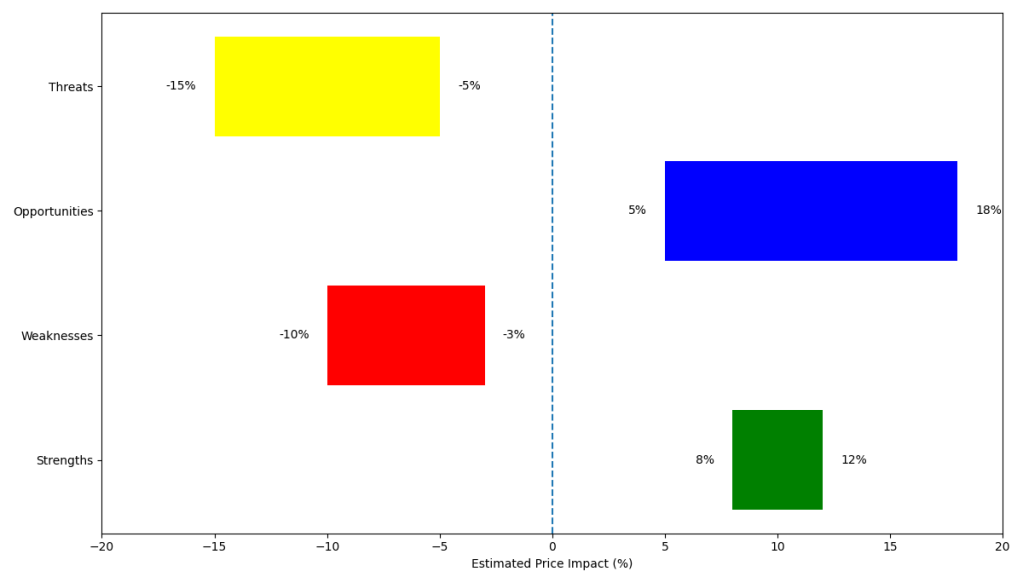
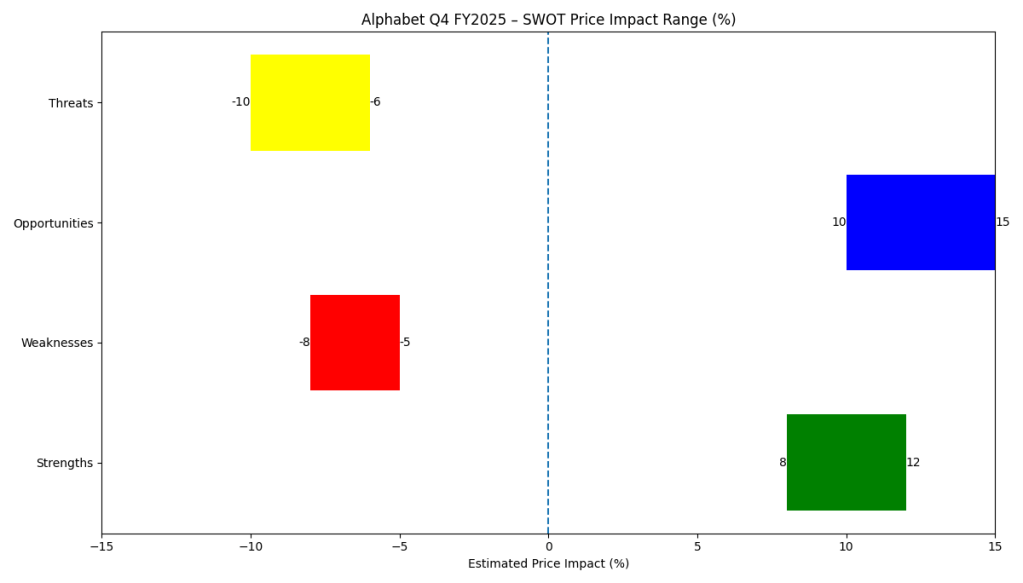
ASML SWOT price impact chart showing strengths (+8% to +15%), opportunities (+10% to +18%), weaknesses (–12% to –6%), and threats (–15% to –8%) with a zero baseline, illustrating potential valuation drivers and risks after the latest earnings.
ASML SWOT price impact ranges: Structural strengths from EUV monopoly and AI demand provide upside potential, while valuation risk, customer concentration, and export restrictions represent key downside factors.

Valuation Scenarios

ASML’s valuation reflects its position as a toll collector on advanced chip manufacturing rather than a traditional cyclical equipment maker.

Bear Case

AI spending slows, High-NA adoption delayed, and multiples compress.

→ –20% to –30% downside

Base Case

Steady AI demand, gradual High-NA ramp, stable margins.

→ +10% to +18% upside

Bull Case

Accelerated AI infrastructure buildout and faster High-NA adoption.

→ +30% to +45% upside

Probability-weighted expected return: ~+10–12%

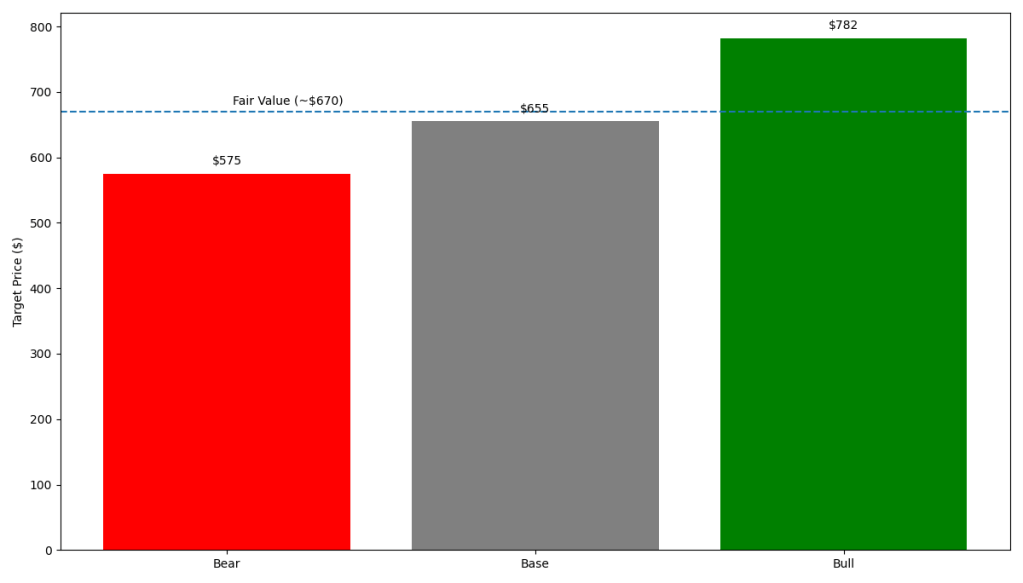
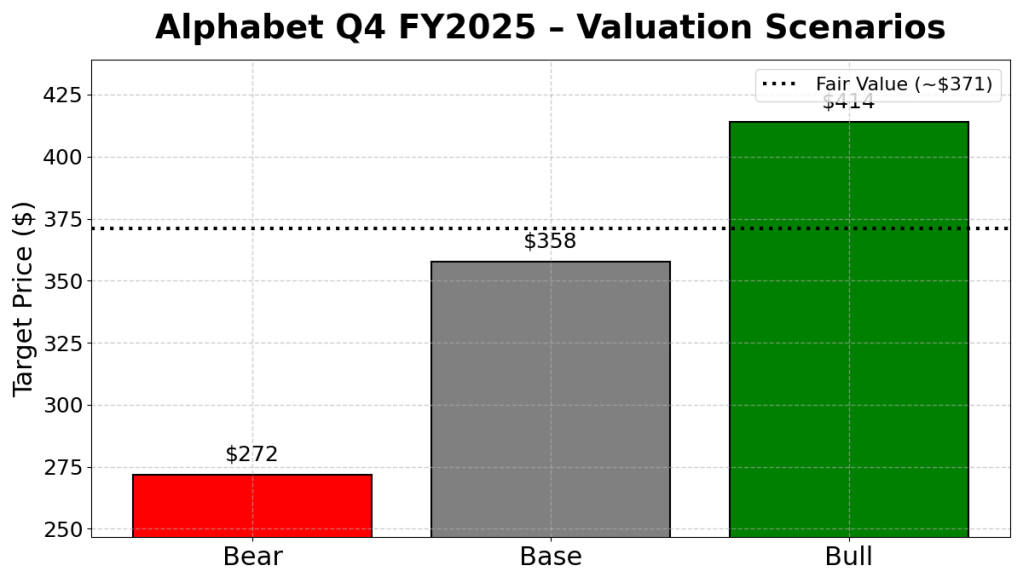
ASML valuation scenarios chart showing Bear case at €660, Base case fair value at €890, and Bull case at €1200, with a dashed fair value line illustrating potential upside and downside based on AI demand and semiconductor cycle assumptions.
ASML valuation scenarios: The base case fair value centers around €890, with downside risk if AI spending slows and upside potential if High-NA EUV adoption and global AI infrastructure investment accelerate.

Verdict

ASML remains one of the most strategic companies in the global technology supply chain. However, with shares trading well above our fair value estimate of €880–900 (≈ $1,040–1,065), the stock appears priced for a strong AI expansion scenario. Investors are now paying for execution perfection.


Call to Action

Follow SWOTstock for structured, fundamentals-driven breakdowns that cut through earnings hype and focus on valuation, risk, and long-term positioning.


Disclaimer

This analysis is for informational purposes only and does not constitute investment advice. Investors should conduct their own research and consider risk tolerance before making investment decisions.


Adobe Q4 FY2025 — AI Adoption Strengthens, ARR Hits New Highs, and The Stock Barely Moves

Adobe reported a solid Q4 FY2025, with revenue rising 10% YoY to $6.19 billion and surpassing $25 billion in ARR. Despite strong financials, the stock slipped 0.8% post-results, reflecting high investor expectations around AI monetization. The company remains a robust subscription model with a fair value around $520 per share.

TL;DR Summary

Adobe (NASDQ: ADBE) closed FY2025 with another strong quarter: revenue rose 10% YoY to $6.19B, ARR surpassed $25B, and AI features across Creative Cloud and Document Cloud continued driving higher engagement. Yet the stock slipped just –0.8% after hours, reflecting investor expectations for stronger AI monetization and cautious sentiment around the $1.9B Semrush acquisition. Adobe remains a premium-quality subscription business, and our fair value stands at $520, supported by durable ARR growth, strong free cash flow, and early—but accelerating—AI upside.


Quarter Recap

Adobe reported its Q4 FY2025 results on December 11, highlighting a company that continues to compound ARR while transitioning deeper into AI-enhanced creative and productivity workflows. Revenue grew 10% YoY to $6.19B, beating expectations, and non-GAAP EPS came in at $5.50. Digital Media ARR and Document Cloud momentum remained strong, and Experience Cloud delivered stable growth ahead of planned integration with Semrush. Free cash flow reached $3.16B for the quarter and over $10B for the full year.

Despite the strong numbers, Adobe’s share price slipped approximately 0.8% after hours. This muted reaction was driven by high expectations, the need for clearer AI monetization signals, and continued caution around software multiples during a volatile macro backdrop.


Key Highlights

  • Revenue of $6.19B, up ~10% YoY; above consensus.
  • Non-GAAP EPS of $5.50; exceeded analyst expectations.
  • Digital Media and Document Cloud ARR both saw solid double-digit growth.
  • Free cash flow reached $10B+ for FY25 — reinforcing balance sheet strength.
  • AI adoption continued accelerating across Creative Cloud and Acrobat.
  • Announced $1.9B acquisition of Semrush to deepen Experience Cloud capabilities.
  • FY2026 guidance targets ~10%+ ARR growth, with expanding AI-driven workflows.

SWOT Analysis

Adobe enters FY2026 with solid momentum, supported by durable ARR, growing AI adoption, and strong cash generation. Still, the market remains cautious as it weighs valuation, competition, and the pace of AI monetization. Below is a clear, investor-ready SWOT with quantitative price impacts.

Strengths (+6% to +12%)

  • Record ARR growth across Creative Cloud, Document Cloud, and Experience Cloud reinforces subscription durability.
  • AI tools such as Firefly and Acrobat AI Assistant deepen product engagement and increase switching costs.
  • Robust free cash flow provides flexibility for buybacks and acquisitions.
  • Consistent revenue and EPS beats reflect disciplined execution.

Weaknesses (–3% to –7%)

  • Premium valuation multiples make the stock sensitive to any growth deceleration.
  • AI monetization still lacks explicit revenue attribution, creating uncertainty.
  • Experience Cloud faces rising competition in enterprise marketing and analytics.
  • Muted stock reaction shows investor expectations were already high.

Opportunities (+8% to +15%)

  • Monetization of Firefly and enterprise AI workflows can drive incremental ARR.
  • Acrobat AI Assistant is positioned to become a major enterprise productivity catalyst.
  • Semrush integration offers new cross-sell and retention opportunities in Experience Cloud.
  • AI-driven automation may support future price increases and margin expansion.

Threats (–10% to –18%)

  • Competitive pressure from Canva, Figma, and emerging AI-native design tools.
  • Slowing enterprise budgets could affect Experience Cloud bookings.
  • Regulatory scrutiny around AI training and creative rights could create material risk.
  • If AI momentum does not translate into revenue, valuation multiples may compress.
SWOT price impact range chart for Adobe Q4 FY2025 showing strengths, weaknesses, opportunities, and threats with estimated stock price impact from –25% to +25%.

Valuation Scenarios

Adobe’s valuation hinges on ARR durability, AI monetization success, and execution in Experience Cloud. Here are the scenario-based outcomes and how each target is derived.

Bear Case — $455 (25% probability)

  • ARR growth slows below 10%.
  • AI engagement does not translate into meaningful pricing expansion.
  • Experience Cloud bookings lag amid cautious enterprise spending.
  • EPS multiple contracts toward ~18× forward earnings.

Base Case — $525 (50% probability)

  • ARR grows ~10%+ inline with FY26 guidance.
  • AI features deliver moderate, steady uplift to engagement and retention.
  • Semrush integration supports Experience Cloud without margin drag.
  • EPS multiple stabilizes around ~20–22×.

Bull Case — $580 (25% probability)

  • Firefly, Acrobat AI Assistant, and enterprise workflows accelerate AI monetization.
  • Creative Cloud pricing power increases with minimal churn.
  • Semrush drives stronger-than-expected Experience Cloud expansion.
  • EPS multiple expands toward ~24–25×.

Probability-Weighted Fair Value

= (0.25 × 455) + (0.50 × 525) + (0.25 × 580)

~$520 per share

Valuation scenarios chart for Adobe Q4 FY2025 showing bear, base, and bull price targets with probability weights and a dashed fair value line at $520.

Verdict

Adobe’s Q4 results reaffirm the strength of its subscription engine and show that AI adoption is meaningfully increasing engagement. Yet investors are demanding clearer proof of monetization before rewarding the stock with higher multiples. For Type 1 tech-savvy growth investors, Adobe remains a high-quality compounder with manageable execution risk, strong cash flow, and emerging AI tailwinds. At around $520 fair value, the stock appears reasonably priced relative to forward fundamentals.


Call to Action

If you want deeper earnings-season insights, follow SWOTstock for clear, fact-based analysis built directly from official reports and transcripts. No noise, no hype — just the truths that matter for long-term investors.


Disclaimer

This analysis is for informational purposes only and is not financial advice. All conclusions are based solely on Adobe’s official filings and earnings call commentary.


Oracle Q2 FY2026 — Revenue Miss, AI Backlog Surge, and a 14% Drop: Value Reset or Warning Sign?

Oracle’s Q2 FY2026 results showed mixed performance with revenue at $16.06B slightly below expectations, while adjusted EPS at $2.26 was aided by a one-time gain. A significant $523B RPO backlog indicates strong future demand, yet stock fell over 10% to ~$199 amid concerns over profitability and capital intensity.

TL;DR Summary

Oracle (NYSE: ORCL) reported mixed Q2 FY2026 results: revenue came in slightly below expectations, adjusted EPS beat but was boosted by a one-time gain, and OCI continued strong but not hyper-scale acceleration. The standout metric was a massive $523B RPO backlog, signaling powerful long-term demand for AI and cloud infrastructure. Yet the stock still dropped over 10% after hours to ~$199 as investors recalibrated near-term profitability, cloud CapEx intensity, and the quality of earnings. Our fair value stands at $210–$215, with the pullback offering a more reasonable entry point for value-oriented investors who can tolerate AI-cycle volatility.


Quarter Recap

Oracle released its Q2 FY2026 results on December 10. Total revenue reached $16.06B, a modest YoY increase but a slight miss versus expectations. Adjusted EPS beat estimates at $2.26; however, the strength was driven by a $2.7B pretax gain from selling Oracle’s stake in Ampere Computing. OCI remained a bright spot, growing roughly 68% YoY and supported by AI training and inference demand, although growth did not exceed bullish expectations.

The biggest surprise came from Remaining Performance Obligations (RPO), which surged to $523B — one of the highest forward-demand indicators in enterprise tech. Despite this, the stock sold off sharply as investors focused more on margin pressure, heavy CapEx needs, and the softer revenue print. By late after-hours trading, Oracle shares had fallen to around $199, down more than 10%.


Key Highlights

  • Revenue: $16.06B, slightly below consensus
  • Adjusted EPS: $2.26, aided by a one-time Ampere stake sale
  • OCI: ~68% YoY growth, strong but not accelerating beyond expectations
  • RPO: Jumped to $523B, signaling multi-year cloud and AI demand
  • CapEx & Debt: Rising commitments for cloud infrastructure expansion
  • Market Reaction: Stock dropped from ~$230 to ~$199 after hours

SWOT Analysis

Oracle’s Q2 results highlight a company balancing immense long-term opportunity with near-term financial strain. While the AI infrastructure cycle is driving unprecedented backlog levels, the path to monetizing this demand profitably remains uncertain. The sell-off reflects this tension: long-term durable demand on one side, and rising costs, slower revenue, and an inflated EPS figure on the other.

Strengths (Price Impact: +6% to +12%)

  • Massive RPO backlog of $523B supporting multi-year revenue visibility (+3% to +5%)
  • Highly sticky database and support revenue base anchoring cash flow (+2% to +4%)
  • Strong OCI growth of ~68% YoY securing relevance in AI infrastructure (+3% to +5%)
  • Consistent capital returns through buybacks and dividends (+1% to +2%)

Weaknesses (Price Impact: –6% to –12%)

  • Revenue miss relative to AI-fueled expectations (–3% to –5%)
  • EPS beat driven by one-time Ampere stake sale (–2% to –4%)
  • Near-term margin pressure from heavy cloud infrastructure investments (–3% to –5%)
  • Elevated debt profile reducing financial flexibility (–1% to –2%)

Opportunities (Price Impact: +10% to +18%)

  • Multi-year AI infrastructure demand cycle boosting OCI adoption (+5% to +8%)
  • Database migration to OCI offering structural margin lift (+3% to +5%)
  • Cerner modernization creating long-term operating leverage (+2% to +4%)
  • Enterprise consolidation driving large, integrated cloud modernization deals (+2% to +3%)

Threats (Price Impact: –12% to –20%)

  • CapEx requirements rising to fulfill massive AI/cloud backlog (–5% to –8%)
  • Fierce competition from AWS, Azure, and Google Cloud (–3% to –6%)
  • AI contract profitability still unclear and may dilute margins (–2% to –4%)
  • Macro slowdown could hit enterprise IT spending (–2% to –3%)
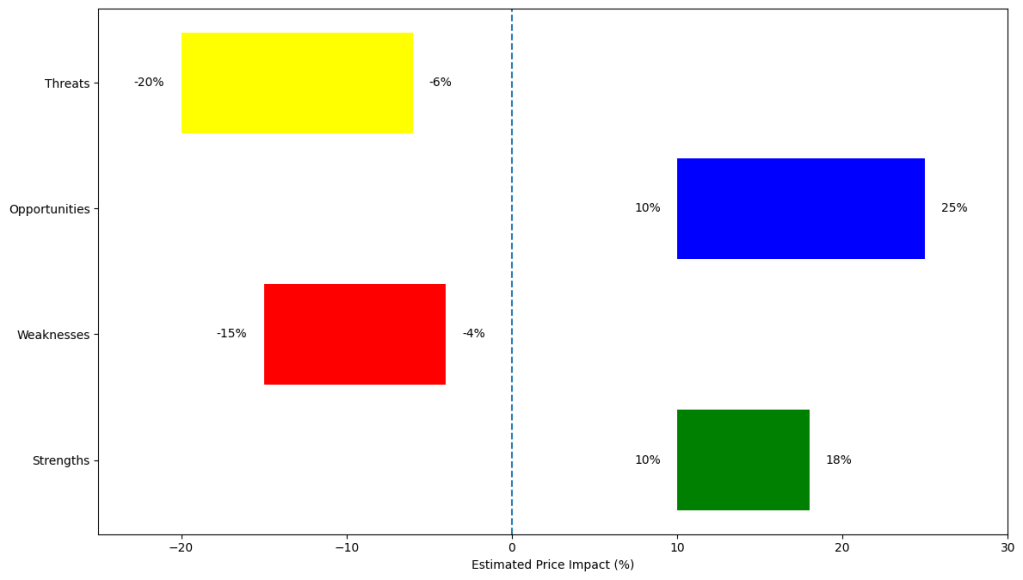
Oracle Q2 FY2026 SWOT analysis chart showing estimated stock price impact ranges: Strengths +6% to +12%, Weaknesses –12% to –6%, Opportunities +10% to +18%, and Threats –20% to –12%, displayed on a horizontal bar chart with x-axis starting at –25%.

Valuation Scenarios

With shares falling to ~$199, Oracle now trades below our intrinsic value range. The key valuation driver is how quickly OCI can scale profitably relative to the heavy CapEx needed to support long-term AI demand. Below are three scenarios based on earnings normalization, cloud margin trajectories, and the appropriate earnings multiple for a hybrid software + cloud infrastructure business.

Bear Case — $175

  • OCI slows to 40–50%
  • CapEx stays elevated for multiple years
  • Core EPS normalizes lower after removing one-time gains
  • Multiple compresses to 15× forward EPS
  • Price Target: ~$175

Base Case — $215

  • OCI grows 55–65%
  • Revenue normalizes to mid-single digits
  • CapEx moderates by FY2027
  • Margins expand gradually
  • Valuation at ~17.5× forward EPS
  • Price Target: ~$215

Bull Case — $255

  • OCI re-accelerates to 70%+
  • AI contracts become margin accretive
  • Cloud and software synergy improves profitability
  • Market assigns a premium 20× forward multiple
  • Price Target: ~$255

Fari Value

Assigning scenario probabilities:

  • Bear: 30%
  • Base: 50%
  • Bull: 20%

FV = (175 x 0.3) + (215 x 0.5) + (255 x 0.2)

= 52.5 + 107.5 + 51 = 211

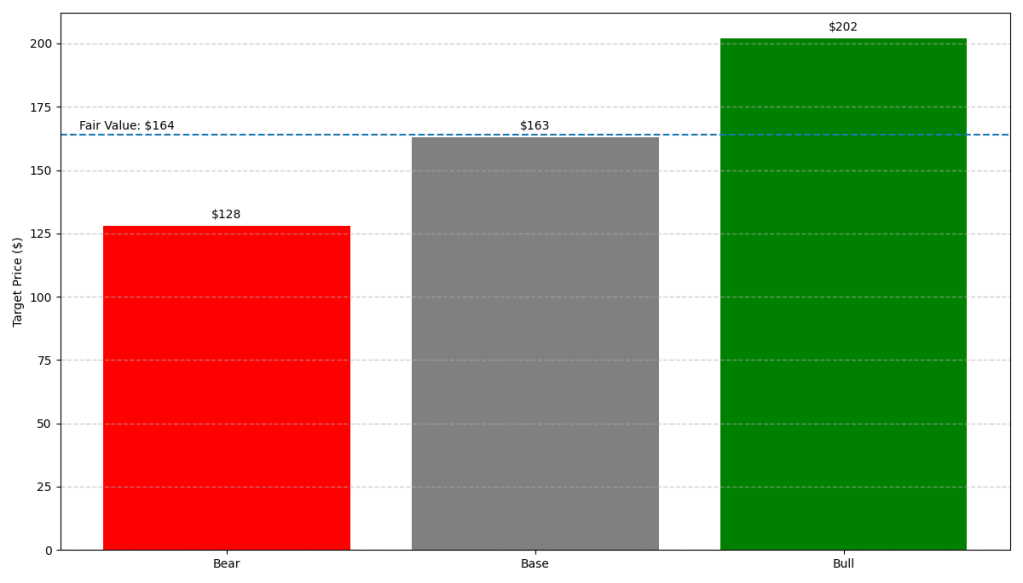
🎯 Probability-Weighted Fair Value = $211

Oracle Q2 FY2026 valuation scenarios chart comparing Bear case price target $175, Base case $215, and Bull case $255, with a dashed line indicating the probability-weighted fair value of $211.

Verdict

Oracle’s Q2 numbers delivered a mixed message: enormous long-term demand but weaker near-term fundamentals. The stock’s drop to ~$199 reflects investors resetting expectations for cloud profitability and earnings quality. Still, the pullback now places Oracle below our fair value estimate, creating a potentially attractive entry point for long-term, value-oriented investors who accept AI-cycle volatility. For investors seeking steady cash flow, disciplined capital returns, and long-term cloud upside, Oracle now screens more reasonable than before.


Call to Action

If you want structured, fact-based breakdowns of every earnings season — from Big Tech to industrials to retail — subscribe to SWOTstock. We turn dense earnings reports into clear insights so you can invest with conviction, not noise.


Disclaimer

This analysis is for informational purposes only and is not financial advice. All estimates are based on publicly available company filings and earnings calls. Investors should conduct their own due diligence before making investment decisions.