
TL;DR
CoreWeave’s (CRWV:NASDAQ) third quarter strengthened its business case. Revenue rose sharply, operating margins improved, and management reported stronger pricing across both new and older infrastructure. Customer prepayments and contract-backed financing provide additional support for its expansion.
The next test is whether that progress produces durable cash returns after hardware investment, interest costs and dilution. Renewing existing GPU contracts could help, but the opportunity remains sensitive to future demand and pricing.
For growth investors, CoreWeave offers substantial potential alongside significant financial risk. Our provisional probability-weighted valuation is approximately $56 per share, with a wide range of possible outcomes and little margin of safety around that price.
Quarter Recap
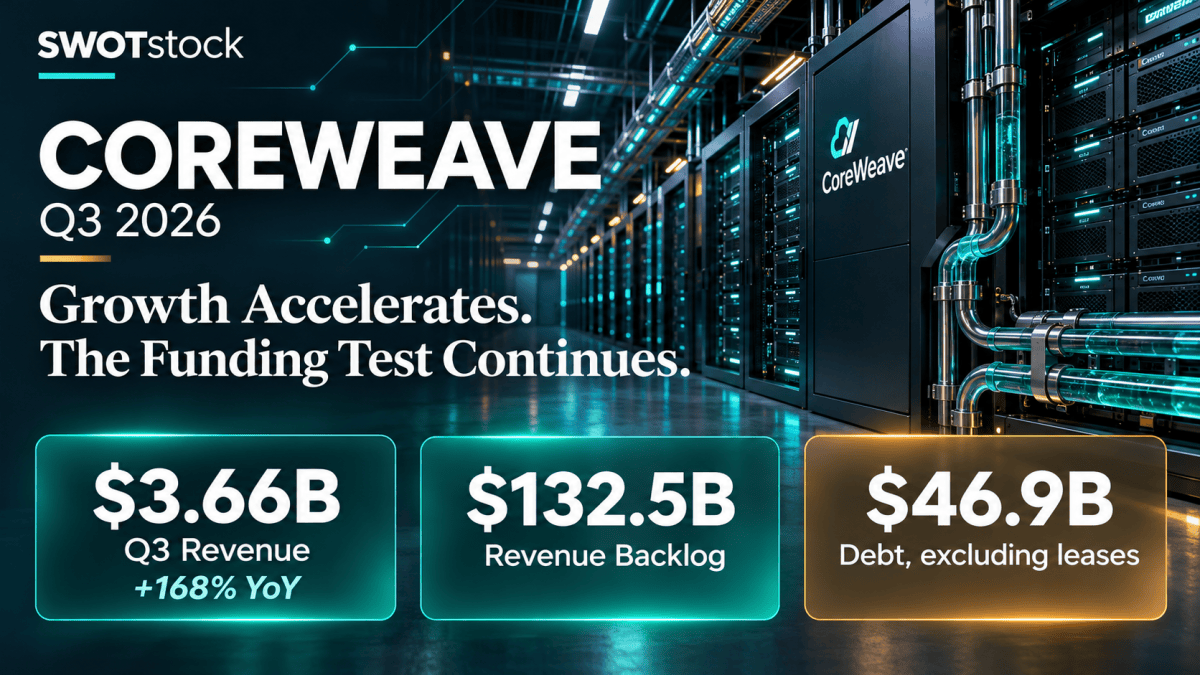
CoreWeave reported Q3 2026 revenue of $3.661 billion, up 168% year over year. GAAP operating income reached $207 million, while adjusted operating income was $379 million.
Adjusted operating margin increased from approximately 1% in Q1 to 5% in Q2 and 10% in Q3. However, it remained below the prior-year quarter’s 16%.
Below operating profit, financing costs continued to weigh heavily. Net interest expense reached $846 million, and the company recorded a $709 million net loss. Adjusted EBITDA of $2.256 billion therefore needs to be read alongside depreciation, interest and investment requirements.
Market Reaction
The initial response was positive. CoreWeave closed at $48.73 on November 10, before the release. A retrieved November 11 premarket snapshot subsequently showed $56.06, approximately 15% higher. That was an extended-hours observation, before the first regular post-earnings session.
Key Highlights
Existing GPUs could become an important source of cash
Management reported that Ampere and Hopper pricing increased 30–50% quarter over quarter, with recontracting prices above original contracts. More than 130,000 GPUs come off contract in 2027, followed by approximately 170,000 in 2028.
At current pricing, management described approaching $4 billion of annualised revenue opportunity from 2027 renewals, rising to nearly $10 billion when including 2028 renewals. These opportunities are outside reported backlog. They represent potential revenue from recontracting capacity rather than secured incremental sales.
The attraction is straightforward: equipment that completes its initial financing cycle can continue earning revenue. The investment question is how long it remains competitive, at what utilisation and price, and with what continuing operating and maintenance costs.
Financing is becoming more closely linked to customers
Management reported a 7.9% weighted average debt cost, down 250 basis points year over year. It expects approximately $9 billion of customer prepayments and deposits over the following three months, including more than $3 billion associated with existing infrastructure.
Management also said it does not intend to issue additional parent-level unsecured debt through 2027 at prevailing yields. Its plan instead draws on customer advances, asset-level facilities, equipment financing and operating cash generation.
This provides more information about how expansion could be funded. Customer advances nevertheless carry future service obligations, and additional financing remains dependent on terms and availability.
Software could deepen customer relationships
CoreWeave said 70% of new Q3 cloud customers were already Forge customers. That suggests its development tools can provide an entry point into infrastructure spending.
Management also disclosed the first customer for CoreWeave Omni, which extends its platform to infrastructure owned by others. This could provide a route to growth requiring less company-funded hardware. Separately disclosed revenue, margins and retention are still needed to judge the scale and durability of that opportunity.
SWOT Analysis
The ranges below are judgment-based estimates of potential effects on equity value, holding other factors broadly constant. They are not price targets, and they should not be added together.
Strengths
Deployment is producing operating progress: potential value support of 8–15%. Revenue increased from $2.575 billion in Q2 to $3.661 billion in Q3, while adjusted operating income rose from $128 million to $379 million. Continued execution would strengthen confidence that infrastructure spending can translate into earnings.
Customer commitments support financing visibility: potential value support of 5–12%. Management’s model links borrowing to contracted cash flows and infrastructure. Reliable execution could reduce perceived financing risk and support a higher valuation. Delivery and customer payment remain essential to that outcome.
Weaknesses
Debt magnifies financial sensitivity: potential value pressure of 12–20%. Reported debt excluding leases totalled approximately $46.9 billion at September 30. With interest expense still exceeding operating earnings, a comparatively small deterioration in enterprise value can cause a much larger percentage decline in the equity remaining for shareholders.
Expansion consumes substantially more cash than operations generate: potential value pressure of 8–15%. Nine-month operating cash flow was $5.638 billion, against $23.558 billion of cash property and equipment purchases. Operating cash flow also included a $3.492 billion contribution from changes in deferred revenue. Funding requirements therefore remain central to shareholder returns.
Opportunities
Renewals could improve lifetime infrastructure returns: potential value support of 10–20%. Successful recontracting would extend revenue generation beyond initial contracts without repeating the original deployment investment. The benefit depends on useful asset life, pricing and continuing costs; management’s full renewal opportunity should not be assumed in advance.
Platform services could broaden the business: potential value support of 5–12%. Forge, managed inference and Omni could increase customer spending and diversify revenue. Evidence of recurring platform earnings with lower capital requirements would support stronger valuation economics.
Threats
Compute supply could eventually weaken pricing: potential value pressure of 12–20%. Strong current pricing improves returns, but also encourages competing investment. Lower utilisation or renewal prices would reduce cash generation against committed infrastructure and financing costs.
Delivery or funding disruption could delay growth: potential value pressure of 10–20%. CoreWeave’s $132.5 billion backlog remains subject to delivery and service availability requirements. Delays could postpone revenue while costs continue, and financing shortfalls could require slower expansion or additional equity.
Valuation Scenarios
Our model values 2028 operating earnings, subtracts projected net debt, divides by projected shares and discounts the resulting equity value back approximately two years at 15% annually.
Operating earnings retain depreciation and stock-based compensation expenses. This matters because hardware consumption and employee compensation are economic costs.
The forward assumptions below are SWOTstock estimates. They are neither company guidance nor consensus targets.
Bear Case — Approximately $10 per Share
Revenue reaches $26 billion in 2028, with a 14% operating margin, producing $3.64 billion of operating income. A 16× enterprise-value-to-operating-income multiple gives $58.24 billion of enterprise value.
Subtracting $50 billion of net debt, dividing by 650 million shares and discounting back produces approximately $9.59 per share.
This assumes growth continues but pricing, deployment or financing disappoints. A severe funding crisis could produce a worse outcome.
Probability: 30%.
Base Case — Approximately $54 per Share
Revenue reaches $34 billion, with an 18% operating margin, producing $6.12 billion of operating income. An 18× multiple gives $110.16 billion of enterprise value.
After $60 billion of net debt, 700 million shares and discounting, present value is approximately $54.18 per share.
This requires sustained backlog conversion and substantial margin improvement. It includes selective renewal success without adding management’s entire uncontracted opportunity.
Probability: 50%.
Bull Case — Approximately $128 per Share
Revenue reaches $44 billion, with a 23% operating margin, producing $10.12 billion of operating income. A 20× multiple gives $202.4 billion of enterprise value.
After $75 billion of net debt, 750 million shares and discounting, present value is approximately $128.44 per share.
This requires favourable deployment, pricing, renewals and platform adoption, while allowing for greater borrowing and dilution.
Probability: 20%.
Probability-Weighted Fair Value
The three cases produce a weighted fair value of $55.66, rounded to $56 per share.
That offers little protection around the retrieved $56.06 premarket snapshot. At the $48.73 regular-session close, the discount to estimated fair value was approximately 12.4%.
Precision is limited. Future debt and dilution are scenario assumptions rather than outputs from a complete funding schedule. Shifting ten percentage points of probability from Bull to Bear lowers estimated fair value to approximately $44.
Verdict
CoreWeave’s Q3 results provide stronger evidence that its infrastructure can generate operating leverage. The renewal opportunity and broader platform adoption add credible avenues for future growth.
For growth investors, the unresolved issue is how much of that operating success reaches common shareholders after financing, replacement investment and dilution. Management expects positive adjusted net income in 2028, but achieving that milestone is still ahead.
Around $56, our model suggests a high-risk growth investment with limited valuation protection. A stronger investment case would come from a wider discount or evidence that financing needs and lifetime hardware returns are improving beyond our Base assumptions.
The next checkpoints are actual prepayment collections, completed financing terms, realised renewal economics and cash generation after investment.
Join the Discussion
Which will matter most to CoreWeave’s long-term shareholder returns: new capacity deployment, older-GPU renewals, or the growth of its software platform?
Disclaimer
This article is for educational and informational purposes and is not investment advice. Valuations reflect assumptions and may change materially. Financial analysis uses CoreWeave’s official disclosures and earnings-call transcript; market prices are separately sourced snapshots.

