
TL;DR
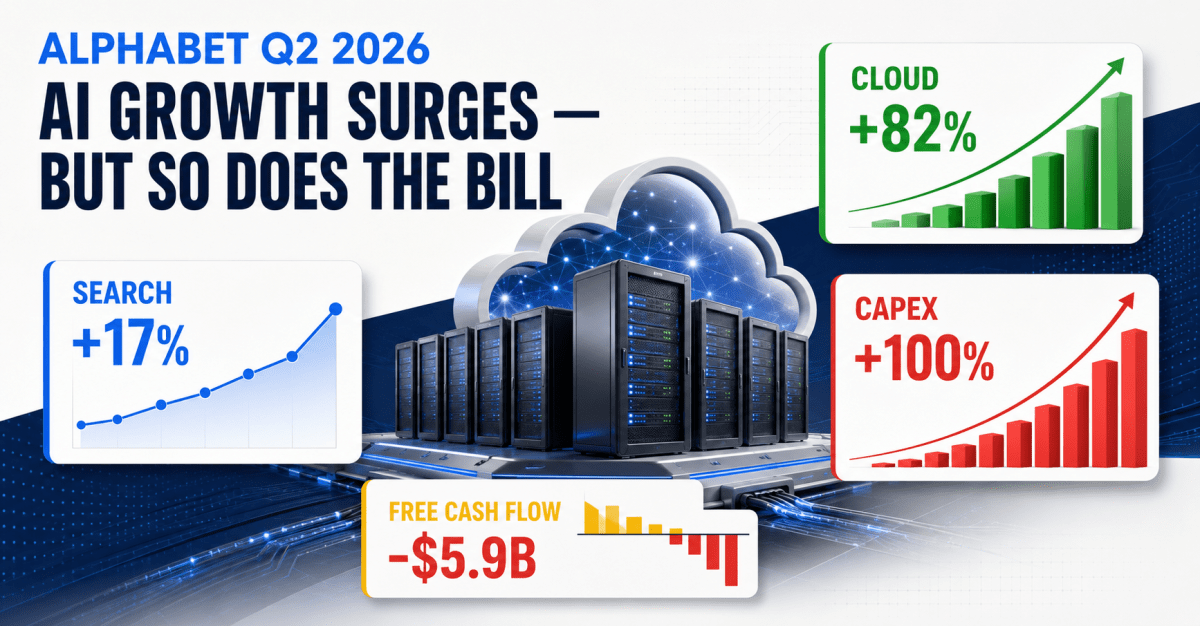
Alphabet (GOOGL:NASDAQ) delivered exceptional operating growth in Q2 2026. Revenue increased 24%, operating income rose 30%, Google Search grew 17%, and Google Cloud revenue surged 82% while its operating margin expanded to approximately 35.6%.
The market reaction was nevertheless negative. Alphabet initially gained 3.4% following the release before reversing sharply. The shares subsequently traded about 4.9% below their pre-earnings closing price during the following pre-market session.
The tension is increasingly clear: Alphabet is demonstrating strong demand for its AI products and infrastructure, but the investment required to meet that demand is rising even faster. Quarterly capital expenditure doubled to $44.9 billion, exceeded operating cash flow and pushed free cash flow into negative territory.
After removing exceptional investment gains from reported earnings, our probability-weighted fair-value estimate is approximately $324 per share. Against a pre-market price near $325, Alphabet appears fairly valued but offers little margin of safety.
Alphabet Q2 2026 Earnings Recap
Alphabet reported Q2 2026 revenue of $119.8 billion, representing an increase of 24% from the previous year.
Operating income increased 30% to $40.8 billion, while operating margin expanded from 32% to 34%.
The key reported figures were:
- Revenue: $119.8 billion, up 24%
- Operating income: $40.8 billion, up 30%
- Operating margin: 34%, up two percentage points
- Operating cash flow: $39.1 billion, up 41%
- Capital expenditure: $44.9 billion, up 100%
- Free cash flow: negative $5.9 billion
- Reported diluted EPS: $9.11, up from $2.31
Reported net income reached $112.2 billion, but that figure requires careful interpretation.
Alphabet disclosed that gains on equity securities contributed approximately $77.1 billion to net income and $6.26 to diluted EPS. Removing that disclosed effect produces underlying quarterly EPS of approximately $2.85.
The investment gain has genuine economic value and strengthened Alphabet’s balance sheet. However, it should not be treated as recurring operating earnings when valuing the core business.
All financial figures are based on Alphabet’s official Q2 2026 earnings release.
Market Reaction
Alphabet Class A shares closed at $342.09 before the earnings release.
The shares initially rose as high as $353.78 in after-hours trading, representing a gain of approximately 3.4%. That positive reaction did not last.
The price subsequently fell as low as $325.00 after hours and reached $323.23 during the following pre-market session. At the latest pre-market observation used in this analysis, Alphabet was trading near $325.34, approximately 4.9% below its pre-earnings close.
The decline from the initial after-hours high to the pre-market low represented a reversal of approximately 8.6%.
The price sequence was therefore clearly negative:
Initial gain → complete reversal → new pre-market low → sustained decline
Price action alone cannot prove why investors sold the shares. However, the failure to hold the initial gain indicates that the strong headline growth was insufficient to support the pre-earnings valuation once investors processed the complete financial picture.
The most evident analytical tension is between exceptional operating growth and deteriorating free-cash-flow conversion. This is our independent interpretation of the reported financials and trading pattern—not an explanation drawn from news reports or analyst commentary.
Key Highlights
Search Remains Resilient
Google Search and other advertising revenue increased 17% to $63.3 billion.
Search represented approximately 53% of Alphabet’s total revenue and remains the financial foundation supporting the company’s AI expansion.
The quarter provides no immediate evidence that generative AI is materially eroding Search revenue. Alphabet is currently growing Search while integrating AI features into the product.
However, revenue growth does not completely resolve the long-term risk.
Investors still need to determine whether AI-assisted searches can preserve advertising conversion, revenue per query and operating economics after accounting for the higher computing cost of producing AI-generated answers.
For now, Search remains a major strength. Its long-term economics, however, cannot simply be assumed.
Google Cloud Has Become a Major Profit Engine
Google Cloud delivered the strongest operating performance of the quarter.
Cloud revenue increased 82% to $24.8 billion, while operating income rose from $2.8 billion to $8.8 billion. Its implied operating margin expanded from approximately 20.7% to 35.6%.
Cloud now contributes nearly 22% of the combined operating income generated by Google Services and Google Cloud before Alphabet-level expenses and Other Bets.
This demonstrates that Alphabet’s AI infrastructure is not supporting only experimental products. Google Cloud is already converting strong demand into substantial revenue and operating profit.
The unresolved issue is whether that profit growth will ultimately exceed the enormous capital investment required to sustain it.
Gemini Has Achieved Considerable Scale
Alphabet reported that the Gemini App reached 950 million monthly active users.
Its APIs were processing 22 billion tokens per minute across first-party models, while nearly 90% of Fortune 100 companies were reported to be using Gemini Enterprise.
These figures demonstrate considerable consumer reach and enterprise adoption. But usage alone is not proof of monetization or shareholder return.
Alphabet must eventually convert that usage into subscriptions, advertising, enterprise consumption or other high-margin recurring revenue.
The question is no longer whether people and businesses are using Alphabet’s AI products. The question is how much profit and free cash flow Alphabet can generate from that usage.
AI Investment Is Consuming More Cash
Alphabet’s capital expenditure doubled to $44.9 billion, exceeding quarterly operating cash flow of $39.1 billion.
Free cash flow consequently deteriorated from positive $5.3 billion in the previous-year period to negative $5.9 billion, despite the strong increases in revenue and operating income.
This created a striking divergence:
- Operating income increased substantially.
- Operating cash flow remained strong.
- Capital expenditure grew even faster.
- Free-cash-flow conversion deteriorated.
This does not automatically mean that Alphabet is overspending.
Infrastructure must normally be built before it can generate its full revenue contribution. The present quarter may therefore reflect the cash cost of constructing capacity before that capacity produces its eventual earnings.
But investors still need evidence that the future cash flows will exceed the capital, depreciation, energy and financing costs required to produce them.
Capital Allocation Has Changed
Alphabet ended the quarter with approximately $242.5 billion of cash, cash equivalents and marketable securities, compared with $98.2 billion of long-term debt.
However, the increase in financial resources did not come entirely from internal cash generation. Alphabet raised capital through common equity, mandatory convertible preferred stock and senior unsecured notes.
The company also repurchased no common shares during the quarter, compared with $13.2 billion of repurchases in Q2 2025.
Diluted shares increased approximately 0.9% year over year, while an additional at-the-market equity programme of up to $40 billion remains available.
For a company historically distinguished by enormous internal cash generation, this represents a meaningful shift in capital allocation.
The financing may prove rational if Alphabet’s AI investment earns attractive long-term returns. If it does not, shareholders will have absorbed both weaker free-cash-flow conversion and dilution.
Alphabet SWOT Analysis
The quarter strengthens the case that Alphabet can compete successfully in AI. It does not yet settle whether the current investment cycle will produce attractive returns for shareholders.
The percentage ranges below estimate each factor’s potential effect on fair value relative to our neutral base assumptions. They are scenario sensitivities rather than predictions of the next share-price movement.
The ranges should not be added together because several factors overlap.
Strengths
Search remains a growing and highly profitable foundation.
Search revenue increased 17%, while Google Services produced an implied operating margin of approximately 41.8%.
If Search growth proves five to eight percentage points stronger than the cautious assumptions embedded in our base case, the estimated fair-value benefit could be approximately 3% to 6%.
Google Cloud has become a material second profit engine.
Cloud revenue increased 82%, while its operating margin reached approximately 35.6%.
If Cloud sustains stronger-than-expected growth or achieves another three to five percentage points of margin improvement, the estimated fair-value benefit could be approximately 4% to 8%.
Alphabet retains substantial financial flexibility.
Cash and marketable securities exceeded long-term debt and mandatory convertible preferred equity by approximately $126 billion.
This liquidity gives Alphabet considerable flexibility to fund infrastructure, research and product development while providing some downside support. The estimated contribution to fair value is approximately 3% to 5%.
Weaknesses
Capital expenditure has overtaken quarterly operating cash generation.
Capital expenditure reached 37.5% of quarterly revenue and exceeded operating cash flow.
If annual capital expenditure remains $30 billion to $40 billion above a normalized path for several years, the resulting reduction in distributable cash flow could lower fair value by approximately 10% to 18%.
AI research and experimental businesses are absorbing more operating profit.
Alphabet-level expenses, primarily including shared AI research, reached $5.8 billion. Other Bets produced an additional operating loss of $1.8 billion.
Their combined quarterly operating drag increased from approximately $4.6 billion to $7.6 billion.
If that increase persists without corresponding monetization, the estimated fair-value impact could be approximately negative 5% to negative 8%.
External financing and reduced repurchases increase dilution risk.
Alphabet repurchased no shares during the quarter while raising capital through common equity, preferred stock and debt.
Existing dilution, preferred dividends, higher interest expenses and possible future issuance could reduce the value attributable to common shareholders by approximately 2% to 5%.
Opportunities
Gemini has reached monetizable consumer scale.
With 950 million monthly active users, even modest subscription, advertising or commercial-query monetization could become financially meaningful.
Successful monetization of only part of this user base could add approximately 3% to 8% to fair value.
Enterprise AI could extend Google Cloud’s growth runway.
Alphabet attributed Cloud’s acceleration to enterprise AI solutions, AI infrastructure and its core Google Cloud Platform services.
If Gemini Enterprise and AI infrastructure demand translate into recurring, high-margin consumption rather than temporary capacity demand, the incremental fair-value opportunity could reach approximately 5% to 10%.
Capital intensity could eventually normalize.
The present investment cycle carries substantial upfront cash costs. If capital expenditure eventually declines by five to eight percentage points of revenue while operating growth remains intact, Alphabet could generate significant free-cash-flow operating leverage.
The resulting fair-value benefit could reach approximately 8% to 15%.
Threats
AI could increase Search usage while weakening Search economics.
More queries do not necessarily guarantee equivalent advertising conversion, revenue per query or cost efficiency.
Because Search contributes more than half of Alphabet’s revenue, even modest economic deterioration could materially affect recurring earnings.
A moderate impairment of Search economics, combined with valuation-multiple compression, could reduce fair value by approximately 10% to 20%.
AI infrastructure may produce inadequate returns on capital.
Cloud and AI revenue can grow rapidly while shareholder value still disappoints if depreciation, energy, model-development and financing costs absorb most of the incremental profit.
If free cash flow remains persistently below the level implied by Alphabet’s operating growth, the estimated fair-value impact could be approximately negative 15% to negative 25%.
Investment gains introduce earnings and balance-sheet volatility.
Approximately $6.26 of Alphabet’s reported $9.11 quarterly EPS came from disclosed gains on equity securities.
These gains should not be capitalized like recurring operating earnings and could partially reverse in future periods. The estimated fair-value exposure is approximately negative 1% to negative 4%.
Alphabet Valuation Scenarios
Alphabet’s reported quarterly EPS cannot be annualized because most of it came from investment gains rather than recurring operations.
After removing the investment-related EPS effects disclosed over the latest four quarters and adjusting for a previously disclosed European Commission fine, we estimate trailing normalized earnings power of approximately $10.70 per share.
We also include a conservative net-financial-asset adjustment of $10 per share. This figure deducts long-term debt and mandatory convertible preferred equity from cash and marketable securities.
Alphabet’s non-marketable securities are excluded from this adjustment because their valuations are volatile and generated much of the exceptional accounting gain.
Bear Case: $230 per Share
The bear case assumes:
- Forward normalized EPS of $10.00
- A valuation multiple of 22 times earnings
- Net financial assets of $10 per share
- A 25% scenario probability
The calculation is:
$10.00 × 22 + $10 = $230
This scenario assumes that Search growth slows, Google Cloud growth normalizes, and rising AI expenses and depreciation constrain recurring earnings.
Capital expenditure remains elevated but fails to generate adequate incremental cash returns.
The 22-times earnings multiple still recognizes the quality of Alphabet’s established businesses while incorporating substantial execution and capital-efficiency risk.
Base Case: $321 per Share
The base case assumes:
- Forward normalized EPS of $11.50
- A valuation multiple of 27 times earnings
- Net financial assets of $10 per share
- A 50% scenario probability
The calculation is:
$11.50 × 27 + $10 = $320.50
Rounded fair value: $321 per share
The assumed forward EPS represents growth of approximately 7% from our normalized trailing earnings base.
This is deliberately more conservative than the quarter’s 30% operating-income growth. Higher depreciation, research spending, financing costs, preferred dividends and dilution could absorb a meaningful portion of the operational improvement.
The 27-times multiple reflects Alphabet’s strong competitive position, continued Search growth and Google Cloud’s emergence as a major profit engine. It also recognizes that free-cash-flow conversion remains unresolved.
Bull Case: $426 per Share
The bull case assumes:
- Forward normalized EPS of $13.00
- A valuation multiple of 32 times earnings
- Net financial assets of $10 per share
- A 25% scenario probability
The calculation is:
$13.00 × 32 + $10 = $426
This scenario requires more than continued AI adoption.
Search must remain economically resilient, Google Cloud must sustain strong growth and margins, Gemini must become meaningfully monetized, and infrastructure spending must begin generating attractive incremental cash returns.
Under those conditions, Alphabet could justify both higher earnings and a higher valuation multiple.
Probability-Weighted Fair Value
Applying the assigned probabilities produces the following result:
- Bear case: 25% × $230 = $57.50
- Base case: 50% × $320.50 = $160.25
- Bull case: 25% × $426 = $106.50
The combined probability-weighted value is:
$57.50 + $160.25 + $106.50 = $324.25
Our estimated fair value is therefore approximately $324 per share.
Investment Verdict
Alphabet’s operating results remain exceptionally strong.
Search continues to grow at a double-digit rate, Google Cloud has become a major profit engine, and Gemini has reached meaningful consumer and enterprise scale.
But the investment conclusion is more restrained than the operating results.
Alphabet has demonstrated that AI can generate demand. It has not yet demonstrated that the current scale of AI investment will generate proportionate free cash flow.
Capital expenditure has overtaken quarterly operating cash generation, while external financing and potential dilution have become part of the capital-allocation story.
At approximately $325, Alphabet trades almost exactly at our $324 probability-weighted fair-value estimate. Investors buying at this level are effectively paying for the base case without receiving a meaningful margin of safety.
For a valuation-conscious investor:
- Around $325: Approximately fairly valued
- Around $275: Roughly a 15% discount to estimated fair value
- Around $260: Approximately a 20% margin of safety
- Around $243: Approximately a 25% margin of safety
- Around $230: Bear-case value and potential fat-pitch territory, provided the underlying operating thesis remains intact
Alphabet’s post-earnings decline has removed much of its previous valuation premium. It has not yet created an obvious value opportunity.
The central investment question is no longer whether Alphabet can attract AI users or enterprise demand. The evidence from Q2 suggests that it can.
The question is whether Alphabet can turn that demand into enough recurring free cash flow to justify the extraordinary amount of capital now being committed.
At the current price, that unresolved question appears fairly reflected rather than attractively discounted.
What to Watch Next
The next few quarters should provide evidence on whether Alphabet’s AI investment is beginning to produce operating leverage or whether higher capital intensity is becoming a permanent feature of the business.
The most important indicators to watch are:
- Search revenue growth and monetization
- Google Cloud growth and operating margin
- Gemini’s conversion from usage into revenue
- Capital expenditure as a percentage of revenue
- Free-cash-flow recovery
- Depreciation and shared AI research expenses
- Further equity issuance or shareholder dilution
- The possible resumption of share repurchases
What matters more to your Alphabet investment thesis: Google Cloud’s accelerating growth or the deterioration in free-cash-flow conversion?
Share your view in the comments, and follow SWOTstock for more independent earnings analysis based on company-reported evidence.
Disclaimer
This article is for informational and educational purposes only and does not constitute investment, financial, legal or tax advice. The valuation scenarios and price-impact ranges are estimates based on stated assumptions and are not predictions or guarantees of future performance.
Financial markets involve risk, including the possible loss of principal. Investors should conduct their own research and consider their financial circumstances, objectives and risk tolerance before making any investment decision. The author may hold positions in securities discussed.
 SWOT Stock - Smart Investing Made Simple