Alphabet Q2 2025 Earnings: AI Momentum vs. Rising CapEx — Is GOOGL Still a Buy?

Alphabet’s Q2 2025 earnings beat expectations with 14% revenue growth, soaring cloud margins, and AI‑driven engagement. Is GOOGL fairly valued or poised for more upside? Read our full SWOT and valuation analysis.

TL;DR

Alphabet delivered Q2 2025 revenue of $96.4B (+14% YoY) and EPS of $2.31 (+22% YoY), driven by AI‑powered engagement across Search and YouTube, and a Google Cloud margin jump to 20.7%. However, CapEx surged 70% YoY to $22.4B (guidance raised to $85B), raising near‑term cash flow concerns. Our probability‑weighted fair value: ~$195/share, suggesting GOOGL is fairly valued with modest upside.


Quarter Recap: Alphabet’s AI‑Fueled Growth

Alphabet beat expectations across the board:

  • Revenue: $96.43B (+14% YoY)
  • Net Income: $28.2B (+19% YoY)
  • EPS: $2.31 (+22% YoY)
  • Google Services: $82.5B (+12%), driven by Search & YouTube.
  • YouTube Ads: $9.8B (+13% YoY); Shorts monetization now equals in‑stream levels.
  • Google Cloud: $13.62B (+32% YoY) with 20.7% operating margin, nearly doubling YoY.
  • CapEx: $22.4B (↑70% YoY), FY25 guidance lifted to $85B for AI/cloud data centers.

CEO Sundar Pichai emphasized AI as “positively impacting every part of the business.” He highlighted that $250M+ Google Cloud deals doubled YoY, showcasing enterprise AI traction.


Key Highlights from Q2

  • AI at Scale: AI Overviews hit 2B+ monthly users; AI Mode reached 100M+ monthly users in the U.S. & India.
  • Enterprise Momentum: Cloud operating margin doubled to 20.7%, with stronger large‑scale enterprise deals.
  • Subscription Growth: Platforms & Devices up 20% YoY, enhancing recurring revenue streams.
  • Regulatory Watch: Q2 included $1.4B in legal costs; DOJ antitrust rulings could progress later this year.
  • AI Talent Retention: Pichai addressed competitive pressures, reaffirming Alphabet’s “ability to attract and retain top‑tier researchers.”
  • Search Trade‑offs: AI Overviews may reduce ad click rates in some verticals — management is testing new ad formats to offset this.
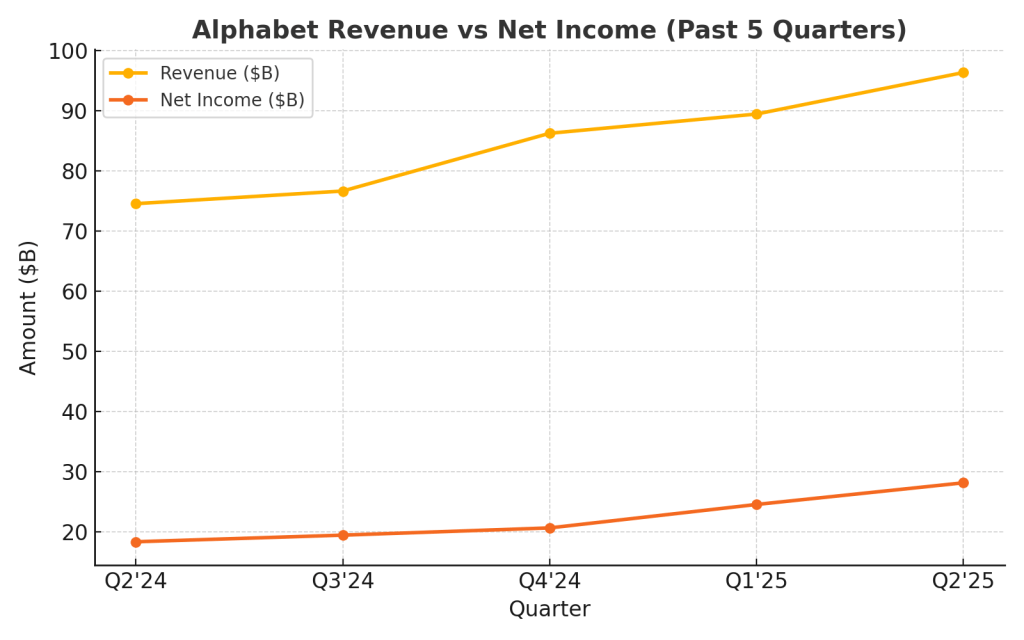
Line chart showing Alphabet’s revenue and net income for the past five quarters, highlighting strong growth with Q2 2025 revenue at $96.4 billion and net income at $28.2 billion.

SWOT Analysis (With Price Impact)

Strengths (+$8 to +$12):

  • AI products deepening Search & YouTube engagement.
  • Cloud at 20.7% margin, $50B+ annualized revenue run‑rate.
  • Strong cash position ($95B) and shareholder returns ($13.6B buybacks, $2.5B dividends).

Weaknesses (–$5 to –$8):

  • FY25 CapEx raised to $85B, weighing on free cash flow.
  • Rising TAC (traffic acquisition costs) and operating expenses.
  • Elevated legal expenses impacting profitability.

Opportunities (+$6 to +$10):

  • Enterprise adoption of Gemini AI models and Google Cloud solutions.
  • AI‑driven Search and YouTube monetization enhancements.
  • Subscription and device growth for stable recurring revenue.

Threats (–$6 to –$10):

  • DOJ antitrust remedies may reshape Search monetization.
  • Intense competition from AWS & Azure in enterprise AI.
  • Ad spend vulnerability during macroeconomic slowdowns.

SWOT Price Impact Table
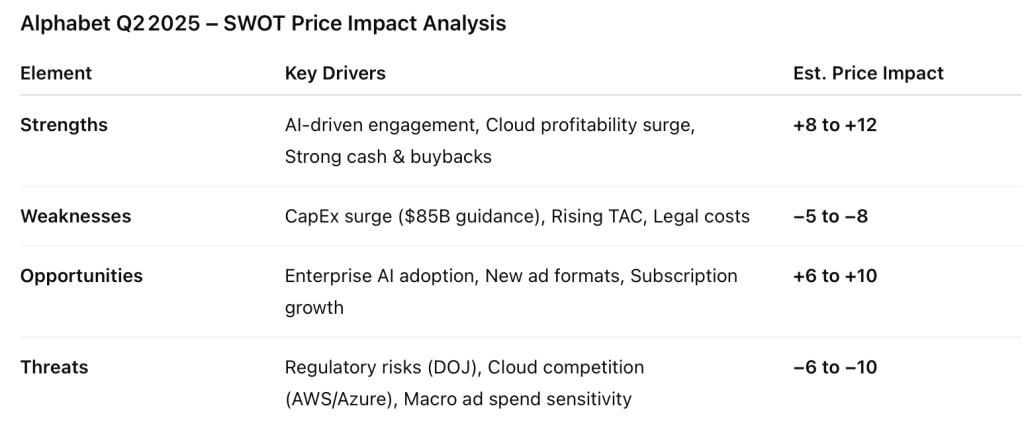
SWOT analysis table for Alphabet Q2 2025 showing key drivers and estimated price impact for strengths, weaknesses, opportunities, and threats.
Horizontal bar chart showing Alphabet Q2 2025 SWOT price impact ranges: Strengths (+8 to +12) in green, Weaknesses (−8 to −5) in red, Opportunities (+6 to +10) in blue, and Threats (−10 to −6) in yellow, with a vertical zero line for reference.

Valuation Scenarios

Valuation scenarios table for Alphabet Q2 2025 with target prices and probabilities

Fair Value Calculation (12‑month outlook)

From the valuation scenarios:

  • Bull: $225 × 30% = $67.5
  • Base: $192 × 50% = $96.0
  • Bear: $156 × 20% = $31.2

Weighted Fair Value=67.5+96.0+31.2=194.7Weighted Fair Value=67.5+96.0+31.2=194.7

Rounded: ≈ $195 per share

Vertical bar chart showing Alphabet Q2 2025 valuation scenarios: Bear case at $156 (20% probability) in red, Base case at $192 (50% probability) in gray, and Bull case at $225 (30% probability) in green, with a dotted line indicating the fair value at $195.

Verdict

At $192, Alphabet is fairly valued, offering limited short-term upside but strong long-term growth potential if AI-driven monetization plays out as management anticipates. Growth-focused investors may see this as an attractive hold for AI & cloud exposure; value-focused investors may prefer to wait for a wider margin of safety.


Call to Action

Are you positioning for Alphabet’s AI-powered future? Share your thoughts — is GOOGL a buyhold, or wait for a dip?


Disclaimer

This analysis is for informational purposes only and based solely on Alphabet’s official Q2 2025 financial report and earnings call. It does not constitute financial advice.


Leave a comment


Tesla Q2 2025: Robotaxi Dreams Begin, But Bumps on the Road Ahead

Tesla’s Q2 2025 earnings reveal a 12% revenue drop, 14% delivery decline, and a sharp free cash flow plunge — but Robotaxi and FSD growth offer hope. See our full SWOT analysis, valuation scenarios, and fair value estimate of $323 for tech‑savvy growth investors.

TL;DR

Tesla’s Q2 2025 results were mixed: Robotaxi operations are finally live in Austin, and FSD adoption is surging. But vehicle deliveries dropped 14% to ~384,000 units, revenue fell 12%, and free cash flow plunged nearly 90%. At ~$305, our probability‑weighted fair value sits around $323, leaving modest upside if Tesla can deliver on its autonomy and energy ambitions.


Quarter Recap

Tesla reported Q2 2025 revenue of $22.5 B (‑12% YoY) and GAAP net income of $1.2 B. Automotive gross margins improved slightly to 18.2%, but operating margin fell to ~4.1%, and free cash flow dropped nearly 89% to ~$146 M.

Vehicle deliveries declined 14% YoY to ~384,000 units, while production remained flat at ~410,000, underscoring demand and pricing headwinds.

CEO Elon Musk highlighted two milestones:

  1. Robotaxi pilot launched in Austin, with plans to expand to cover half the U.S. population by year‑end (pending regulatory approvals). Musk indicated that meaningful revenue contributions could start as early as late 2026, assuming regulatory approvals and fleet scaling.
  2. FSD v12 adoption rose 25–45% in North America, boosting high‑margin software revenue.

Still, Musk cautioned about “a few rough quarters ahead,” reflecting the challenges of balancing growth investments with near‑term profitability.

(Visual Placeholder: Revenue vs Net Income for past 5 quarters)


Key Highlights

  • Robotaxi Launch: First fleet now live; expansion targeted for late 2025, potential monetization from 2026.
  • FSD Momentum: Rapid subscription growth, strengthening recurring revenue.
  • Energy Business Surge: Megapack deployments up 45% YoY; revenue for the segment reached an estimated $2.1 B this quarter with backlog through 2026.
  • Tariff Impact: CFO confirmed $300 M in added costs this quarter.
  • Bitcoin Gain: $284 M recognized, adding balance sheet flexibility.
  • Stock Reaction: Shares fell ~8–9% post‑earnings, their sharpest single‑day drop since June, as the market absorbed the weak delivery numbers and Musk’s cautious outlook.
Line chart showing Tesla's revenue and net income over the past five quarters, with revenue declining from 25.2 billion to 22.5 billion USD and net income falling from 3.5 billion to 1.2 billion USD.

SWOT Analysis: Where Tesla Stands

Strengths (+$25 to +$40/share)

  • Robotaxi rollout opens new multibillion‑dollar markets with revenue potential from 2026 onward.
  • FSD v12 adoption expanding, locking in software revenue streams.
  • Energy storage growth creates a buffer against auto sector volatility.

Weaknesses (‑$15 to ‑$25/share)

  • Deliveries fell 14% YoY to ~384,000 units.
  • Free cash flow plunged ~89% to ~$146 M; operating margin dropped to ~4.1%.
  • Tariff costs and pricing competition dragging margins.
  • Heavy reliance on regulatory credits to pad profitability.

Opportunities (+$20 to +$35/share)

  • Scaling Robotaxi beyond pilot markets to 5+ metros by 2026.
  • AI & robotics (Optimus, Dojo) positioning Tesla beyond auto.
  • Megapack and software sales diversifying revenue mix.

Threats (‑$20 to ‑$30/share)

  • Intensifying EV competition (BYD, Hyundai, legacy automakers).
  • Election‑year tariffs and unpredictable policy changes.
  • Musk’s political involvement impacting brand equity, particularly in key U.S. markets.
  • Execution risk on autonomy and Robotaxi timelines.
Horizontal bar chart illustrating Tesla's Q2 2025 SWOT price impact estimates: strengths at $25 to $40, opportunities at $20 to $35, weaknesses at minus $25 to minus $15, and threats at minus $30 to minus $20.

SWOT Summary Table

Tesla Q2 2025 SWOT summary table showing strengths, weaknesses, opportunities, and threats with estimated price impacts

Valuation Scenarios

Tesla Q2 2025 valuation scenarios table showing bull, base, and bear cases with EPS, P/E multiples, and target prices

Weighted fair value:
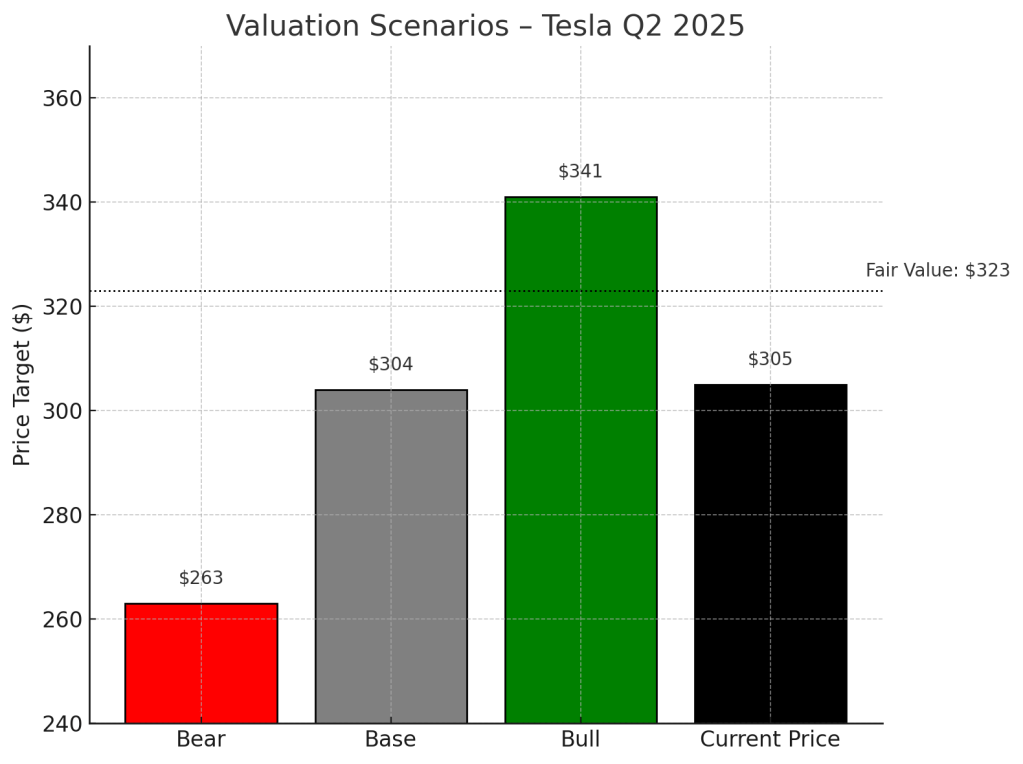
(0.3×341)+(0.5×304)+(0.2×263)(0.3×341)+(0.5×304)+(0.2×263) = ≈ $323.

Bar chart showing Tesla's Q2 2025 valuation scenarios: Bear case $263, Base case $304, Bull case $341, and Current Price $305, with a dotted line marking the fair value at $323.

Verdict

At ~$305, Tesla trades slightly below our fair value. For tech‑savvy growth investors, this is a measured opportunity— upside hinges on Tesla delivering on its Robotaxi and AI roadmap. Near‑term volatility is likely, but long‑term optionality remains compelling.

For context: Street targets remain widely dispersed, from Barclays’ $275 (neutral to bearish) to Cantor Fitzgerald’s $355–500 (bullish), reflecting high uncertainty about execution and regulatory outcomes. This divergence reinforces our balanced stance: buy on weakness if you believe in autonomy scaling.


Call to Action

Do you see Tesla’s Robotaxi pivot as a true game‑changer? Or is it just another long‑promised milestone? Share your thoughts in the comments and explore our other in‑depth earnings breakdowns at SWOTstock.com.


Disclaimer

This post is for information only and not investment advice. All insights are based on Tesla’s official Q2 2025 financial report, earnings call, and management commentary.


Leave a comment


SAP Q2 2025 Earnings: Cloud Momentum, AI Push — Is This Pullback a Buy?

SAP’s Q2 2025 earnings delivered 24% cloud growth, margin expansion, and a strong AI roadmap, yet shares dipped 6%. Is this a buying opportunity for growth investors?

TL;DR

SAP’s Q2 2025 delivered 24% YoY cloud growth83% free cash flow surge, and margin expansion, yet the stock dropped ~6%. For growth‑minded investors, this may be an opportunity to accumulate, as SAP pushes deeper into AI‑driven enterprise solutions and China expansion, though macro and FX risks remain.


Quarter Recap: Why This Matters to Growth Investors

SAP posted Q2 revenues of €9.43B, driven by cloud revenue of €5.13B (+24% YoY) and a backlog increase of 22%Operating margin rose to 27.2% (+1.8pp), while free cash flow surged 83% to €2.36B.

So why did shares drop ~6%? The market zeroed in on slowing backlog growthmacroeconomic uncertainty, and FX drag, which overshadowed the otherwise strong report.

Why you should care: SAP’s fundamentals still point to a cloud‑first, AI‑powered transformation with improving profitability — a combination attractive for growth investors with a mid‑term horizon.


Key Highlights

  • Cloud revenue: €5.13B (+24% YoY)
  • Total backlog: +22% YoY
  • Operating margin27.2% (+1.8pp YoY)
  • Free cash flow€2.36B (+83% YoY)
  • Share buyback: Up to €5B, supporting EPS
Line chart showing SAP’s revenue and net income over the past five quarters, highlighting steady growth through Q2 2025.

AI: More Than a Buzzword — What SAP Is Building

SAP is embedding generative AI into its Business AI platform, integrating tools across ERP, procurement, and HR. It’s also expanding AI‑as‑a‑service offerings, giving customers access to pre‑built, domain‑specific AI models.

CEO Christian Klein emphasized that AI is “not just an add‑on but core to SAP’s next‑generation enterprise software.” This positions SAP to capture higher‑margin, stickier revenue as clients adopt AI‑enhanced workflows.


Peer Comparison: How Does SAP Stack Up?

Bar chart comparing SAP, Oracle, and Microsoft in Q2 2025 for cloud growth percentage, operating margin percentage, and P/E ratio.
  • SAP: Cloud +24%, margin 27.2%, P/E ~24x
  • Oracle: Cloud +20%, margin ~41%, P/E ~30x
  • Microsoft (Intelligent Cloud): +21%, margin ~42%, P/E ~35x

SAP trades at a relative discount while maintaining competitive growth — a point for long‑term investors to watch.


SWOT Analysis: Price Impact on the Table

SAP’s Q2 shows resilience in cloudgrowing AI initiatives, and geographic diversification, offset by backlog sensitivity and macro risk.

Horizontal bar chart showing SAP Q2 2025 SWOT price impact: strengths and opportunities with positive effects, weaknesses and threats with negative effects.
SWOT analysis table for SAP Q2 2025 showing strengths, weaknesses, opportunities, and threats with estimated price impact ranges.

Valuation Scenarios: Where Could the Stock Go?

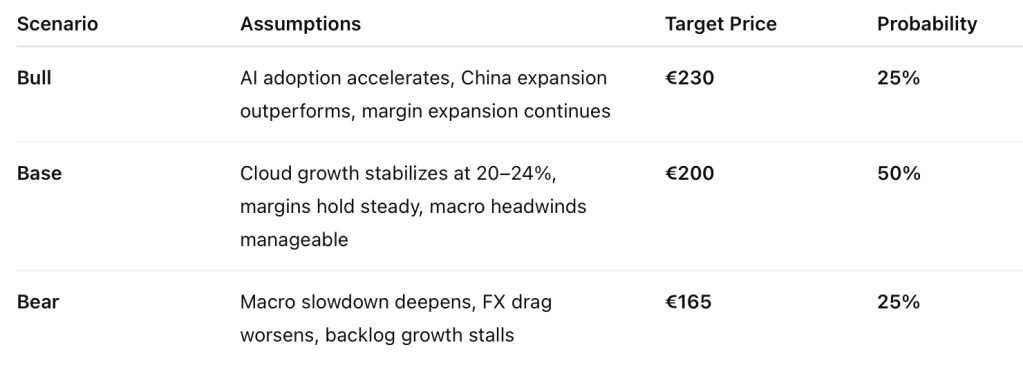
Bar chart showing SAP Q2 2025 valuation scenarios: Bear case €165, Base case €200, Bull case €230, Current Price €185, with a dotted line marking the fair value at €199.
Valuation scenarios table for SAP Q2 2025 showing bull, base, and bear cases with assumptions, target prices, and probabilities.

Probability‑Weighted Fair Value:
(0.50 × 200) + (0.25 × 230) + (0.25 × 165) = €198.75 (~€199).


Verdict: An Attractive Mid‑Term Entry for Growth Investors

SAP is cheaper than its peers, with comparable growth and a clear AI‑driven roadmap. The post‑earnings dip brings it within our fair value range (€195–205), offering a tactical entry for investors who believe in its AI and China growth story.


Call to Action: Should You Buy?

Before adding SAP, ask yourself:

  • Do you believe AI integration will drive higher‑margin growth?
  • Are you comfortable with China exposure amid global trade uncertainty?
  • Does SAP’s valuation vs. Oracle/Microsoft justify a position in your portfolio?

Join the conversation: What’s your take on SAP’s AI pivot? Share your thoughts in the comments and explore more at SWOTstock.com.


Disclaimer

This article is for informational purposes only and does not constitute investment advice. All analysis is based solely on SAP’s official Q2 2025 financial statements, earnings call transcript, and management commentary.


Leave a comment